Ukraine, Syria, NATO: why the Kremlin needs Erdogan to win / Photo: Vyacheslav PROKOFYEV - SPUTNIK/AFP

 'Never again Bolsonaro': thousands march ahead of Brazil election runoff

 After botched execution, US woman was nearly taken off life support before revival
 Searing AIDS drama 'Elsinore' opens London film festival

 Evicted pensioner who sparked Spain housing protests dies: tenant union
 Golf star Rahm quitting LIV tour over 'unacceptable' terms
 Thousands march fearing return of a Bolsonaro presidency in Brazil
 French PM denies police ordered to confront student protesters

 Rubio touts US power, calls on Europe to emerge from 'slumber'
 Trump says 'we don't think' Russian plague is bio-weapon
 Five children among 26 killed in Ukraine after Russian strikes

 Man City should 'accept' punishment for rule breaches, says Lineker
 US woman who survived botched execution is awake and speaking
 From 1800s to modern pharma: a Nobel-winning chemistry quest

 Southampton boss Eckert given suspended ban over 'Spygate'
 Russia warns of 'false' information as second plague case reported
 IEA ready to release more oil reserves if necessary
 HSBC 'consults' over UK unit job cuts amid AI adoption
 UK court quashes five ex-traders' Libor rate rigging convictions
 XM Receives “Global Customer Experience Leader Award 2026” at the TrustFinance Performance Awards
 Stocks slide as oil climbs on Mideast flareup
 Heavy casualties in Ukraine after Russian strikes
 French wine harvest set to hit historic low
 Kyiv 'cannot agree' to EU membership limiting food exports: minister

 Arteta targets more Arsenal glory after signing new deal until 2030

 Russell hit with Singapore grid penalty for taking new power unit
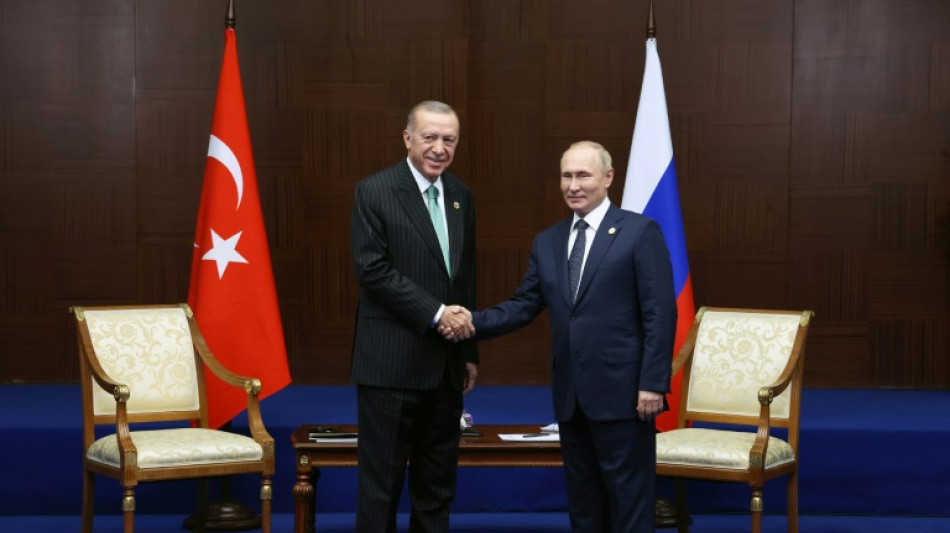
When Turks head to the polls on Sunday to decide a historic presidential election, the Kremlin will be hoping they give long-standing leader Recep Tayyip Erdogan a convincing victory, observers say.
The winner will have leverage over key areas for Moscow, such as Russia's large-scale military campaign in Ukraine, the war in Syria and the Kremlin's standoff with NATO.
Erdogan, 69, who has ruled Turkey for two decades, won the first round earlier in May, even though polls showed him trailing his 74-year-old rival Kemal Kilicdaroglu.
For the Kremlin, Erdogan is a known quantity who has collaborated closely with Russian President Vladimir Putin over the past 20 years, while Kilicdaroglu has recently blamed Moscow for meddling in the vote.
"Russia must have breathed a sigh of relief," a Western diplomat who has worked in Turkey and Russia told AFP, referring to the outcome of the first round on May 14.
Erdogan and Putin -- despite backing opposing players in conflicts in the Middle East and the ex-Soviet Caucasus region -- have developed close ties over years of working together.
Even the Turkish leader himself hailed his "special relationship" with Putin during a recent interview with US broadcaster CNN.
"Russia and Turkey need each other in every field possible," Erdogan said.
In a world where Moscow and Ankara are both sceptical of Western military, political and economic dominance, Putin and Erdogan see each other as reliable partners.
- 'Incredibly similar' -
"They are incredibly similar to each other with respect to their political mentality, their style and their relation to the outside world," independent political analyst Arkady Dubnov told AFP.
They both "sincerely despise the West's liberal values", he added.
Yet Putin and Erdogan have not always seen eye to eye, and each leader threw his political and military clout behind rival camps when conflicts broke out in Syria, Libya and Nagorno-Karabakh.
When Turkey mistakenly shot down a Russian fighter jet near the Syrian border in 2015, Putin described the incident as a "stab in the back".
Still, when Erdogan faced down an attempted coup less than a year later, Putin was the first leader to offer his support in a telephone call.
And despite their divergent positions, they have been able to find common ground.
"There are many contradictions in their interests," Fyodor Lukyanov, a foreign policy expert close to the Kremlin, told AFP.
"But the personal, long-standing relationship between the two leaders helps a lot," he said.
"They are able to find a way forward on a variety of issues."
The Western diplomat who spoke to AFP described the leaders' relationship as pragmatic.
"They're very good at compartmentalising: differences are put aside and they work together where their interests are aligned," the diplomat said on condition of anonymity.
"There is no 'bromance' between Erdogan and Putin, it's purely transactional," he added.
Putin's decision to send troops to Ukraine last year has given Turkey -- a member of the NATO defence alliance -- the opportunity to mediate between Western countries and an increasingly isolated Kremlin.
While Turkey has delivered drones to Kyiv, it has refused to join sanctions against Moscow.
It has become an important, alternative transit hub for heavily sanctioned Russian exports, attracting investments and buying gas at knockdown prices.
- 'Predictable' relationship -
Alongside the UN last year, Erdogan brokered the Black Sea grain deal that unlocked Ukrainian exports from three ports, easing fears of a global food crisis.
But a victory for Western-sympathetic Kilicdaroglu could threaten the established relationship, analysts say.
Kilicdaroglu may, for example, push for a thaw between NATO and Turkey, which has the second-biggest army of the alliance.
In May, Kilicdaroglu accused Russia of interfering in the election. The Kremlin denied the allegations and said Moscow would retain close ties with Ankara regardless of the vote's outcome.
Last month Putin praised Erdogan at the launch of the Russian-built Akkuyu nuclear power plant, Turkey's first.
The project was a "convincing example of how much you, President Erdogan, are doing for your country, for the growth of its economy, for all Turkish citizens", Putin said.
"Putin has always been known for being loyal... to those who act in the same way towards him and Russia," Lukyanov said.
"It's not so much about Erdogan as about the fact that predictable relationships with Turkey are extremely necessary now."
T.Khatib--SF-PST