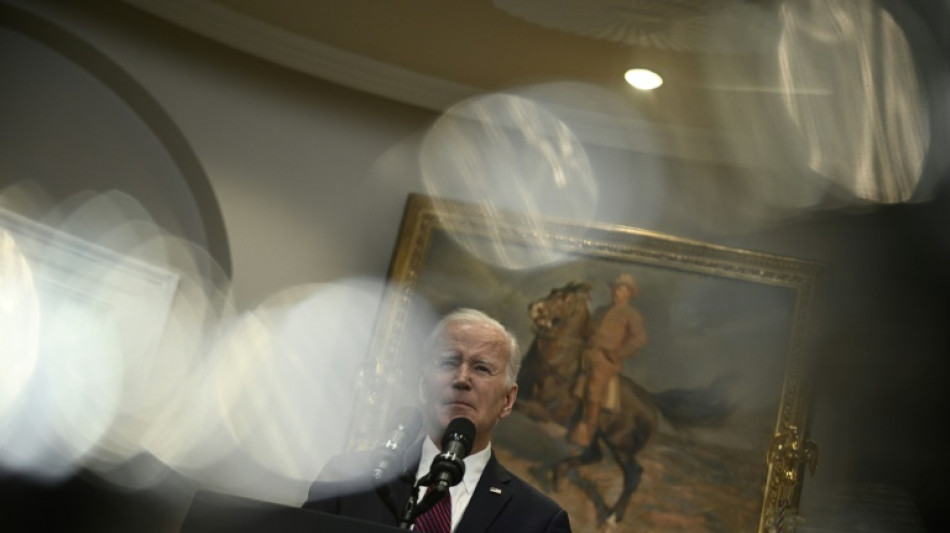
What's the 14th Amendment and can it help avert a debt crisis? / Photo: Brendan SMIALOWSKI - AFP/File

 Morikawa says LIV players face 'business decision' after Rahm exit

 Tenzing Norgay's son says Himalayas sending climate warning

 On your bike! Bottas opts for two wheels to reach Singapore GP

 Alcaraz, Sinner, Osaka commit to Australian Open '1 Point Slam'

 Dodgers beat Braves to advance in MLB playoffs, Rays oust Yankees

 'A sun as black as my lungs': how corruption crucified a polluted Albania city

 The British historian helping the French rediscover de Gaulle

 Dodgers beat Braves to advance, Guardians survive in MLB playoffs

 Latin American, Caribbean women top Nobel literature buzz

 US says Fiji-based Chinese official paid bribes for Beijing

 After botched US execution, Christa Pike was nearly taken off life support

 Guinea-Bissau junta urges military unit loyal to ex-president to disarm

 As species decline, green turtles offer glimmer of hope

 Brothers Scott and Beauden Barrett named to start for All Blacks

 EU trade chief seeks to dial down China tensions

 'Never again Bolsonaro': thousands march ahead of Brazil election runoff

 After botched execution, US woman was nearly taken off life support before revival

 Searing AIDS drama 'Elsinore' opens London film festival

 Evicted pensioner who sparked Spain housing protests dies: tenant union

 Golf star Rahm quitting LIV tour over 'unacceptable' terms

 Thousands march fearing return of a Bolsonaro presidency in Brazil

 French PM denies police ordered to confront student protesters

 Rubio touts US power, calls on Europe to emerge from 'slumber'

 Trump says 'we don't think' Russian plague is bio-weapon

 Five children among 26 killed in Ukraine after Russian strikes

US President Joe Biden has been considering the "14th Amendment" option to avert a debt ceiling crisis, as the deadline to resolve an impasse on lifting the borrowing limit fast approaches.
Although raising the debt ceiling is a routine process, it has become contentious in recent years with Republican lawmakers seeking spending curbs in exchange for the increase -- and failure to act risks a default.
But what is the little-known clause that could help the country avert a debt debacle?
- What does it say? -
The 14th Amendment to the US Constitution says that "the validity of the public debt of the United States, authorized by law... shall not be questioned."
This includes "debts incurred for payment of pensions and bounties for services in suppressing insurrection or rebellion."
The clause, written to address divisions after the bloody Civil War, has been raised by legal experts to suggest how a debt limit crisis may be avoided.
By some arguments, this provision renders the debt limit unconstitutional, allowing the US Treasury to violate it if policymakers fail to resolve their impasse, and raise cash to avert a major impact on public debt.
- Is it viable? -
If the Treasury borrowed in excess of the debt limit set by Congress, this would violate the law, said Neil Buchanan, a law professor at the University of Florida.
But failing to meet spending obligations enacted by Congress could be a worse violation, giving the Treasury some justification to borrow more and continue paying its bills.
There could be legal challenges if the 14th Amendment is invoked, but not doing so poses such risks too.
If the Treasury runs out of borrowing room to meet its obligations and ends up delaying certain payments, those who have money owed to them have a "perfectly good legal claim," said Buchanan.
Social Security recipients who fail to receive their checks could join a class action lawsuit, he added.
On the other hand, if the Biden administration continued borrowing money, Republicans could sue him for not following the debt ceiling.
- Will there be economic fallout? -
"There is good reason to believe that using the 14th Amendment to circumvent the debt ceiling would lead to a legal challenge and a period of palpable uncertainty for the global economy," warned Isaac Boltansky, director of policy research at BTIG.
But near-term movements in specific markets could be hard to predict.
"If investors thought Treasury was selling debt that might later be considered invalid because of a court ruling they might be reluctant to buy those Treasury bonds, which might push up interest rates," Nancy Vanden Houten of Oxford Economics told AFP.
Invoking the 14th Amendment could also "shake investor and business confidence," she added.
Yet all of this must be weighed against the fallout from not paying financial obligations on time, which could be more damaging, she added.
- Where does Biden stand? -
On Tuesday, Biden told a press conference he had been "considering the 14th Amendment."
While some think that invoking it would be a legitimate move, the president conceded "the problem is it would have to be litigated."
In the meantime, without an extension, things would "still end up in the same place," Biden said.
But he added that after the current situation blows over, he is thinking of looking into what the court would say, on whether this path would work.
Former president Barack Obama had ruled this option out during his administration.
- Is it a likely path? -
The 14th Amendment is not a top choice for policymakers, although it remains on the table.
Analysts consider other possibilities like a short-term increase or suspension of the debt limit as more likely scenarios.
"The reality is that (Biden) doesn't have any good choice," said Buchanan.
But if Republicans do not agree to an unconditional debt limit raise, the Biden administration could "ignore the debt ceiling" and "put the ball in their court," said professor Robert Hockett of Cornell Law School.
"They would be suing to force the president to default on the national debt," he said.
L.AbuTayeh--SF-PST