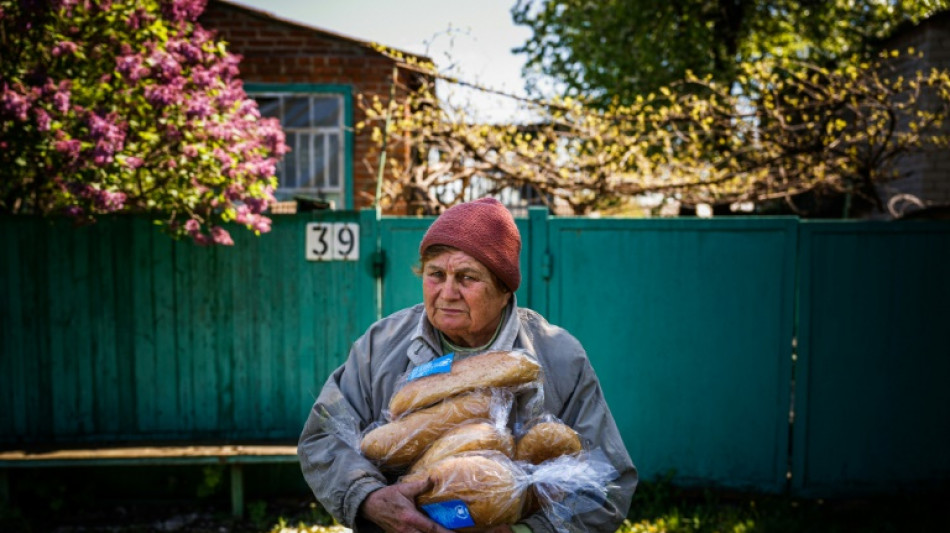
'Drive fast': The bread delivery runs in war-torn Donbas / Photo: Dimitar DILKOFF - AFP

 High school students turn out for new protests across France
 Bid by Italy's Intesa bank to take over MPS gets boost

 Stablecoins Are Quietly Becoming Business Infrastructure, NOWPayments Data Shows

 Oil surges, stocks sink as US reportedly eyes new Iran strikes

 Woman in botched US execution walking, mentally 'foggy': lawyer
 Farhan hopes Pakistan's new combination takes off in Sri Lanka T20Is

 Teenager Andreeva seals China Open semi-final with Bartunkova

 Britain's Burnham says open to Germany joining warplane project

 Kovac's tough love has Dortmund dreaming of title charge
 China announces candidate for WHO chief

 South Korea test-fires its first homegrown hypersonic weapon: presidency

 ONAR Advances Nasdaq Listing Preparation Following Advertise Purple Acquisition and Financing

 Thailand opens extradition process for reporter sought by China

 France struggles to wean social housing off gas

 Germany lifts GDP forecast as economy withstands Iran war
 Sri Lanka appoints Kusal Mendis as Test captain
 Norris confident McLaren can shine in Singapore
 Alex Bodi pushes ahead with expansion: ALIX LASERS showroom planned for Bucharest
 Fossil fuels off COP31 agenda as global output keeps rising

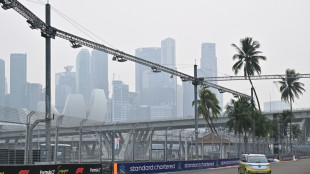 Haze not 'a threat' to Singapore F1 race: organisers

 COP31 organisers say to seek 'ambitious' action with their text
 Bartunkova thrashes Muchova to reach China Open semi-finals
 Drone hits Yandex data centre, in first such attack on Russia

 Oil prices surge and stocks sink on fresh inflation worries

 AI startup Manus raises $500m after Meta acquisition blocked by China
Three huge bags wedged under the handlebar of his red and white moped, Oleksandr rushes through the winding trails of the Donbas, east Ukraine, to deliver bread to remaining locals.
Almost every day, Russian strikes hit the town of Siversk, about 10 kilometres (6.2 miles) from a front line that has barely moved since last summer.
Oleksandr has just picked up the bread at the Siversk town hall humanitarian centre, which gets around 2,500 loaves twice a week from the cities of Kramatorsk and Kostiantynivka.
"We need to drive fast, so that nothing catches up with us," Oleksandr smiles, referring to potential shelling.
Under the spring sun, the 44-year-old drives full speed until he reaches a dirt road lined with small houses and blossoming trees.
Oleksandr, wearing blue overalls, used to work as a welder.
One day, he was asked to help repair a neighbour's roof and then to bring bread.
One thing led to another, and he ended up regularly taking part in humanitarian food distribution in his area.
- White, sweet or black bread -
He starts the day's deliveries at his neighbours, just across from his own house.
Olena Ishakova, 62, comes out of her home in a long blue dressing gown with yellow pockets and collar.
"On Tuesdays we get two loaves of white bread, on Thursdays we get sweet bread and black bread," Ishakova says.
She grabs the loaves wrapped in bags stamped with the logo of the "World Food Program".
Ishakova's daughter and grand-daughter were evacuated last February towards the calmer west of Ukraine, but she stayed in Siversk with her husband.
In July and August, Russian forces launched small unsuccessful assaults on the town that they also shelled.
The eastern part of Siversk with its high buildings was the worst damaged, while the western part and its smaller houses was relatively spared.
Out of the 11,000 residents before the war, about 1,500 remain, authorities say.
"It'll be a year since we've had any electricity on May 5," Ishakova says, with the pounding of artillery shots in the background.
"We don't know who is shooting, or from where. We only hear the explosions... I sit in the house, the windows shake, it's scary, very scary." she says, wondering when it will all stop.
- 'Afraid' -
Oleksandr runs into Valentyna Zaruba, a 73-year-old who delivers bread in a neighbouring street.
"I'm in charge of my street, and someone else is in charge of theirs, that's how we work", Zaruba explains.
Depending on the days, Zaruba delivers the bread with a wheelbarrow, or with her bike.
"All the neighbours are afraid," Zaruba says, "everyone prays for the war to end, to stay alive and for our houses not to be destroyed."
"At night, if the weather allows, we gather and talk about it."
The previous night, shelling damaged three homes at the end of the street. An 82-year-old was wounded.
Holding her bike, Zaruba goes to see Lyubov Shcherbak, who is surrounded by a dozen chatty hens and four roosters.
"How can we live without bread? There's nowhere for us to bake it" in Siversk, she says.
"I don't know what to think anymore. I hope things will get better... I don't know," she says, her gaze lost in the horizon.
Zaruba, standing next to her, says she "cannot leave an elderly woman alone. My conscience just won't let me."
Q.Najjar--SF-PST