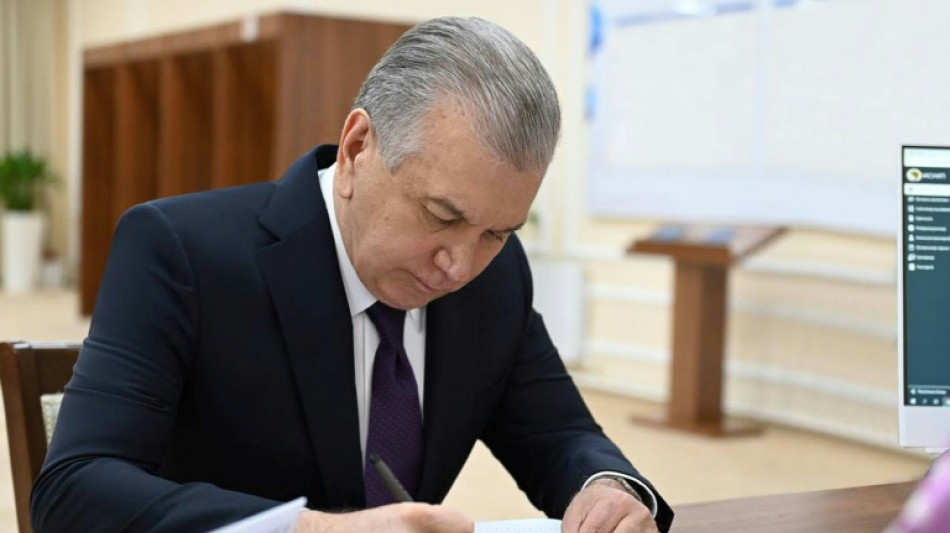
Mirziyoyev: Uzbek reformer with autocratic tendencies / Photo: Handout - Uzbek Presidential Press Service/AFP

 High school students turn out for new protests across France
 Bid by Italy's Intesa bank to take over MPS gets boost

 Stablecoins Are Quietly Becoming Business Infrastructure, NOWPayments Data Shows
 Oil surges, stocks sink as US reportedly eyes new Iran strikes
 Woman in botched US execution walking, mentally 'foggy': lawyer
 Farhan hopes Pakistan's new combination takes off in Sri Lanka T20Is
 Teenager Andreeva seals China Open semi-final with Bartunkova
 Britain's Burnham says open to Germany joining warplane project
 Kovac's tough love has Dortmund dreaming of title charge
 China announces candidate for WHO chief

 South Korea test-fires its first homegrown hypersonic weapon: presidency

 ONAR Advances Nasdaq Listing Preparation Following Advertise Purple Acquisition and Financing

 Thailand opens extradition process for reporter sought by China
 France struggles to wean social housing off gas
 Germany lifts GDP forecast as economy withstands Iran war
 Sri Lanka appoints Kusal Mendis as Test captain
 Norris confident McLaren can shine in Singapore
 Alex Bodi pushes ahead with expansion: ALIX LASERS showroom planned for Bucharest
 Fossil fuels off COP31 agenda as global output keeps rising
 Haze not 'a threat' to Singapore F1 race: organisers
 COP31 organisers say to seek 'ambitious' action with their text
 Bartunkova thrashes Muchova to reach China Open semi-finals
 Drone hits Yandex data centre, in first such attack on Russia
 Oil prices surge and stocks sink on fresh inflation worries

 AI startup Manus raises $500m after Meta acquisition blocked by China
Uzbekistan's President Shavkat Mirziyoyev is credited with leading Central Asia's most populous country out of isolation, but his appetite for change may be waning now that he has consolidated power.
His country has just voted for constitutional changes allowing him to stay in office until 2040, in an election observers said lacked pluralism and competition.
Mirziyoyev's reforms -- including ending infamous forced labour in the cotton industry -- have been hailed both by long-suffering citizens and foreign observers.
The bar was set low by his hardline mentor and predecessor Islam Karimov, who gained a reputation for torturing opponents including by boiling and freezing them.
Mirziyoyev, born in 1957 in the east of Soviet Uzbekistan, served in Karimov's government for 13 years.
When Karimov died in 2016 after ruling for more than a quarter of a century, Mirziyoyev's role as heir quickly became clear.
He took control of Karimov's funeral arrangements and outmanoeuvred the head of Uzbekistan's notorious security service, Rustam Inoyatov, to become leader.
He launched changes unthinkable under his predecessor, but his critics say some recent moves carry echoes of the country's despotic past.
- Out of isolation -
The grey-haired 65-year-old opened up the country's economy and trade, as well tourism and foreign investment.
Ties with neighbouring Kyrgyzstan and Tajikistan -- countries Karimov once threatened with war over hydropower projects -- have improved.
Mirziyoyev has advocated pragmatic ties with the Taliban in neighbouring Afghanistan, while trade with Russia and China has grown -- although he has stopped short of rejoining a Moscow-led security bloc.
His tenure has also seen controls loosen over Islam -- followed by more than 90 percent of the population but viewed with suspicion by Karimov.
Mirziyoyev's most celebrated achievement has been his clampdown on forced labour in the cotton fields, where wages for up to two million pickers have increased year-on-year.
Authorities hope Western firms will now end a long-standing boycott after the International Labour Organisation heralded the end of systemic child labour and forced labour.
Mirziyoyev once boasted that under his leadership, Uzbeks had learned to "live free, without fear".
But his critics say there is more continuity than change, suggesting Mirziyoyev might not be the man to totally overhaul Uzbekistan's reputation as a rights abuser.
- Bloody protests -
Less than a year into Mirziyoyev's second term, protests broke out in the country's Karakalpakstan area in July 2022 over a move to remove the region's right to self-determination.
The unrest left at least 21 dead and forced Mirziyoyev to make a rare about-turn and walk back the proposed changes.
Human Rights Watch said in November that the authorities "unjustifiably used lethal force... to disperse mainly peaceful demonstrators" after verifying dozens of videos and photos of the protests.
In total, 171 people face charges over the protests and in late January, 16 people were sentenced to terms between three and 16 years in prison.
Human Rights Watch said that "a trial of some of the protesters opened... but there remained a lack of accountability for the 21 people killed and dozens who were seriously wounded."
Mirziyoyev is also facing accusations of nepotism.
The public prominence of the eldest of his two daughters, Saida Mirziyoyeva, 36, who held a post in the state communications agency until last year, has drawn comparisons with Karimov's eldest daughter, Gulnara Karimova.
Karimova, referred to as a "robber baron" in leaked US diplomatic cables, is currently jailed on embezzlement and criminal conspiracy charges after falling foul of her father's regime while he was still alive.
K.AbuTaha--SF-PST