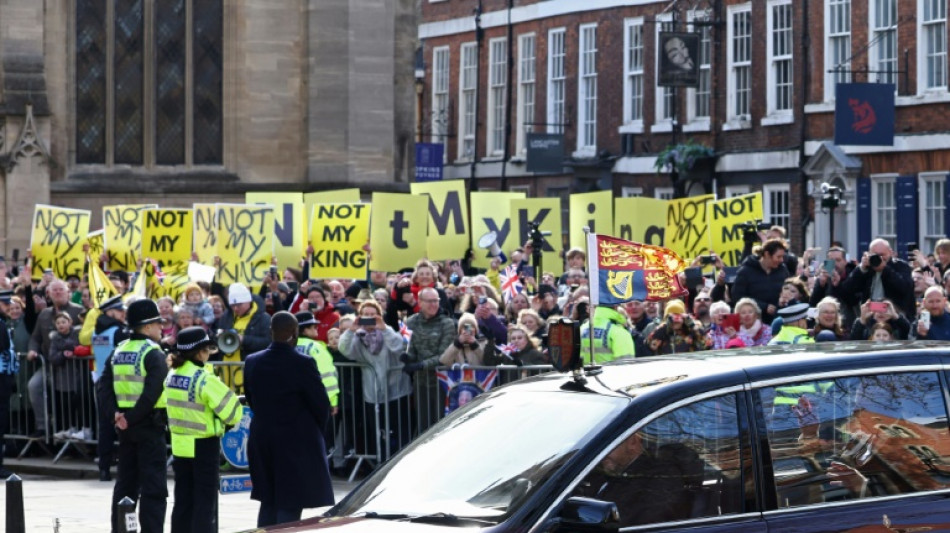
'Not my king': Charles III inherits a fraying realm / Photo: Darren Staples - AFP

 Venezuela's Maduro, wife hit with new US torture charges

 Argentina friendlies no fairy tale for African footballers

 US suspending Microsoft from visa program: Vance

 Man City must 'stick together' during crisis, says Haaland

 CAS opens hearing into Senegal AFCON title appeal
 UK police agree searches for ex-prince Andrew's homes 'unlawful': judge

 After botched US execution, Christa Pike walking, mentally 'foggy': lawyer

 'Stunned' Madrid mourns pensioner who sparked housing protests

 High school students turn out for new protests across France

 Bid by Italy's Intesa bank to take over MPS gets boost

 Stablecoins Are Quietly Becoming Business Infrastructure, NOWPayments Data Shows

 Oil surges, stocks sink as US reportedly eyes new Iran strikes

 Woman in botched US execution walking, mentally 'foggy': lawyer

 Farhan hopes Pakistan's new combination takes off in Sri Lanka T20Is

 Teenager Andreeva seals China Open semi-final with Bartunkova

 Britain's Burnham says open to Germany joining warplane project
 Kovac's tough love has Dortmund dreaming of title charge

 China announces candidate for WHO chief

 South Korea test-fires its first homegrown hypersonic weapon: presidency

 ONAR Advances Nasdaq Listing Preparation Following Advertise Purple Acquisition and Financing

 Thailand opens extradition process for reporter sought by China
 France struggles to wean social housing off gas
 Germany lifts GDP forecast as economy withstands Iran war

 Sri Lanka appoints Kusal Mendis as Test captain

 Norris confident McLaren can shine in Singapore

King Charles III next week formally takes the crown of the United Kingdom. But arguably the realm is more disunited today than at any time since the tempestuous days of his 17th century namesakes.
The elected leaders of Scotland and Wales want to scrap the monarchy; Northern Ireland's biggest party Sinn Fein wants reunification with the Republic of Ireland; and British republicans are vowing to mar Charles's big day with protests.
"I consider myself first and foremost a citizen, not a (royal) subject," Scotland's new First Minister Humza Yousaf told The National newspaper in March.
He vowed to look at installing an elected head of state within five years of Scotland gaining independence from the UK -- even if that goal has receded after numerous setbacks for Yousaf's ruling Scottish National Party.
Nevertheless, Yousaf plans to attend the coronation, as does Welsh First Minister Mark Drakeford -- another avowed republican.
And in a historic first, so will Sinn Fein, which refuses to take its seats in the UK parliament out of opposition to British rule in Northern Ireland.
The nationalist party's Northern Ireland leader Michelle O'Neill says she will come to Westminster Abbey on May 6 out of respect for the divided territory's pro-UK unionists.
Further afield in the Commonwealth, political fissures threaten the post-colonial inheritance of the 74-year-old Charles, who is also king in 14 countries outside the UK.
Australia's government is actively planning to scrap the monarchy. Barbados has already done so.
- Footing the bill -
Anti-monarchists at home scent a chance to renew debate about the constitutional future of the British royal family, long suppressed by public respect for Charles's long-reigning mother, Queen Elizabeth II.
"It is a very big opportunity for us, and I think we're going to make the most of it," said Graham Smith, chief executive of the pressure group Republic, which wants an elected head of state.
Republic plans demonstrations along the route of the coronation procession, after following Charles at several public events with chants of "not my king" since Elizabeth's death in September.
Smith acknowledged that the late queen was the monarchy's "star player" over her record-breaking reign of 70 years.
Her son took over at a relatively advanced age, and enjoys little of the same deference.
"This is far more fertile ground, people are far more willing to listen and engage," the Republic chief argued.
The group's arguments are falling on more receptive ears in part because the state is footing the coronation bill, at a time when Britons are enduring the worst cost-of-living crisis in decades.
The final tally will only be made public afterwards, but Smith predicted it would reach at least £100 million ($125 million).
The number of Britons who believe the monarchy is "very important" stands at a record low of 29 percent, according to annual survey data collated by the National Centre for Social Research (NatCen).
An overall majority still supports the monarchy, but backing falls markedly among the young.
"The challenge going forward will be for the monarchy to deliver its relevance and appeal to a younger generation to maintain this support," NatCen chief executive Guy Goodwin said.
- Civil war -
No blood will be split over the future of the monarchy this time -- unlike in the 17th century.
Charles I led England into civil war, and ended up losing his head in 1649 a short walk from where his descendant's coronation will take place.
Charles II remained king of Scotland after his father's execution, and was restored to the English and Irish thrones after a republican interregnum.
But the religious tensions that were a driving factor of the civil war remained potent. Charles II's Catholic brother was deposed in favour of Protestant heirs.
The monarchy is more stable today, according to Anna Whitelock, professor of the history of monarchy at City, University of London.
"But yes, it's a disunited kingdom in many ways. Clearly there's an opportunity to engage in a debate which just wasn't in play during the queen's long reign," she told AFP.
"Young people especially are beginning to question what the monarchy does, its worth, whether it's accountable. There's a shifting of the dial, with the protests and the hashtag #NotMyKing."
But the republican debate will take time to evolve, Whitelock said. "There's no chance of this Charles following in the grisly steps of the first one."
J.AbuShaban--SF-PST