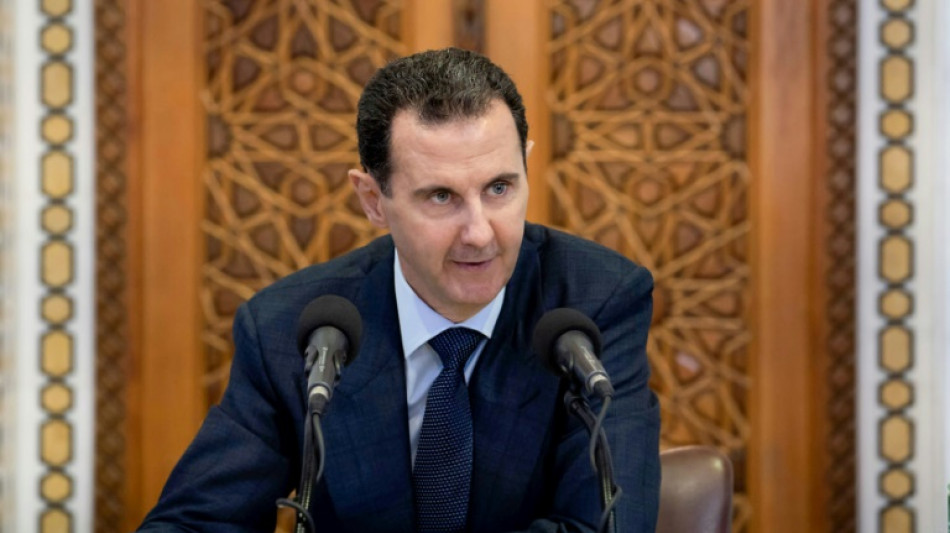
Syria's Assad returns to Arab fold after years of isolation / Photo: - - AFP/File

 Trump rules out new Iran attack before US midterm elections
 Far-right influencer shows Israel's coarse political turn
 Seals and sea lions get hearing tested at Australia zoo

 Mourinho's Real Madrid playing catch-up in Clasico countdown
 Joy as USS Lincoln back home after troubled Gulf deployment
 OpenAI says Iran, Russia influence ops busted
 Anthropic bans 'cruel' behavior against its Claude AI
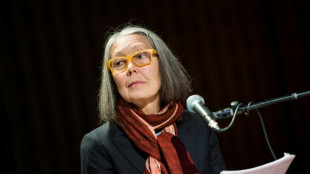 Anne Carson's Nobel literature prize 'a proud moment for Canada': PM

 Montagliani to seek CONCACAF re-election in boost for Infantino: reports

 Oil surges, stocks sink on jitters over US plans in Iran war

 John Cena and Jessica Biel hit the gas in 'Matchbox: The Movie'

 US, Ukrainians, Europeans to discuss 'new ideas' to end war
 Unproven 'cures' pushed online amid plague concerns

 Nigeria looks to ease fuel prices as election looms
 Prosecutors in Maradona death trial seek sentences up to 12 years

 Swiss captain Xhaka gets suspended fine for fake Covid cert
 Ex-prince Andrew raid warrants ruled 'unlawful' but UK police maintain probe
 Two Latvians arrested inside UK military base: police

 Eckert 'forever grateful' for Southampton support over spy scandal
 Venezuela's Maduro, wife hit with new US torture charges
 Argentina friendlies no fairy tale for African footballers
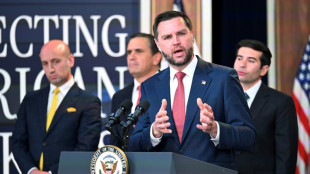 US suspending Microsoft from visa program: Vance

 Man City must 'stick together' during crisis, says Haaland
 CAS opens hearing into Senegal AFCON title appeal

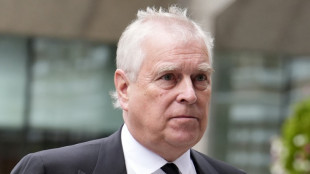 UK police agree searches for ex-prince Andrew's homes 'unlawful': judge
Twelve years after Syrian President Bashar al-Assad was shunned, Arab countries have gradually welcomed his regime back into the fold -- as victor of a war that has yet to end.
Despite Assad not yet controlling all of Syria, the Arab acceptance serves to legitimise his rule over the impoverished and war-wrecked country.
"Assad has simply rejected compromise and waited for his enemies to give up, and it worked," said Aron Lund of the Century International think tank. "One by one they're coming back to shake his hand and pretend that the past decade never happened."
Saudi Arabia and several other Arab countries severed ties with Assad more than a decade ago, and the Cairo-based Arab League suspended Damascus's membership in 2011 as several powers bet on Assad's demise.
But on Wednesday, Syria's Foreign Minister Faisal Mekdad visited regional powerhouse Saudi Arabia for the first time since civil war erupted in 2011, ahead of nine Arab states meeting in Jeddah on Friday to discuss letting Damascus back in.
Rehabilitation sends "a message to the opposition that Assad will triumph in the end and that their foreign backers will betray them", Lund told AFP.
Syria's war began when repression of peaceful anti-government protests in 2011 escalated into a deadly conflict that pulled in foreign powers and global jihadists.
More than half a million people have been killed and around half of Syria's pre-war population forced from their homes.
"I don't think there is a political solution on the table in Syria," Lund said. "Currently, there is no military solution either."
- 'Broken by war' -
The shattered country is at the mercy of foreign powers, with Russian, Iranian, Turkish and American forces all present.
Damascus now controls most of Syria, after clawing back much of the ground it had lost with the crucial support of allies Iran and Russia.
Arab nations have been warming to Assad again, beginning with the United Arab Emirates which re-established ties in late 2018 and has led the charge to reintegrate Damascus.
These efforts culminated on Wednesday with Mekdad's Jeddah visit at a time when warming ties between Riyadh and its regional arch-foe Tehran are reshaping Middle East politics.
After the devastating February 6 earthquake in Turkey and Syria, Arab outreach to Damascus gathered pace, including from holdout countries Egypt and Saudi Arabia.
Now, Assad is hoping normalisation with wealthy Gulf states could bring economic relief and money for reconstruction, as broader international funding remains elusive without a UN-backed political settlement to the conflict.
But Lund believes "US sanctions will continue to deter Saudi or Emirati investment in Syrian business or reconstruction projects".
"Even without those sanctions it would be a gamble to invest any serious money," he added.
"The economy is broken by war, corrupt to the point of near lawlessness, and controlled by dangerous and violent regime oligarchs."
Arab countries are also betting on increasing security co-operation with Syria, which has turned into a narco-state with the $10 billion captagon industry, mostly trafficked to the Gulf.
"Normal relations also means more security cooperation, including on drug trafficking," Syria expert Sam Heller told AFP.
- 'Too much injustice' -
Reflecting Assad's changing fortunes, even major rebel backer Turkey has expressed openness to Damascus.
Such detente is a heavy blow to Syria's political and armed opposition, which received Arab support particularly in the conflict's early stages.
"Arab normalisation with Damascus certainly diminishes the relevance of Syrian-Syrian negotiations," Heller said.
Several rounds of UN-brokered talks in Geneva between the government and opposition groups, aimed at forging a new constitution, have failed.
The government has "traditionally refused to recognise Syrian opposition representatives as its real counterparts", Heller said.
"These bilateral engagements with Saudi Arabia and others are exactly what Damascus has been looking for."
For Mohammad al-Abdallah of the Syria Justice and Accountability Centre, normalisation with Assad is an attempt "to bring the Arab region back to how it was before 2011".
"But this won't work," he said, "because it is based on too much injustice -- against the refugees and the displaced, the missing and the detained."
M.AbuKhalil--SF-PST