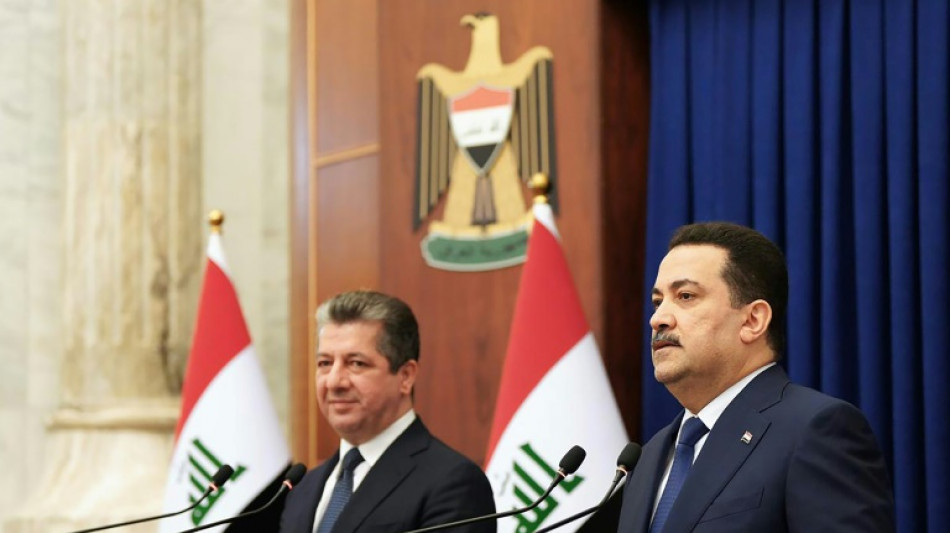
Iraq, Kurdish region sign accord to resume oil exports / Photo: - - IRAQI PRIME MINISTER'S PRESS OFFICE/AFP

 Zverev churns out win in Shanghai Masters opener
 Hurricane Isaias strengthens en route to US Gulf Coast

 US activists deploy poll volunteers over Trump intimidation fears

 Saint Laurent designer Vaccarello leaves after glittering decade

 'Tough to stay here': Nepal flood survivors wait for homes

 Malaysia closes schools in capital, parts of country due to haze

 Buccaneers stun Cowboys for first win of NFL season
 Activists hope trial will stop 'forever chemicals' at Italy plant

 Guardians rally for 9-5 victory over White Sox to stay alive in MLB playoffs

 Asian stocks mixed amid AI concerns, oil dips after surge

 Wallabies expect fast-paced All Blacks in Bledisloe opener
 Tech scammer Elizabeth Holmes focus of documentary by absurdist Nathan Fielder

 Climate hopes shift from politics to the courts
 Will Nobel Peace Prize pick make waves at the White House?

 Trump rules out new Iran attack before US midterm elections
 Far-right influencer shows Israel's coarse political turn
 Seals and sea lions get hearing tested at Australia zoo

 Mourinho's Real Madrid playing catch-up in Clasico countdown
 Joy as USS Lincoln back home after troubled Gulf deployment
 OpenAI says Iran, Russia influence ops busted

 Anthropic bans 'cruel' behavior against its Claude AI

 Anne Carson's Nobel literature prize 'a proud moment for Canada': PM

 Montagliani to seek CONCACAF re-election in boost for Infantino: reports

 Oil surges, stocks sink on jitters over US plans in Iran war

 John Cena and Jessica Biel hit the gas in 'Matchbox: The Movie'

Iraq's federal government and the Kurdistan autonomous region signed an accord Tuesday to allow Kurdish oil exports to resume through Turkey after they were halted 10 days earlier.
The agreement, signed in Baghdad in the presence of Prime Minister Mohamed Shia al-Sudani and Kurdish premier Masrour Barzani, was to be implemented "today", a Kurdish regional government official told AFP.
The deal was described as temporary but signals the end of independent oil exports by northern Iraq's Kurdish regional government and marks a clear limit to its autonomy.
The agreement comes two days after Iraq, Saudi Arabia and several other major oil exporters announced a sharp reduction in their production from May that sent up global energy prices.
Barzani said on Twitter that the deal is "temporary" until Iraq's parliament agrees a new oil and gas law, but he called it "a crucial step towards ending the long-standing dispute" between Arbil and Baghdad.
Ankara had stopped handling Iraqi Kurdish oil last month after an international tribunal ruled in a nine-year-old dispute that Baghdad was right to insist on overseeing all Iraqi oil exports.
Oil exports are the key revenue source for both the federal and regional governments and their management has long been a sensitive topic in relations.
The government of war-scarred Iraq is betting on earning around $70 per barrel in its budget calculations for the next three years and has been irritated to see the autonomous region go it alone by exporting its oil via Turkey.
The Kurdistan government sees Baghdad as trying to profit from the region's resources while dragging its feet on paying the salaries of Kurdish civil servants and other funds for its regional public sector.
- 'Breakthrough deal' -
Gulf Analyst Yesar Al-Maleki, of the Middle East Economic Survey (MEES), said the deal aimed "first and foremost" at quickly re-starting exports to Turkey.
"But it also presents an opportunity for Baghdad to finally be involved in Iraqi Kurdistan's oil sector" and should also allow Kurdistan "to accrue higher revenues" in future.
Maleki hailed the deal as a "breakthrough for the two PMs" that could help both sides draft the new energy law and "resolve the existing historic disputes once and for all".
Sales of Kurdistan crude will be managed from now by the State Oil Marketing Organization, a federal government official and a Kurdish official told AFP.
A joint committee formed by the federal and regional governments will supervise the export process, they added.
Revenues will be paid into an account under the control of the Kurdish government which will be overseen by Baghdad, they said.
The halt to exports through a pipeline to the Turkish Mediterranean port of Ceyhan had left foreign oil firms with nowhere to pump Kurdish oil.
Norway's DNO, one of the main firms operating in Iraqi Kurdistan, announced it was halting production at its wells.
Prior to Ankara's action on March 25, the autonomous region was exporting roughly 450,000 barrels per day of crude.
Iraq, the second largest producer within the Organization of the Petroleum Exporting Countries, exports an average of 3.3 million bpd.
N.Awad--SF-PST