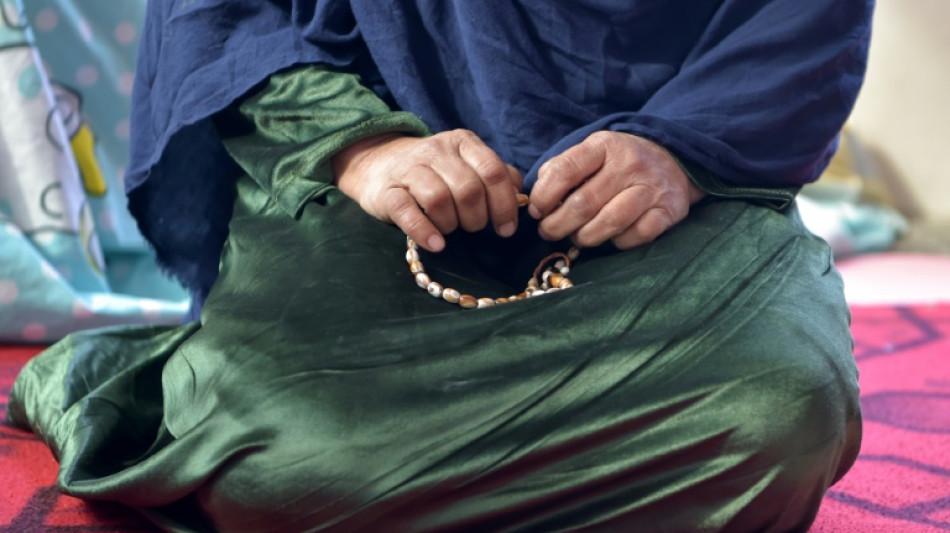
Divorced Afghan women fear being forced back to abusive ex-husbands / Photo: Luana Sarmini-Buonaccorsi - AFP

 Barca skipper Raphinha out against Getafe and Galatasaray

 MEXC and Payward Highlight Collaboration as Crypto and TradFi Converge at TOKEN2049

 EU states agree beefed-up European financial markets watchdog

 Eritrea, Ethiopia trade barbs as Tigray rebels retreat

 Kompany 'proud' of Man City success despite guilty verdict

 Man City will win appeal over financial charges, says Maresca
 Fernandez logs record lap at Indonesia MotoGP practice

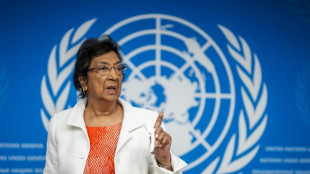
 Navi Pillay: S.Africa's global rights activist and Nobel winner

 Ufunded Launches “Spotlight” Series, Documenting the Minds Shaping Modern Trading
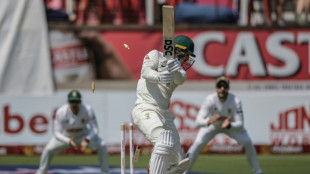
 Russell goes fastest in practice for smoggy Singapore GP
 For exiled Russian director Zvyagintsev, triumph without belonging
 Home hope Zheng storms into China Open semi-finals

 Zverev churns out win in Shanghai Masters opener
 Hurricane Isaias strengthens en route to US Gulf Coast

 US activists deploy poll volunteers over Trump intimidation fears

 Saint Laurent designer Vaccarello leaves after glittering decade

 'Tough to stay here': Nepal flood survivors wait for homes

 Malaysia closes schools in capital, parts of country due to haze
 Buccaneers stun Cowboys for first win of NFL season
 Activists hope trial will stop 'forever chemicals' at Italy plant

 Guardians rally for 9-5 victory over White Sox to stay alive in MLB playoffs

 Asian stocks mixed amid AI concerns, oil dips after surge

 Wallabies expect fast-paced All Blacks in Bledisloe opener

 Tech scammer Elizabeth Holmes focus of documentary by absurdist Nathan Fielder

 Climate hopes shift from politics to the courts

Abused for years by her ex-husband who broke all of her teeth, Marwa has retreated into hiding with her eight children after being told her divorce had been revoked.
Marwa was one of a small number of women who, under the previous US-backed government, were granted a legal separation in Afghanistan, where domestic abuse is widespread.
When Taliban forces swept into power in August 2021, her husband claimed he had been forced into the divorce and persuaded local commanders to order her back into the marriage.
"My daughters and I cried a lot that day," Marwa, 40, whose name has been changed for her own protection, told AFP.
"I said to myself, 'Oh God, the devil has returned.'"
The Taliban government adheres to an austere interpretation of Islam and has imposed severe restrictions on women's lives that the United Nations called "gender-based apartheid".
Lawyers told AFP that several women, in the immediate months after the Taliban seized power, have reported being dragged back into abusive marriages after being told by local commanders that their divorces had been annulled.
The Taliban authorities say this is not an official government policy. AFP’s investigation revealed that isolated cases like these happened during the aftermath of the country’s takeover.
For months Marwa endured a new round of beatings, locked away in the house, with her hands broken and fingers cracked.
"There were days when I was unconscious, and my daughters would feed me," she said.
"He used to pull my hair so hard that I became partly bald. He beat me so much that all my teeth are broken."
Gathering the strength to leave, she fled hundreds of kilometres (miles) to a relative's house with her six daughters and two sons, who have all assumed fictitious names.
"My children say, 'Mother, it's okay if we are starving. At least we have got rid of the abuse,'" said Marwa, sitting on the cracked floor of her bare home, clasping a string of prayer beads.
"Nobody knows us here, not even our neighbours," she said, fearing her husband would discover her.
- 'Islam permits divorce' -
The United Nations mission in Afghanistan says that violence against women in Afghanistan is widespread.
"Globally, 1 in 3 women have experience physical or sexual violence, mostly by an intimate partner," the mission said in a statement in November 2021.
"Afghanistan has one of the highest rate of violence against women globally, with nine out of 10 women experiencing at least one form of intimate partner violence in their lifetime."
Divorce, however, is often more taboo than the abuse itself and the culture remains unforgiving to women who part with their husbands.
Under the previous US-backed government, divorce rates were steadily rising in some cities, where the small gains in women's rights were largely limited to education and employment.
Women once blamed their fate for whatever happened to them, said Nazifa, a lawyer who successfully handled around 100 divorce cases for abused women, but who is no longer permitted to work in Taliban-ruled Afghanistan.
As awareness grew, women realised that separating from abusive husbands was possible.
"When there is no harmony left in a husband and wife relationship, even Islam permits a divorce," explained Nazifa, who only wanted to give her first name.
Under the ousted regime, special family courts with women judges and lawyers were established to hear such cases, but the Taliban authorities have made their new justice system an all-male affair.
Nazifa told AFP that five of her former clients have reported being in the same situation as Marwa.
Another lawyer, who did not want to be identified, told AFP she recently witnessed a court case where a woman was fighting against being forcefully reunited with her ex-husband.
She added that divorces under the Taliban government are being granted when a husband was a classified drug addict or has left the country.
"But in cases of domestic violence or when a husband does not agree to a divorce, then the court is not granting them," she said.
The Taliban authorities insist divorce is allowed according to sharia.
A nationwide network of shelters and services that once supported women has almost entirely collapsed, while the Ministry of Women's Affairs and the Human Rights Commission have been shut.
- 'Knock on the door' -
Sana was 15 when she married her cousin, 10 years older than her.
"He would beat me if our baby cried or the food was not good," she said as she prepared tea on a gas stove at a home where she has been living in secret.
"He used to say that a woman does not have the right to talk."
With the help of a free legal service project she won a divorce from her husband in court -- but her relief was shattered when local officials came knocking.
Threatened with losing custody of her four daughters, she returned to her ex-husband who by then had also married another woman.
She escaped after he announced the engagement of her daughters.
"My daughters said, 'Mother, we will commit suicide,'" Sana said.
She was able to gather some money and escape with her children, and with the help of a relative found a one-room house, furnished only with a gas stove and some cushions for sleeping.
"Whenever there's a knock on the door, I fear that he's found me and come to take the kids away."
- Ordeal for children -
A Taliban official told AFP the authorities would look into such cases where previously divorced women had been forced to return to their ex-husbands.
"If we receive such complaints, we will investigate them according to sharia," said Inayatullah, spokesman for the Taliban supreme court, who like many Afghans goes by one name.
When asked whether the Taliban regime would acknowledge divorces granted under the previous government, he said: "This is an important and complex issue."
"The Dar al-Ifta is looking into it. When it arrives at a uniform decision, then we will see," he said, referring to a court-affiliated institution that issues rulings on sharia.
For Marwa and her daughters, who survive by sewing clothes, the trauma has left deep psychological wounds.
"I'm afraid I won't be able to get them married," said Marwa, looking at her daughters.
"They tell me, 'Mother, watching how bad your life has been, we hate the word husband.'"
ash-lsb-est-jd/ecl/mel/kma
D.AbuRida--SF-PST