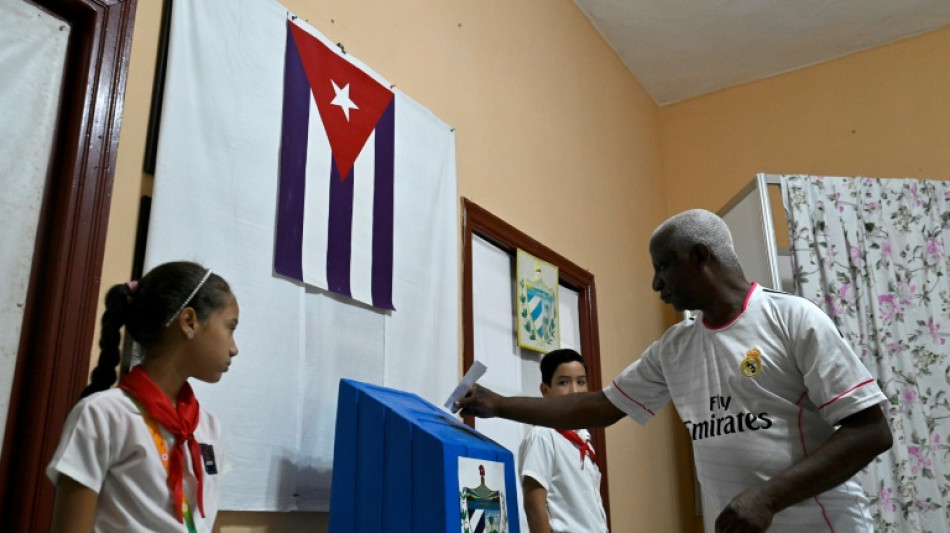
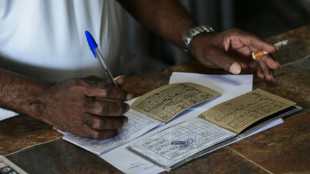
Abstention key issue as Cubans vote in legislative elections / Photo: ADALBERTO ROQUE - AFP

 US sanctions: a 'test of resilience' for ICC
 NFL legend Mike Ditka dead at 86
 Hurricane Isaias set to strike Gulf Coast late Friday
 Trump forms panel to probe US Fed governor Lisa Cook
 Clashes in Durban as fresh anti-migrant riots erupt in South Africa
 France students plan more protests, UN 'concerned' over violence
 De Zerbi calls on struggling Spurs to react in Man Utd clash

 US sanctions on ICC: a 'test of resilience'

 Outrage over US military plan to livestream firing squad execution

 Argentina snap up defence guru Edwards ahead of World Cup
 BMW pulls car lease offer from German far-right politician
 Brazil election offers Jair Bolsonaro a shot at revenge
 Man Utd boss Carrick 'personally' affected by Man City verdict
 Evolution Metals & Technologies Corp. Raises Fiscal 2026 Revenue Guidance 62% at Midpoint to $10–$11 Million and Reaffirms $400–$460 Million Fiscal 2027 Outlook
 Red Bull's Verstappen takes pole position for Singapore GP sprint race

 Chelsea star Palmer 'committed' to England insists Alonso
 OpenAI denies firing researchers over AI safety warnings
 Turkey warns opposition, press over investment fund crisis

 Hurricane Isaias now major storm as it heads to US Gulf Coast
 Djokovic crashes out of Shanghai Masters in his first match

 EU says Turkey's crackdown on rights hampers membership bid

 Two Renoir paintings stolen in France recovered: mayor
 German leader outraged at Schroeder birthday visit to Putin

 Stocks up, oil retreats as Trump rules out pre-vote Iran attack

 South African judge Navi Pillay wins Nobel Peace Prize
Cubans headed to the polls on Sunday for National Assembly elections in which the results are a foregone conclusion but with the abstention rate the real issue at stake.
As many as eight million eligible voters selected from the 470 candidates on the ballot -- 263 women and 207 men -- vying for the 470 seats in the congress.
But what was really in play was the number of Cubans who refuse to vote.
The opposition -- which does not have candidates on the ballot -- has called on Cubans to abstain, with one opposition Twitter account calling the vote a farce.
Voting is not obligatory and abstention has risen steadily in recent years.
Municipal elections in November attracted a turnout of 68.5 percent, down from the 74 percent who voted two months earlier in a referendum on a new family code, and even further down from the 90 percent in the 2019 referendum on a new constitution.
On Sunday, the latest figure released by the National Election Council said that as of 2:00 pm, turnout was 60.14 percent.
Cuba's communist government does not allow opposition, so most of the parliamentary candidates are members of the Cuban Communist Party (PCC).
Dissident Manuel Cuesta Morua, a member of the Council for the Democratic Transition in Cuba, said that "a sociological force is becoming the largest political party in the country: the abstentionist party."
In reality, candidates still need to receive 50 percent of votes to be elected.
Voters had two choices on their ballots: they can tick the names of any number of individual candidates, or they can select the "vote for all" option.
"I voted for the unified vote because, despite the needs, the difficulties that this country can have, I could not imagine" abstaining, Carlos Diego Herrera, a 54-year-old blacksmith in Havana, told AFP.
He said abstaining would be like voting "for those that want to crush us, the Yankees."
The United States has imposed sanctions on the island nation since 1962, three years after the communist revolution that saw Fidel Castro take power after overthrowing US-backed dictator Fulgencio Batista.
Student Rachel Vega, 19, said she had also voted for all the candidates, considering it "a step forward right now" that would "improve the situation in the country."
President Miguel Diaz-Canel is among the candidates, as is his predecessor, the 91-year-old Raul Castro.
"With the united vote we defend the unity of the country, the unity of the revolution, our future, our socialist constitution," said Diaz-Canel, 62, after voting in Santa Clara, a town 175 miles (280 kilometers) southeast of Havana.
More than 23,000 polling stations opened their doors at 7:00 am (1100 GMT) and closed 12 hours later, an hour later than had been scheduled.
J.AbuShaban--SF-PST