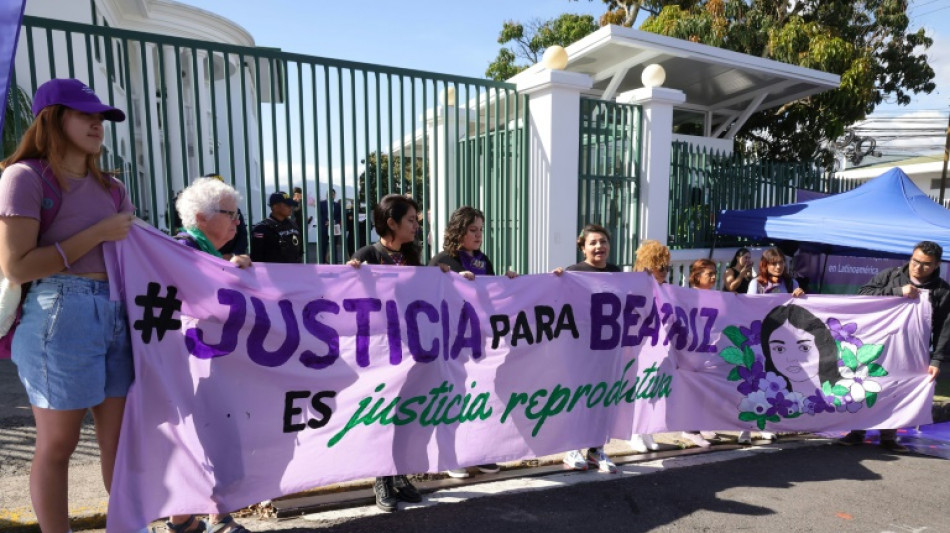
Judgment awaited in Inter-American court's first abortion rights case / Photo: Randall CAMPOS - AFP

 Flydubai co-pilot planned suicide attack on Tel Aviv airport: UAE prosecutor

 Mike Ditka: Chicago Bears icon as player and coach

 Outrage over plan to livestream US military firing squad execution

 US sanctions: a 'test of resilience' for ICC
 NFL legend Mike Ditka dead at 86
 Hurricane Isaias set to strike Gulf Coast late Friday
 Trump forms panel to probe US Fed governor Lisa Cook
 Clashes in Durban as fresh anti-migrant riots erupt in South Africa

 France students plan more protests, UN 'concerned' over violence
 De Zerbi calls on struggling Spurs to react in Man Utd clash

 US sanctions on ICC: a 'test of resilience'

 Outrage over US military plan to livestream firing squad execution

 Argentina snap up defence guru Edwards ahead of World Cup

 BMW pulls car lease offer from German far-right politician

 Brazil election offers Jair Bolsonaro a shot at revenge

 Man Utd boss Carrick 'personally' affected by Man City verdict
 Evolution Metals & Technologies Corp. Raises Fiscal 2026 Revenue Guidance 62% at Midpoint to $10–$11 Million and Reaffirms $400–$460 Million Fiscal 2027 Outlook

 Red Bull's Verstappen takes pole position for Singapore GP sprint race

 Chelsea star Palmer 'committed' to England insists Alonso

 OpenAI denies firing researchers over AI safety warnings

 Turkey warns opposition, press over investment fund crisis

 Hurricane Isaias now major storm as it heads to US Gulf Coast

 Djokovic crashes out of Shanghai Masters in his first match

 EU says Turkey's crackdown on rights hampers membership bid

 Two Renoir paintings stolen in France recovered: mayor
Activists battled the government of El Salvador Thursday on the final day of the Inter-American Court of Human Rights' first-ever abortion rights hearing.
Representing a woman identified only as "Beatriz" who was made to carry a deformed fetus despite risks to her own health, rights bodies accused the Central American country of trampling on women's rights with its blanket abortion ban.
Beatriz's "rights to life, personal integrity, health and privacy... were limited by the criminalization of abortion" in El Salvador, argued Julissa Mantilla of the Inter-American Commission on Human Rights (IACHR) which appeared as a party in the case.
On the other side of the fence, lawyer Juana Acosta argued for the government of El Salvador that abortion was "criminal" if its "intention is to destroy the unborn."
And her colleague Ana Maria Hidalgo said the American Convention on Human Rights made no distinction between born and unborn "human beings."
"This case involves two human beings, and therefore two holders of... rights: Beatriz and her (unborn) daughter," Hidalgo argued.
The judgement is expected in about six months.
In El Salvador, abortion has been prohibited since 1998 under penalty of up to eight years in prison.
Courts frequently find women guilty of the crime of aggravated homicide instead, imposing sentences that can go up to 50 years.
Beatriz suffered from an auto-immune disease when she fell pregnant for the second time in 2013 aged 20, after a previous complicated birth.
After the fetus was found to be unviable due to a severe developmental defect, doctors said an abortion was necessary, but were not allowed to perform it.
El Salvador's Constitutional Court threw out Beatriz' legal bid for permission to end the pregnancy.
She later went into premature labor, and the fetus died.
The IACHR, which shares an acronym with the Costa Rica-based court to which it referred the case, declared last year that the pain and suffering Beatriz was made to endure amounted to "cruel, inhuman and degrading treatment."
- 'Torture' -
Gisela de Leon of the Center for Justice and International Law (Cejil), a rights NGO among the plaintiffs, said the state had "violated (Beatriz's) rights to life and personal integrity" in what amounted to "a form of torture."
Beatriz died in a car accident in 2017, but her family has pursued the case without her.
"What we really want is for other women not to suffer what my sister had to go through," Beatriz's 30-year-old brother, using the pseudonym Humberto to keep her identity secret, told AFP.
The case comes as some Latin American countries are taking cautious steps towards easing abortion restrictions even while the United States -- which has signed but not ratified the rights court's founding convention -- has been rolling back access.
In Latin America, elective abortion is legal in Argentina, Colombia, Cuba, Uruguay, and some states in Mexico.
In several countries it is allowed in certain circumstances, such as rape or health risks, while outright bans apply also in Honduras, Nicaragua, Haiti and the Dominican Republic.
Several states in the United States have banned or curtailed abortion access since a Supreme Court ruling last June overturned the landmark Roe v. Wade decision that had long protected abortion rights.
H.Darwish--SF-PST