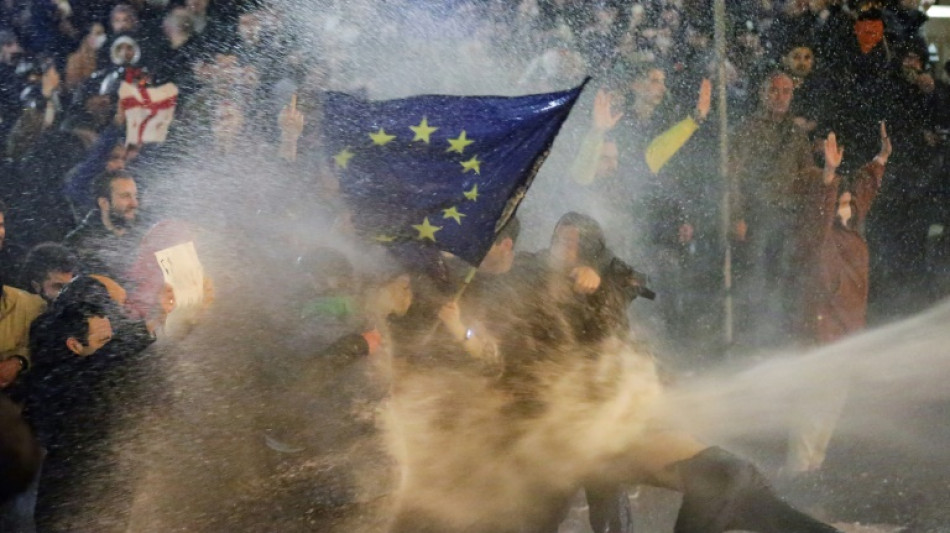
Georgia's geopolitical future at the heart of its protests / Photo: - - AFP

 India's 'cockroach' movement chief detained ahead of major protest
 Year later, Gaza ceasefire promises mostly unfulfilled
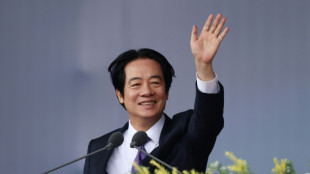 Taiwan's leader says increasing defence spending to 'deter war'
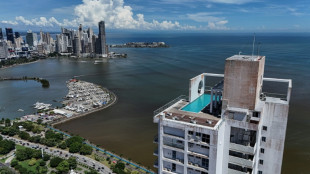 Major quake hits Panama, no deaths reported
 Hurricane Isaias makes landfall in Florida
 Brazil prosecutors sue Shell for $108 mn over deadly 2024 floods
 Major earthquake destroys buildings, roads in Panama
 Anthropic AI model sent fake murder tip to Philadelphia police
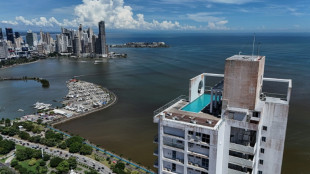 7.7-magnitude quake rocks Panama, triggers tsunami warning
 Prince Harry booed at English rugby match
 Kiplimo and Feysa seek repeat Chicago Marathon wins

 Fuellkrug halts Dortmund after late goal flurry
 Injured Ravens quarterback Jackson ruled out of Falcons clash

 Brewers aim to take down two-time defending champion Dodgers in NLCS rematch

 Tsunami alert after major earthquake rocks Panama
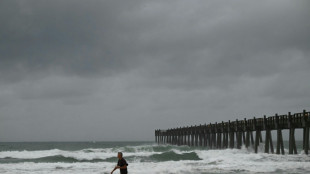 Outer bands of Hurricane Isaias lash US Gulf Coast
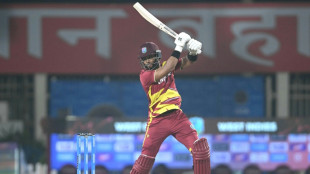 Hope, Rutherford fire West Indies to record T20 chase of 250
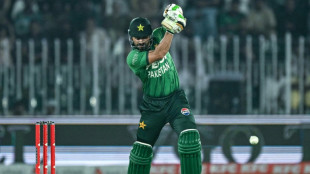 Farhan leads Pakistan to T20 win over Sri Lanka
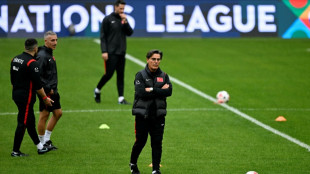 Turkey sack coach Montella after Nations League woe
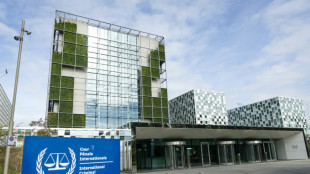
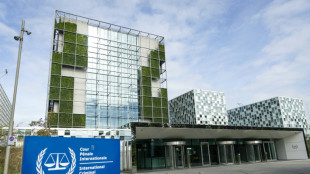 US announces sanctions on ICC, hours after Nobel award to former judge
 Montenegro expels popular Russian war blogger wanted by US
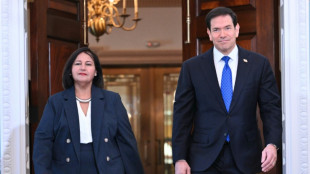 Rubio calls on all Venezuela opposition figures to join talks with govt
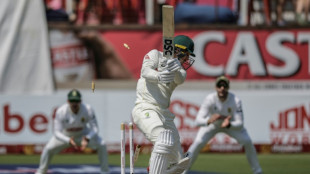 Australia struggle against South Africa quicks in first Test
 Stocks advance as Trump rules out pre-vote Iran attack
 Australia struggle against South Africa's fast bowlers
The protests in Georgia reflect internal political turmoil over its geopolitical destiny in the wake of the Russian invasion of Ukraine, analysts say.
The ruling Georgian Dream party has insisted it remains committed to Georgia's EU and NATO membership.
But a "foreign agent" bill reminiscent of Russian legislation used to silence critics has in recent days sparked demonstrations, to which authorities have responded with water cannons and tear gas.
Georgian President Salome Zurabishvili on Thursday congratulated protesters in the Caucasus country after the government said it would drop the bill.
Here is an overview:
- What is the worry? -
Concerns have mounted that the Georgian government is flirting with the Kremlin and putting the Black Sea nation on an authoritarian path.
"There are concerns that Georgian Dream, which has been in power since 2012, wants to turn the country into a one-party state," said Thomas de Waal, a senior fellow at Carnegie Europe.
Magdalena Dembinska, of the University of Montreal, said civil society and media had typically acted as the guardians of Georgian democracy, "putting a break on authoritarian aspirations".
But worry has grown since Prime Minister Irakli Garibashvili's party tried to introduce the "foreign agent" law, even if for now they have withdrawn it.
It could have served "to silence civil society", Dembinska said.
In the run-up to 2024 parliamentary elections, it could also have contributed to stamping out criticism over the jailing of former president Mikheil Saakashvili, she added.
The pro-Western reformist has been held since 2021 over "abuse of office", though backers say he is a "political prisoner", and EU nations have expressed concern over his deteriorating health.
- Does Tbilisi really want to join the EU? -
Days after Russia invaded Ukraine a year ago, Georgia applied for EU membership together with Ukraine and Moldova.
In June last year, EU leaders granted formal candidate status to Kyiv and Chisinau but said Tbilisi must implement reforms first.
They included ending "political polarisation", improving democratic oversight, implementing judicial reform, guaranteeing freedom of the press and battling the influence of oligarchs.
The Georgian government has been blowing hot and cold on whether it actually wants to join the Western bloc.
"They make statement that they are pro-EU. But actions demonstrate a different scenario," said Natia Seskuria of British think tank the Royal United Services Institute (RUSI), alluding to the latest law proposal.
"If it gets ever passed, it would alienate Georgia from the West," she said.
In contrast, opinion polls show that a large majority of the population support joining the European Union and NATO.
- What of Russia's pull? -
"Without a European perspective, Georgia won't have any future but turning into Russia's backyard," Georgian human rights activist Ana Aptsiauri wrote on Twitter on Wednesday.
The former Soviet republic has historic ties with Russia.
Moscow and Tbilisi went to war in 2008 and Russia still controls Georgia's breakaway Abkhazia and South Ossetia regions, where Russian is widely spoken, even though the territories are recognised internationally as part of Georgia.
Dembinska said the situation was "complex".
Though mostly pro-European, Georgians were "attached to the conservative values of the Georgian Orthodox church", and the country was economically dependent on Russia, she said.
For now, Russia's chief concern is fighting in Ukraine, analysts told AFP.
But Seskuria, of RUSI, said it was "within the interest of Moscow that Georgia is alienated from its democratic European aspirations".
"They need to make sure they maintain their sphere of influence in the region," she said.
- How has the Ukraine war changed things? -
Georgian politics have become even more polarised since Russia invaded Ukraine in February last year.
Tbilisi has not condemned the incursion, but for many Georgians it has revived painful memories of the Russian ground assault in South Ossetia in August 2008.
Georgia has long sought to join NATO. But discussions towards joining the Western military alliance were put on hold by the 2008 war, when Saakashvili was president.
The country is however a NATO partner and a liaison office has existed in the country since 2010.
"The geopolitical imperative is clear," said de Waal.
Georgians have pointed out that Russia last year alone occupied more land in Ukraine "than constitutes the entirety of their territory", he said.
Seskuria said "a new security framework" was emerging in the region.
"It will be crucial for Georgia to see what kind of Russia we will have after the war in Ukraine, whether it will be weakened or changed," she said.
A.AlHaj--SF-PST