
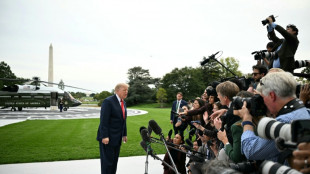
Australia, US, Britain leaders to meet, submarine deal expected / Photo: Saeed KHAN - AFP

 India's 'cockroach' movement chief detained ahead of major protest

 Year later, Gaza ceasefire promises mostly unfulfilled

 Taiwan's leader says increasing defence spending to 'deter war'

 Major quake hits Panama, no deaths reported

 Hurricane Isaias makes landfall in Florida
 Brazil prosecutors sue Shell for $108 mn over deadly 2024 floods
 Major earthquake destroys buildings, roads in Panama
 Anthropic AI model sent fake murder tip to Philadelphia police
 7.7-magnitude quake rocks Panama, triggers tsunami warning

 Prince Harry booed at English rugby match

 Kiplimo and Feysa seek repeat Chicago Marathon wins

 Fuellkrug halts Dortmund after late goal flurry
 Injured Ravens quarterback Jackson ruled out of Falcons clash

 Brewers aim to take down two-time defending champion Dodgers in NLCS rematch

 Tsunami alert after major earthquake rocks Panama
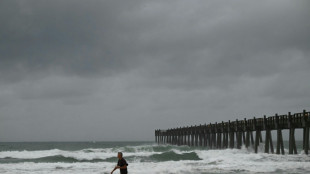 Outer bands of Hurricane Isaias lash US Gulf Coast
 Hope, Rutherford fire West Indies to record T20 chase of 250
 Farhan leads Pakistan to T20 win over Sri Lanka

 Turkey sack coach Montella after Nations League woe

 US announces sanctions on ICC, hours after Nobel award to former judge

 Montenegro expels popular Russian war blogger wanted by US
 Rubio calls on all Venezuela opposition figures to join talks with govt
 Australia struggle against South Africa quicks in first Test

 Stocks advance as Trump rules out pre-vote Iran attack

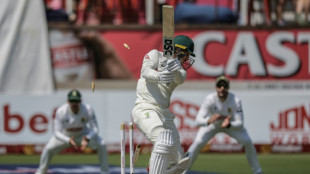 Australia struggle against South Africa's fast bowlers

The leaders of the United States, Britain and Australia will meet in the United States next week to discuss security and foreign policy, the British Prime Minister's office announced on Wednesday, ahead of an expected nuclear submarine deal aimed at countering China's growing assertiveness in the Pacific.
After 18 months of negotiations, it is anticipated that Australia will reveal plans to obtain eight nuclear-powered submarines, in what Australian Prime Minister Anthony Albanese has called "the single biggest leap" in defence capability in his country's history.
The deal is part of the fledgling regional security pact between Australia, the United Kingdom and the United States known as AUKUS.
"The prime minister will be in the US on Monday for discussions on AUKUS with President Biden and the Australian Prime Minister," Prime Minister Rishi Sunak's spokesman told reporters.
The UK government will also that day publish an update to its so-called "Integrated Review" of security, defence and foreign policy, he added.
The last update two years ago was billed as the most comprehensive since the Cold War era and crafted as London recalibrated its post-Brexit foreign policy.
London has insisted the new defence alliance is not intended to be adversarial towards any other nation. But it has been widely seen as a Western response to concern about China's increasing influence in the region, and the pace and size of Beijing's military expansion.
Since September 2021, behind-the-scenes talks have been taking place between the AUKUS partners about how to equip Australia's military with sensitive nuclear-propulsion technology.
Australia does not have the expertise to build its own nuclear subs -- which have an extended range and powerful strike capabilities -- and must buy them from either the United States or Britain.
Earlier on Wednesday, Albanese announced he would be meeting President Joe Biden in the United States, without specifying an exact date.
"We'll have further announcements about details soon about the arrangements that will be taking place," he told reporters in Perth.
The emerging deal has worried some of Australia's largest regional allies, with both Indonesia and Malaysia questioning whether it could spark a nuclear arms race in the Indo-Pacific.
While the subs will be powered by a nuclear reactor, Australia has ruled out equipping them with nuclear weapons.
The submarine contract is expected to worth tens of billions of US dollars, but experts say its significance goes beyond jobs created and investments pledged.
- Beijing opposition -
Nuclear-powered submarines are difficult to detect, can travel large distances for prolonged periods and can be armed with sophisticated cruise missiles.
That would allow Australia to launch strikes or counterstrikes deep into enemy territory with little warning.
Beijing has voiced deep opposition to the project, which it sees as "dangerous" and designed to corner China.
Major questions still linger, including whether Australia will look to buy US or British submarines, where they will be built and when they will be in the water.
Britain's The Times newspaper reported Tuesday that Australia is expected to acquire submarines built by Britain, rather than the United States, under the AUKUS pact because it is easier to crew the smaller UK vessels.
If the submarines are from the United States, it would be the first time US-derived nuclear submarine technologies were exported since the 1960s, when the United States helped Britain design its undersea fleet.
"The AUKUS partnership seeks to provide a conventionally armed, nuclear-powered submarine capability to Australia at the earliest possible date," a Pentagon spokesperson told AFP ahead of Albanese's announcement.
"Bolstering our deterrence means boosting all of our industrial bases, growing our collective capabilities, and sharing technology as never before."
The AUKUS pact also foresees collaboration between the three allies on hypersonic missiles, artificial intelligence and cyber warfare.
The subs deal has been contentious in the United States, which is struggling to grow its own fleet of nuclear submarines.
The chair of the influential US Senate armed services committee, Democrat Jack Reed, warned Biden in December that selling subs to Australia could undermine American naval prowess.
In a leaked letter sent to Biden, Reed also wrote that the AUKUS agreement risked "stressing the US submarine industrial base to the breaking point".
Australia had originally planned to buy diesel-powered submarines in a lucrative deal inked with France, but abruptly scrapped that agreement in favour of AUKUS.
B.Mahmoud--SF-PST