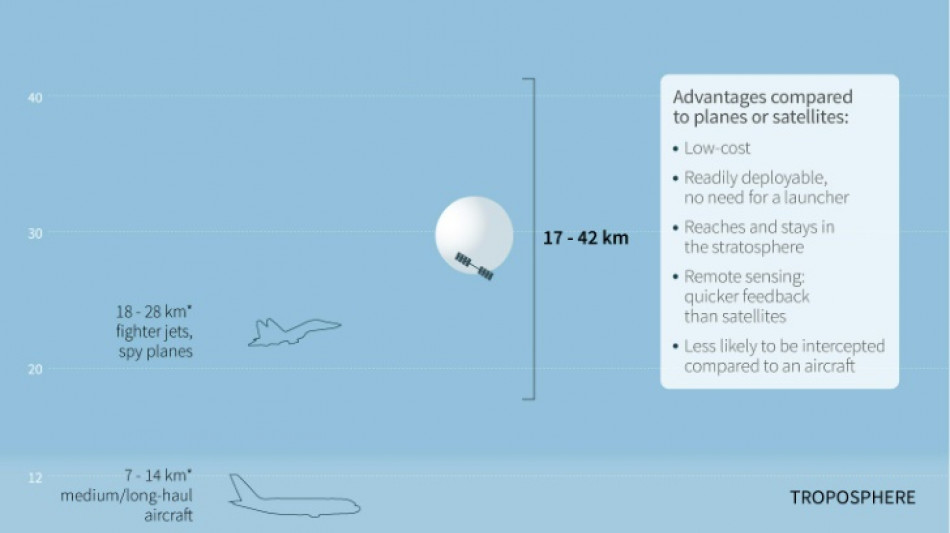
Chinese balloon advanced, hard to shoot down: US expert / Photo: Nalini LEPETIT-CHELLA - AFP

 Indonesia releases eight orangutans rescued from fires to protected forest

 Russian Yandex data centre operations disrupted after drone strike

 Architect fights to save India's past, built on 'stone, tears and sweat'
 Hurricane Simon strengthens as it nears western Mexico

 'Everyone is angry': Okinawans fearful and frustrated after killing

 Trump's trade wars sting US manufacturers ahead of midterms

 Kenyan great Kipchoge wins first marathon in three years

 Barca extend perfect streak, Real Madrid survive Vinicius red

 PSG ease to Ligue 1 win before Manchester City test

 Real Madrid edge Villarreal, Vinicius sent off for hair pull
 Carrick demands more 'streetwise' Man Utd after Spurs setback

 10-man Tottenham ramp up pressure on Man Utd boss Carrick

 India 'cockroach' movement says thousands detained in Delhi protest

 Injury ends season for NHL Rangers star goalie Shesterkin

 Ten-man Spurs rescue draw at Man Utd, Arsenal survive Leeds scare

 Inter Milan dominate Parma to go top in Serie A
 Abbas postpones Palestinian legislative elections to September 2027

 'I don't feel fear': Fulham boss Arbeloa hits back as pressure mounts

 Hurricane Simon strengthens to category 4 as it nears western Mexico

 Alonso hails Henderson 'beauties' as Chelsea star rolls back the years

 Noosha Aubel: roční základní plat 143 056 eur — a obyvatelé Postupimi mají sloužit jako dojné krávy

 Romero claims Atletico late win at Alaves

 Zelensky blasts diesel deal as Russian strikes kill 16

 Arsenal back on track after Leeds scare, five-star Chelsea run riot

 Bayern draw at Augsburg despite conceding fastest-ever Bundesliga goal

The first Chinese surveillance balloon that the Pentagon found flying over sensitive US ballistic missile sites may be guided by advanced artificial intelligence technology, a US expert said Friday.
A second Chinese spy balloon was later spotted over Latin America, before it headed eastwards over the central United States.
William Kim, a specialist in surveillance balloons at the Marathon Initiative think tank in Washington, told AFP that balloons are a valuable means of observation that are difficult to shoot down.
- Guided by AI? -
Kim said the first Chinese balloon looked like a normal weather balloon but with distinct characteristics.
It has a quite large, visible "payload" -- the electronics for guidance and collecting information, powered by large solar panels.
And it appears to have advanced steering technologies that the US military hasn't yet put in the air.
Artificial intelligence has made it possible for a balloon, just by reading the changes in the air around it, to adjust its altitude to guide it where it wants to go, Kim said.
"Before you either had to have a tether... or you just send it up and it just goes wherever the wind takes it," he said.
"What's happened very recently with advances in AI is that you can have a balloon that... doesn't need its own motion system. Merely by adjusting the altitude it can control its direction."
That could also involve radio communications from its home base, he said.
But "if the point of it is to monitor (intercontinental ballistic missile) silos, which is one of the theories... you wouldn't necessarily need to tell it to adjust its location," he added.
- What advantages over satellites? -
Kim said that as satellites become more vulnerable to being attacked from the Earth and space, balloons have distinct advantages.
Firstly, they don't easily show up on radars.
"These are materials that don't reflect, they're not metal. So even though these balloons expand to quite large, detecting... the balloon itself is going to be a problem," he said.
And the payload, if small enough, can be overlooked.
Balloons also have the advantage of holding relatively stationary positions over a surveillance target, compared to constantly orbiting satellites used by spy agencies to take photographs.
"These things can stay overhead, they can stay over one spot months at a time, compared to the low-Earth-orbit satellites," Kim said.
- Could it have entered US airspace by accident? -
Kim called it a "real possibility" that a Chinese balloon may have been intended to collect data from outside US boundaries or much higher but malfunctioned.
"These balloons don't always work perfectly," he said.
The balloons usually operate at altitudes of 65,000-100,000 feet, and this one is at around 46,000 feet, he said.
"That's definitely a little low... If you wanted it to be harder to spot, if you want it to be harder to shoot down, then it would make sense to operate at higher altitudes."
- Why can't the US shoot it down? -
Shooting down a balloon is not as easy as it sounds, said Kim.
"These balloons use helium... It's not the Hindenburg, you can't just shoot it and then and then it goes up in flames."
"If you do punch holes in it, it's just kind of going to leak out very slowly."
Kim recalled that in 1998 the Canadian air force sent up F-18 fighter jets to try and shoot down a rogue weather balloon.
"They fired a thousand 20-millimeter cannon rounds into it. And it still took six days before it finally came down. These are not things that explode or pop when you shoot at them."
He said it was not clear if using surface-to-air missiles would work, because their guidance systems are designed to hit fast-moving missiles and aircraft.
J.AbuShaban--SF-PST