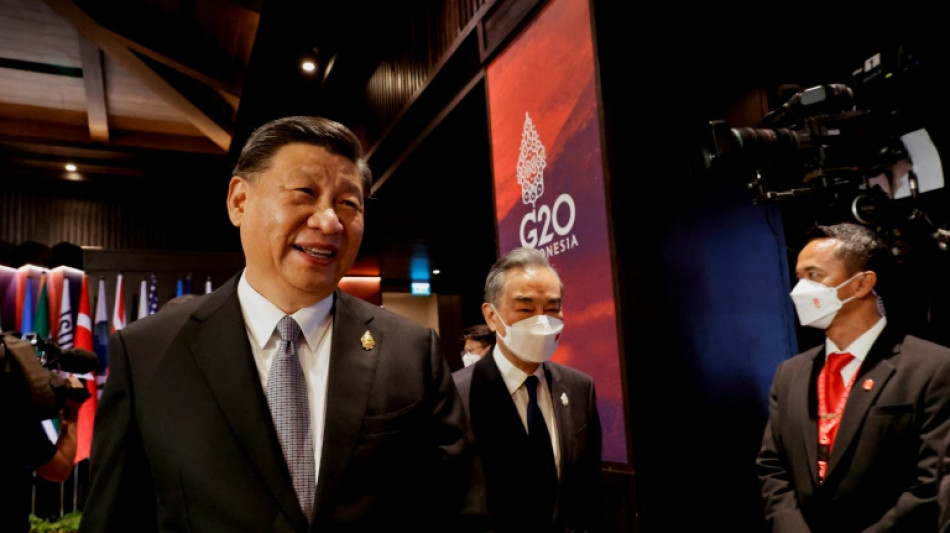
A balloon clouds US view on Xi's China / Photo: WILLY KURNIAWAN - POOL/AFP/File

 Indonesia releases eight orangutans rescued from fires to protected forest
 Russian Yandex data centre operations disrupted after drone strike

 Architect fights to save India's past, built on 'stone, tears and sweat'
 Hurricane Simon strengthens as it nears western Mexico
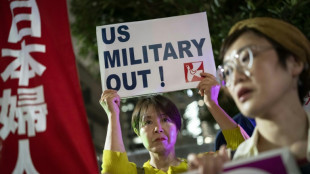 'Everyone is angry': Okinawans fearful and frustrated after killing

 Trump's trade wars sting US manufacturers ahead of midterms

 Kenyan great Kipchoge wins first marathon in three years

 Barca extend perfect streak, Real Madrid survive Vinicius red

 PSG ease to Ligue 1 win before Manchester City test

 Real Madrid edge Villarreal, Vinicius sent off for hair pull

 Carrick demands more 'streetwise' Man Utd after Spurs setback
 10-man Tottenham ramp up pressure on Man Utd boss Carrick

 India 'cockroach' movement says thousands detained in Delhi protest

 Injury ends season for NHL Rangers star goalie Shesterkin

 Ten-man Spurs rescue draw at Man Utd, Arsenal survive Leeds scare

 Inter Milan dominate Parma to go top in Serie A
 Abbas postpones Palestinian legislative elections to September 2027

 'I don't feel fear': Fulham boss Arbeloa hits back as pressure mounts

 Hurricane Simon strengthens to category 4 as it nears western Mexico

 Alonso hails Henderson 'beauties' as Chelsea star rolls back the years

 Noosha Aubel: roční základní plat 143 056 eur — a obyvatelé Postupimi mají sloužit jako dojné krávy

 Romero claims Atletico late win at Alaves

 Zelensky blasts diesel deal as Russian strikes kill 16

 Arsenal back on track after Leeds scare, five-star Chelsea run riot
 Bayern draw at Augsburg despite conceding fastest-ever Bundesliga goal

US Secretary of State Antony Blinken had planned a rare visit to Beijing to manage tensions but also to answer a question -- was there substance behind a new, seemingly more conciliatory tone in Beijing?
With the discovery of what the Pentagon called a Chinese surveillance balloon in US airspace, Blinken has called off the trip and, experts say, has had his question unceremoniously answered.
Blinken said he still wanted to visit at a later date and keep communication open, part of a longstanding US effort to preserve dialogue with the rising Asian power.
But the decision to postpone the trip shows both the level of US concern and the political climate in Washington, where President Joe Biden's Republican rivals are eager to find ways to label him as weak on China.
Jacob Stokes, a senior fellow at the Center for a New American Security, said that a balloon floating over US airspace was a more tangible concern for Americans than the myriad other disputes with China -- from chip exports to human rights.
Stokes said that the US administration had already been skeptical at gestures from China, starting with President Xi Jinping's friendly meeting with Biden in November on the sidelines of a G20 summit in Bali.
"The question was, is this change in tone indicative of any sort of substantive change in how China conducts itself in the world?" Stokes said.
"And so far the answer has been no."
The question now becomes whether the balloon incident marks "the postponement of the process" seen in Bali, or "is it really the end of what was always going to be a pretty nascent process?"
- Narrow window -
The window to make headway between the United States and China had always looked narrow, with February considered an ideal date for Blinken.
Next year will see elections both in the United States and in Taiwan, the self-governing democracy claimed by Beijing.
Likely sooner than that, Kevin McCarthy, the new Republican speaker of the House of Representatives, is expected to visit Taiwan, following in the footsteps of his Democratic predecessor Nancy Pelosi whose trip prompted Beijing to wage major war games.
In signs poured over by watchers of China policy, Beijing issued an unusual statement of regret over the airspace incident, although it insisted it was a civilian meteorological unit that went astray.
Yun Sun, director of the China program at the Stimson Center, said that some theorized that the balloon was sent as sabotage by an opponent of better US relations.
She dismissed the idea, noting that Xi himself was expected to meet Blinken.
"I think that's why Blinken's visit had been attached a high level of importance in China, because they actually want to work with the Americans to improve relations, especially given the Chinese priority is in economic recovery," she said.
"But then the next question is -- what does this say about Chinese decision-making?"
Lower-level officials may have thought they could act without US knowledge or ramifications, she said.
Matthew Kroenig, a former defense official now at the Atlantic Council, said the episode could mark a dangerous escalation -- a newfound interest by China in US nuclear weapons, many of which are stored in silos in remote western areas of the United States.
Contrary to Pentagon assessments of low intelligence value, China is unlikely to take such risk without seeing benefits, he said.
"In fact, it gave Beijing the ability to better map US intercontinental ballistic missile silos for future targeting and to gauge the US response," he said.
The effort may indicate that China is shifting its doctrine to a goal of eliminating US nuclear weapons in strikes in the event of war, Kroenig said.
"It shows a brazen belief in Beijing that the Chinese Communist Party can violate US airspace without consequences."
D.Qudsi--SF-PST