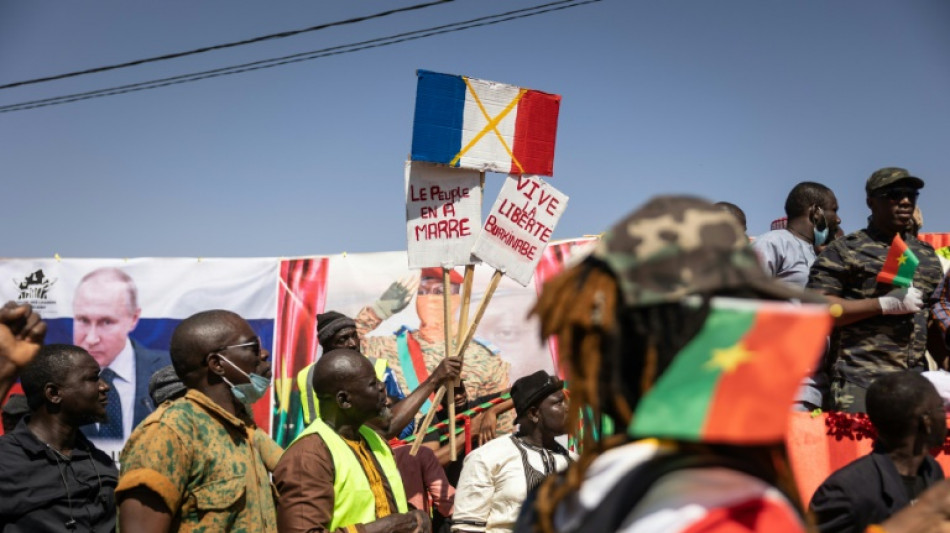
France's shrinking footprint in Africa / Photo: OLYMPIA DE MAISMONT - AFP

 Ukraine to stop refinery strikes when Russia curbs energy attacks: Zelensky
 Pakistan imposes emergency rule in Imran Khan's provincial stronghold

 Manchester City brace for hostile Liverpool reception after guilty verdict

 Brazil's Lula accuses Meta of election interference

 South Korea completes trial of Arctic shipping route

 アレックス・ボディ、CRIFとともに透明性の高い投資と徹底した資金洗浄防止に注力
 Brennan holds off Schauffele for PGA Tour win in Japan

 ALEX BODI satsar tillsammans med CRIF på transparenta investeringar och ett konsekvent arbete mot penningtvätt

 ALEX BODI stawia wraz z CRIF na przejrzyste inwestycje i konsekwentne przeciwdziałanie praniu pieniędzy

 알렉스 보디, CRIF와 함께 투명한 투자와 철저한 자금세탁방지에 주력

 ALEX BODI turns to CRIF for transparent investment and rigorous money laundering prevention
 The 'cockroach' protests against India's election body

 Power, water, jobs: Google on India data centre concerns

 Google faces backlash against India data centre

 Trump urges Zelensky replacement as diesel row rages
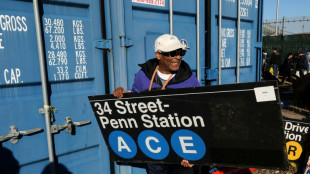 New Yorkers snap up discarded subway signs, seats at annual sale
 Messi nets brace to win in first match after Argentina exit
 Ravindra fit for New Zealand ODI series against India

 All Blacks lose four players for second Wallabies Test

 Spanish women return to action with 2-0 friendly win over USA

 Bordeaux-Begles end wait for away win before Champions Cup defence

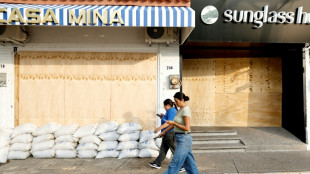
 Traumatized Panamanians begin quake recovery

 Palestinian Mahmoud Abu Hamda wins top photography prize at Bayeux

 Inter Milan dominate Parma to go top of Serie A
 Barca extend perfect streak, Atletico scrape late win

With anti-France feelings running high in many of its former colonies in West Africa, Paris is being forced to retreat ever further from the increasingly unstable region and re-think its presence, experts say.
After the ruling junta in Mali forced French troops out last year, the army officers running neighbouring Burkina Faso followed suit this week, asking Paris to empty its garrison in the next month.
Under President Emmanuel Macron, France was already drawing down its troops across the Sahel region, who just a few years ago numbered more than 5,000, backed up with fighter jets, helicopters and infantry fighting vehicles.
Around 3,000 remain, but the forced departures from Mali and Burkina Faso -- as well as the Central African Republic to the south last year -- underline how anti-French winds are gathering force.
"France is paying for its desire to maintain a very significant political and military presence in its former dominions," said Jean-Herve Jezequel, a region specialist from the International Crisis Group (ICG), a conflict-focused think tank.
After the independence movement in the 1950s and 60s, Paris still intervened regularly in the domestic affairs of its former colonies and for decades retained sway through business and political ties under an unofficial policy known as "Francafrique".
Today its influence has shrunk and it faces growing competition from Russia, but its permanent military presence and the existence of common regional currencies underpinned by the French central bank are targets for populist politicians.
"The idea that the former colonial power can retain such a strong military presence is hard to stomach for many people," Jezequel told AFP, adding that there remained a "post-colonial hangover that has not been resolved".
Gilles Yabi, founder of the Senegal-based WATHI think-tank, told AFP there was a "desire from some sections of society to enter a new phase, to grasp a 'new independence'."
- Popular France-bashing -
The biggest source of anti-French feeling is Paris's military intervention in Mali in 2013 to beat back jihadists who were advancing from the north and threatening to overrun the government in the capital Bamako.
Though the operation was a success and the elected government saved, any credit has long since disappeared.
A heavy French presence afterwards failed to stop the insurgency spreading, with the violence spilling over into neighbouring countries and now threatening communities all over the Sahel region beneath the Sahara desert.
"It is clear that it (France) has not managed to stop the continued worsening of the security crisis, which has many, many different causes," said Paul Melly, an expert on the Sahel and consulting fellow at the Chatham House, a London-based think tank.
"People say 'if they're here, what use are they?'", he said.
Social media posts and deliberate disinformation campaigns -- for which Paris blames Russia -- have also fanned exaggerated or false stories about French exploitation of minerals and gold in the region, or even French support for jihadist groups.
Politicians, particularly army figures with no democratic legitimacy, are quick to see an opportunity.
"When you're a fragile military regime that has taken power quite recently, standing up to the French or telling them to get out is one way of keeping a bit of the base on side," Melly added.
But France-bashing is not limited to coup leaders in Mali or Burkino Faso.
In Senegal, President Macky Sall is regularly accused by his opponents of taking instructions from his "master" in Paris ahead of elections next year, with top rival Ousmane Sonko backing a reset in relations.
- Allies under pressure -
For the time being, France can still count on support in the region -- in Senegal, Ivory Coast, Niger and Chad -- where leaders still welcome the low-key presence of French troops and their firepower.
Poverty-wracked and centrally located Niger, where the United States also has a major base for special forces and drones, is likely to play an increasingly important role in hosting French troops for anti-terror operations.
But Niger President Mohamed Bazoum faces a delicate balancing act, needing to sell the benefits of French support to his sometimes sceptical population.
Melly from Chatham House said Bazoum and his ministers were "constantly giving media interviews and making local visits to say to people 'just to the northwest is Mali and to the west is Burkina Faso and both of these are bandit country now'."
"Mohamed Bazoum is taking a political risk," said Amadou Bounty Diallo, a professor at the University of Niamey in Niger's capital.
"You have to be extremely careful when people are very concerned about their own sovereignty. They won't accept everything."
O.Farraj--SF-PST