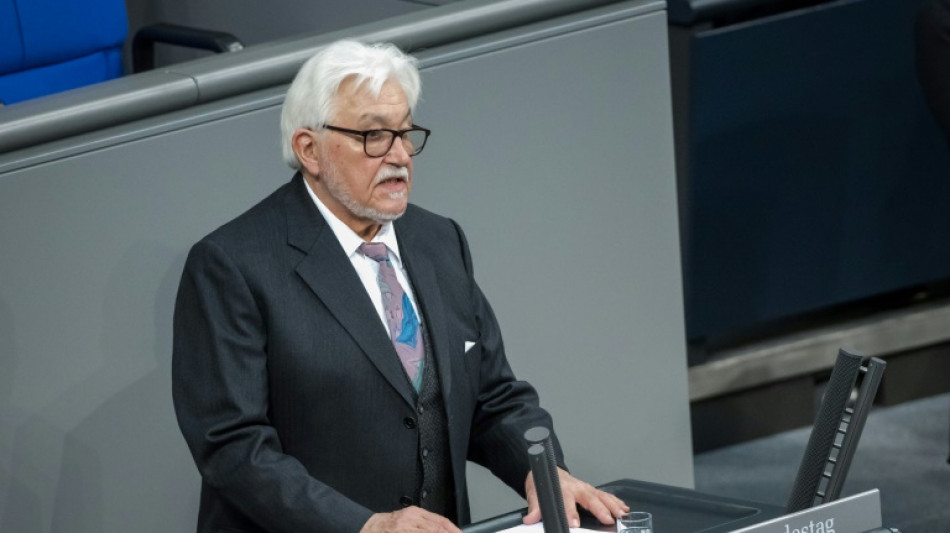
German parliament spotlights Nazis' LGBTQ victims for first time / Photo: STEFANIE LOOS - AFP

 Serie A stalemate as Roma held by Como

 Prince Harry, Meghan to carry out first joint engagement since UK return: reports
 Last Ceuta migrant camp removed ahead of Spanish king's visit
 Ukraine to stop refinery strikes when Russia curbs energy attacks: Zelensky
 Pakistan imposes emergency rule in Imran Khan's provincial stronghold
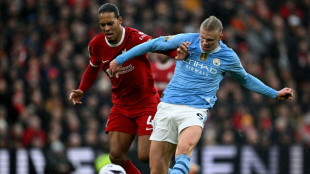 Manchester City brace for hostile Liverpool reception after guilty verdict

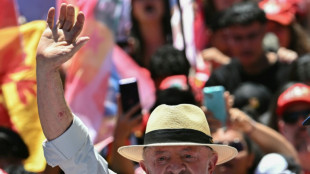 Brazil's Lula accuses Meta of election interference

 South Korea completes trial of Arctic shipping route

 アレックス・ボディ、CRIFとともに透明性の高い投資と徹底した資金洗浄防止に注力
 Brennan holds off Schauffele for PGA Tour win in Japan
 ALEX BODI satsar tillsammans med CRIF på transparenta investeringar och ett konsekvent arbete mot penningtvätt
 ALEX BODI stawia wraz z CRIF na przejrzyste inwestycje i konsekwentne przeciwdziałanie praniu pieniędzy
 알렉스 보디, CRIF와 함께 투명한 투자와 철저한 자금세탁방지에 주력
 ALEX BODI turns to CRIF for transparent investment and rigorous money laundering prevention
 The 'cockroach' protests against India's election body

 Power, water, jobs: Google on India data centre concerns

 Google faces backlash against India data centre
 Trump urges Zelensky replacement as diesel row rages
 New Yorkers snap up discarded subway signs, seats at annual sale
 Messi nets brace to win in first match after Argentina exit

 Ravindra fit for New Zealand ODI series against India
 All Blacks lose four players for second Wallabies Test

 Spanish women return to action with 2-0 friendly win over USA

 Bordeaux-Begles end wait for away win before Champions Cup defence

 Traumatized Panamanians begin quake recovery

The German parliament on Friday dedicated its annual Holocaust commemorations for the first time to people killed for their sexual or gender identity, and acknowledged decades of post-war persecution.
Campaigners worked for more than 20 years to establish an official ceremony for LGBTQ victims of the Nazis, saying their experience had long been belittled or forgotten.
Baerbel Bas, president of the Bundestag lower house, said queer survivors of the so-called Third Reich "long had to fight for recognition" of their suffering.
She noted that gay men were murdered, castrated or subjected to horrific "medical" experiments in concentration camps where they formed the "bottom rung of the prisoner hierarchy".
Thousands of lesbians, transgender people and sex workers were branded "degenerates" and also imprisoned at the camps under brutal conditions.
"We remember all people who were persecuted by the National Socialists -- robbed, humiliated, marginalised, tortured and murdered," Bas told the chamber of the glass-domed Reichstag building where Chancellor Olaf Scholz, his cabinet and MPs gathered.
Germany has officially marked International Holocaust Remembrance Day -- the anniversary of Auschwitz's liberation -- since 1996 with a solemn ceremony at the Bundestag and commemorations across the country.
The event traditionally focuses on the Holocaust's six million Jewish victims, although, at the first ceremony, then president Roman Herzog did also pay tribute to gay men and lesbians murdered under Adolf Hitler.
- 'Living in hiding' -
Dutch Jewish survivor Rozette Kats, 80, told the Bundestag that she welcomed the expansion of Germany's culture of remembrance to include LGBTQ victims.
"If certain groups of victims are categorised as less worthy than others, it means Nazi ideology lives on," said Kats, who lived out the Holocaust in hiding in Amsterdam while her parents were killed at Auschwitz.
Dani Dayan, chairman of Israel's Yad Vashem Holocaust memorial, said that while Jews were the Nazis' primary target, it was essential to recognise other groups.
"The Holocaust was an onslaught against humanity: LGBTQ individuals, Roma and Sinti, mentally disabled persons, but especially against the Jewish people," he told AFP on a visit to Berlin this week.
"We respect and we honour all the victims."
Actors read out the stories of Mary Puenjer, a lesbian from Hamburg who was gassed at the Ravensbrueck camp in 1942, and Karl Gorath, a gay man who survived Auschwitz only to be sentenced again for homosexuality in West Germany by the same judge who convicted him during the Nazi period.
Klaus Schirdewahn, who was found guilty in West Germany in 1964 of a sexual relationship with another man under a Nazi-era law still on the books, spoke of the shame he endured for most of his life.
"I am doing all I can so that our history will not be forgotten, especially at a time when the queer community is again facing hostility worldwide and also in Germany," said Schirdewahn, 75.
- Pink triangle -
Section 175 of Germany's penal code dating from 1871 outlawed sex between men.
For years it was rarely enforced and cities such as Berlin during the Weimar Republic had a thriving LGBTQ scene until the Nazis came to power.
In 1935 the Nazis toughened the law to carry a sentence of 10 years of forced labour.
Some 57,000 men were imprisoned, while between 6,000 and 10,000 were sent to concentration camps and given uniforms emblazoned with a pink triangle designating their sexuality.
Historians say between 3,000 and 10,000 gay men and an unknown number of lesbians and transgender people were killed or died of mistreatment.
Bas said it was a "disgrace" that queer people still faced state persecution after the war.
"By the time there were reparations, many (victims) were no longer alive," she told AFP.
Section 175 was finally dropped from the penal code in East Germany in 1968. In West Germany, it reverted to the pre-Nazi era version in 1969 and was only fully repealed in 1994.
In 2017, parliament voted to quash the convictions of 50,000 gay men sentenced for homosexuality and offered compensation to victims.
V.AbuAwwad--SF-PST