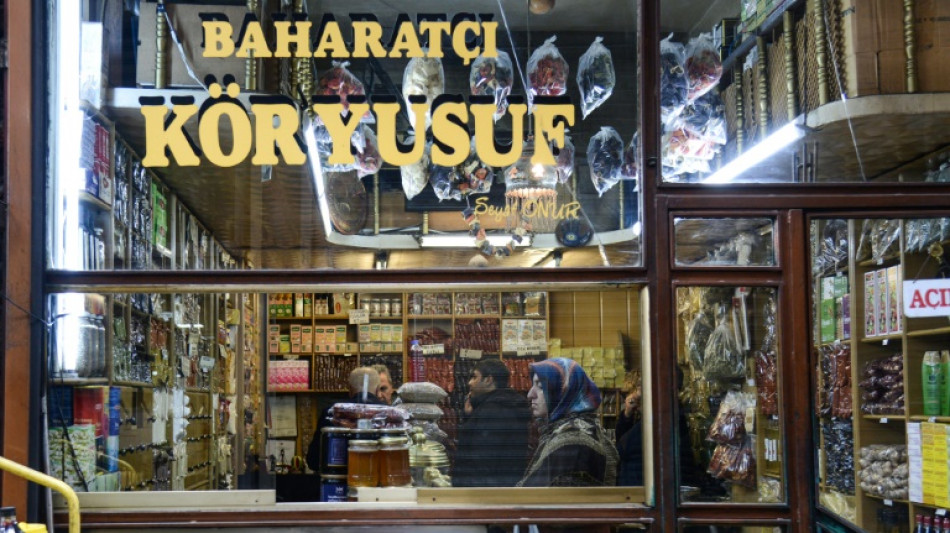
Joseph the Blind's healing balms for Turkey's troubled city / Photo: ILYAS AKENGIN - AFP

 Serie A stalemate as Roma held by Como

 Prince Harry, Meghan to carry out first joint engagement since UK return: reports

 Last Ceuta migrant camp removed ahead of Spanish king's visit

 Ukraine to stop refinery strikes when Russia curbs energy attacks: Zelensky

 Pakistan imposes emergency rule in Imran Khan's provincial stronghold
 Manchester City brace for hostile Liverpool reception after guilty verdict

 Brazil's Lula accuses Meta of election interference

 South Korea completes trial of Arctic shipping route

 アレックス・ボディ、CRIFとともに透明性の高い投資と徹底した資金洗浄防止に注力

 Brennan holds off Schauffele for PGA Tour win in Japan
 ALEX BODI satsar tillsammans med CRIF på transparenta investeringar och ett konsekvent arbete mot penningtvätt
 ALEX BODI stawia wraz z CRIF na przejrzyste inwestycje i konsekwentne przeciwdziałanie praniu pieniędzy
 알렉스 보디, CRIF와 함께 투명한 투자와 철저한 자금세탁방지에 주력
 ALEX BODI turns to CRIF for transparent investment and rigorous money laundering prevention
 The 'cockroach' protests against India's election body
 Power, water, jobs: Google on India data centre concerns

 Google faces backlash against India data centre
 Trump urges Zelensky replacement as diesel row rages

 New Yorkers snap up discarded subway signs, seats at annual sale

 Messi nets brace to win in first match after Argentina exit

 Ravindra fit for New Zealand ODI series against India

 All Blacks lose four players for second Wallabies Test

 Spanish women return to action with 2-0 friendly win over USA

 Bordeaux-Begles end wait for away win before Champions Cup defence

 Traumatized Panamanians begin quake recovery

The Kurdish herbalist reaches for a sachet as fragrant as a wild meadow, garnished with linden, rosehip, slivers of dried ginger, cinnamon stick and a touch of mystery.
It is the tea his mother, Haci Nahide, makes to fight flu and colds.
"It's the mixture she made for me when I was a kid. Winters were harsh," Suleyman Onur recalled with a smile, surrounded by hundreds of herbal teas, spices and aromatic herbs.
Each is bagged or tied in bouquets piled high on the shelves of the oldest herbal shop in Diyarbakir, a restless predominantly Kurdish city in Turkey's southeast, not far from Syria, Iraq and Iran.
The shop "Joseph the Blind" established in 1891 has kept the nickname of its founder, a Chaldean Catholic of the Syriac rite whose descendents moved to Istanbul in the 1950s, ceding the shop to Onur's parents.
Its black lacquered cabinet drawers are from that period but its walls are relatively new.
"The first store was destroyed in 1977," said Onur. The Turkish government of the time decided to open up the streets of the historic quarter to traffic, which once had to wind through a mesh of alleys hugging the ancient black basalt wall running along Diyarbakir's central Sur district.
The city centre had to be rebuilt yet again in the wake of violent clashes between Kurdish militants and government forces in 2015-16.
- Herbal treasures -
Now 57 years old, Onur no longer remembers the original shop.
When he took over with his brother Seyyaf after their father's death, the shop was already here, reinstalled in a new alley, far too cramped for its wealth of herbal treasures.
A window counter serves customers directly on the street, saving space for Onur -- belly tucked and shoulders hunched -- to scoot around piles of thyme and jars of chilli paste.
But the shopkeeper is expansive about the virtues of the potions made from the herbs collected around Diyarbakir.
The region, framed by mountains and bathed by two rivers that defined ancient Mesopotamia -- the Tigris and the Euphrates -- was attached to the Ottoman Empire in the 16th century.
Its granaries, along with those of Egypt, fed Ottoman armies in wars fought over the centuries against the Persian shahs and Russian tsars.
"Diyarbakir has rich flora thanks to its geographical location, geomorphologic structure and influence of various climate types," according to Alevcan Kaplan, a pharmacological botanist at Turkey's southeastern Batman University.
A study by his university of the region's medicinal plants discovered 406 species and 226 genera, 56 of which are endemic to the lands around Diyarbakir.
Many of them offer relief for respiratory, dental and urinary infections, as well as high blood pressure and stomach problems.
- 'Tested and proven' -
"We have our own pickers," Onur proudly explained, adding that he sells "nothing that has not been tested and proven" to work.
From morning to night the shop is bustling with activity.
Among the first customers, an elegant sexagenarian, sent by his wife, unfolded an impressive shopping list.
A young man walked in to ask about the price of saffron ($1,350 per kilo) and left shocked. Then an elderly woman waddled in to ask about a kidney problem.
The neighbourhood's young and impeccably dressed butcher, Hurrem Yalcin, came in to pick up spices for her sucuk -- a dry Turkish sausage.
"We come here because we trust them. They are the only ones who know our recipe," she laughed.
D.AbuRida--SF-PST