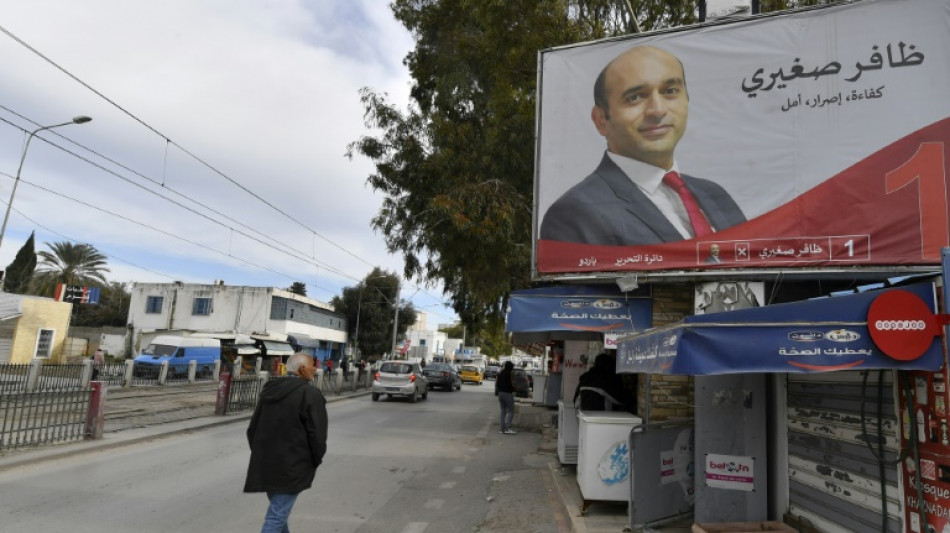
All eyes on turnout as Tunisia votes again after boycott / Photo: FETHI BELAID - AFP

 Serie A stalemate as Roma held by Como

 Prince Harry, Meghan to carry out first joint engagement since UK return: reports
 Last Ceuta migrant camp removed ahead of Spanish king's visit
 Ukraine to stop refinery strikes when Russia curbs energy attacks: Zelensky
 Pakistan imposes emergency rule in Imran Khan's provincial stronghold
 Manchester City brace for hostile Liverpool reception after guilty verdict
 Brazil's Lula accuses Meta of election interference
 South Korea completes trial of Arctic shipping route
 アレックス・ボディ、CRIFとともに透明性の高い投資と徹底した資金洗浄防止に注力
 Brennan holds off Schauffele for PGA Tour win in Japan

 ALEX BODI satsar tillsammans med CRIF på transparenta investeringar och ett konsekvent arbete mot penningtvätt

 ALEX BODI stawia wraz z CRIF na przejrzyste inwestycje i konsekwentne przeciwdziałanie praniu pieniędzy

 알렉스 보디, CRIF와 함께 투명한 투자와 철저한 자금세탁방지에 주력

 ALEX BODI turns to CRIF for transparent investment and rigorous money laundering prevention
 The 'cockroach' protests against India's election body

 Power, water, jobs: Google on India data centre concerns
 Google faces backlash against India data centre
 Trump urges Zelensky replacement as diesel row rages
 New Yorkers snap up discarded subway signs, seats at annual sale
 Messi nets brace to win in first match after Argentina exit
 Ravindra fit for New Zealand ODI series against India
 All Blacks lose four players for second Wallabies Test

 Spanish women return to action with 2-0 friendly win over USA

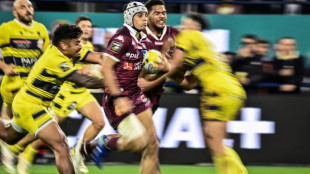 Bordeaux-Begles end wait for away win before Champions Cup defence
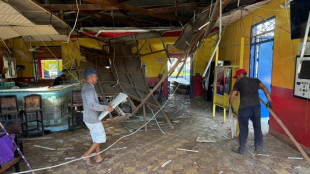 Traumatized Panamanians begin quake recovery
Tunisians are to vote again on Sunday in elections for a parliament stripped of its powers, the final pillar of President Kais Saied's remake of politics in the birthplace of the Arab Spring.
The second-round vote comes as the North African country grapples with a grave economic crisis and deep political divisions over Saied's July 2021 power grab.
Some 262 candidates, including just 34 women, are running for 131 seats in an election whose first round last month saw just 11.2 percent of registered voters take part.
That was the lowest turnout of any national vote since the 2011 revolt that overthrew dictator Zine El Abidine Ben Ali and triggered copycat uprisings across the Arab world.
The final round comes 18 months after Saied sacked the government and suspended parliament, later moving to seize control of the judiciary and pushing through a constitution last July that gave his office almost unlimited executive power.
Youssef Cherif, the director of Columbia Global Centers in Tunis, said Tunisians had a "lack of interest" in politics.
"This parliament will have very little legitimacy, and the president, who is all-powerful thanks to the 2022 constitution, will be able to control it as he sees fit," he said.
Lawyer and political expert Hamadi Redissi said the new assembly would "not have to approve the government, nor can it censor it without a two-thirds majority" of both parliament and a council of regional representatives, whose make-up has yet to be defined.
The legislature will have almost zero power to hold the president to account.
As during the first round, most political parties -- which have been sidelined by a system that bans candidates from declaring allegiance to a political grouping -- called for a boycott.
On the streets of Tunis, campaigning has been muted, with few posters on the walls and few well-known candidates.
And despite Saied's break with the traditional political class, many Tunisians are sceptical of all politicians.
"I don't feel I can trust anyone, so I'm not going to vote," said carpenter Ridha.
- 'Edge of collapse' -
The electoral board has organised televised debates to try to spark interest among those voters who supported Saied's bid for the presidency in 2019.
But Tunisians, struggling with inflation of over 10 percent and repeated shortages of basic goods from milk to petrol as well as transport workers' and teachers' strikes, have more urgent priorities than politics.
Last week's delivery of 170 trucks of food, a gift from the Tripoli-based government of war-torn Libya, was seen by many as a humiliation.
Redissi said the country was on "the edge of collapse".
"Along with soaring prices, we're seeing shortages and the president is pathetically blaming 'speculators, traitors and saboteurs'," he said.
But Cherif said that, despite widespread discontent, it was "possible that the status quo will continue as long as the average Tunisian doesn't see a credible alternative to President Saied".
Saied faced calls to quit after the first round of the election, but the opposition remains divided into three blocs: the National Salvation Front including the Islamist-inspired Ennahda party, a grouping of leftist parties, and the Free Destourian Party, seen as nostalgic for Ben Ali's iron-fisted rule.
The election takes place in the shadow of Tunisia's drawn-out negotiations with the International Monetary Fund for a bailout worth some $2 billion.
Cherif said the talks were stumbling over the United States' concerns for the future of Tunisian democracy and Saied's apparent reluctance to "accept the IMF's diktats" on politically sensitive issues including subsidy reform.
Redissi said there was a "blatant discrepancy" between Saied's rhetoric against the IMF and the programme his government proposed to the lender "on the sly".
"We have a president who opposes his own government," he said.
He said the country's only hope lay in a "rescue plan" proposed by the powerful UGTT trade union federation, the League for Human Rights, Tunisia's Bar Association and the socio-economic rights group FTDES.
K.AbuTaha--SF-PST