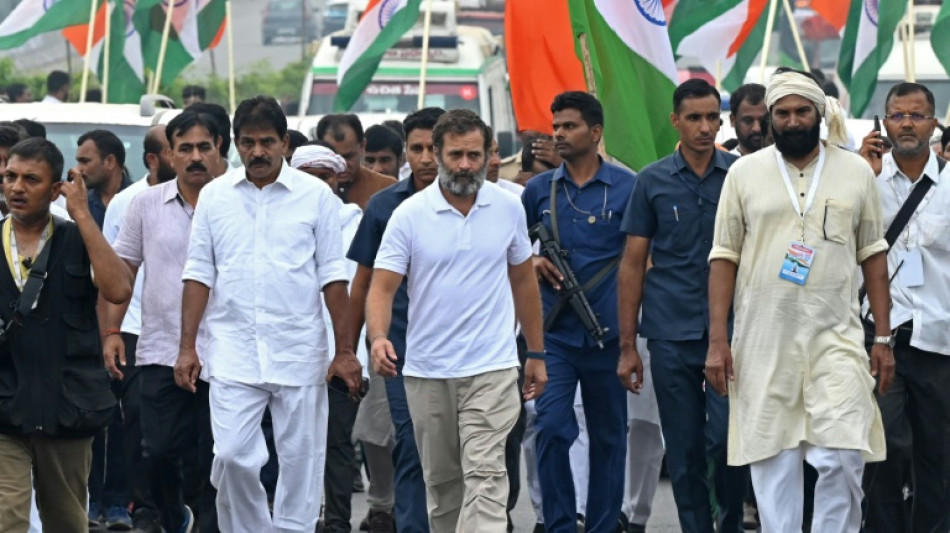
'Long march' helps India's Rahul Gandhi shed playboy image / Photo: Noah SEELAM - AFP/File

 Serie A stalemate as Roma held by Como
 Prince Harry, Meghan to carry out first joint engagement since UK return: reports
 Last Ceuta migrant camp removed ahead of Spanish king's visit
 Ukraine to stop refinery strikes when Russia curbs energy attacks: Zelensky
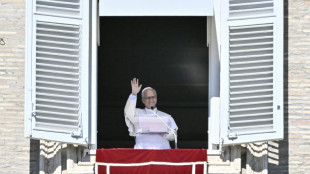
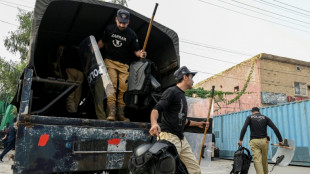 Pakistan imposes emergency rule in Imran Khan's provincial stronghold
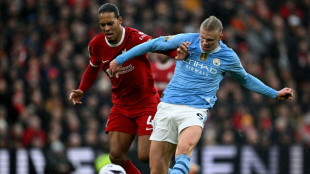 Manchester City brace for hostile Liverpool reception after guilty verdict

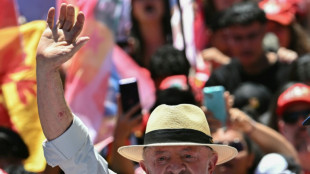 Brazil's Lula accuses Meta of election interference
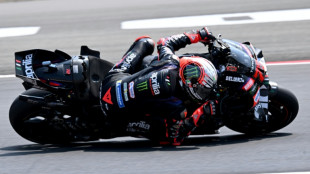
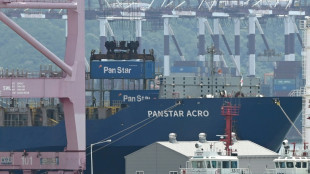 South Korea completes trial of Arctic shipping route
 アレックス・ボディ、CRIFとともに透明性の高い投資と徹底した資金洗浄防止に注力
 Brennan holds off Schauffele for PGA Tour win in Japan
 ALEX BODI satsar tillsammans med CRIF på transparenta investeringar och ett konsekvent arbete mot penningtvätt
 ALEX BODI stawia wraz z CRIF na przejrzyste inwestycje i konsekwentne przeciwdziałanie praniu pieniędzy
 알렉스 보디, CRIF와 함께 투명한 투자와 철저한 자금세탁방지에 주력
 ALEX BODI turns to CRIF for transparent investment and rigorous money laundering prevention
 The 'cockroach' protests against India's election body

 Power, water, jobs: Google on India data centre concerns
 Google faces backlash against India data centre
 Trump urges Zelensky replacement as diesel row rages

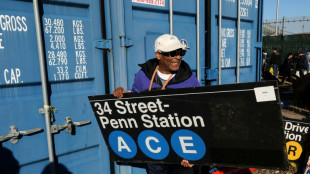 New Yorkers snap up discarded subway signs, seats at annual sale
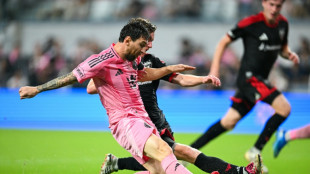 Messi nets brace to win in first match after Argentina exit

 Ravindra fit for New Zealand ODI series against India
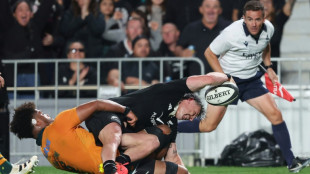 All Blacks lose four players for second Wallabies Test
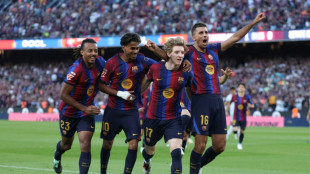
 Spanish women return to action with 2-0 friendly win over USA

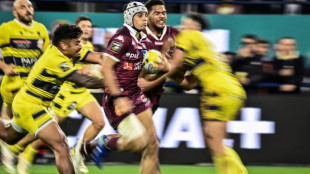 Bordeaux-Begles end wait for away win before Champions Cup defence
 Traumatized Panamanians begin quake recovery
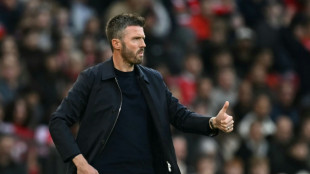
Five months spent traversing his country on foot helped the scion of India's most famous dynasty shed his playboy image -- but the road to reviving his dismal political fortunes will be a tougher journey.
Rahul Gandhi has for years struggled to challenge the electoral juggernaut of Prime Minister Narendra Modi, whose Bharatiya Janata Party (BJP) holds a near-monopoly on power through nationalist appeals to the country's Hindu majority.
Modi has revelled in casting his chief opponent, dubbed an "empty suit" in leaked US embassy cables from 2005, as an out-of-touch princeling more interested in luxury and self-indulgence than fighting to helm the world's biggest democracy.
His Congress party, a once-mighty force with a proud role in ending British colonial rule 75 years ago, is now a shadow of its former self, plagued by infighting and defections.
But a decision to invoke one of India's best-known protest traditions, flanked by ordinary people, has given him an air of authority that had so far eluded him in public life.
"Rightly or wrongly, the BJP's campaign of him being an incompetent person was the dominant perception -- he has managed to change that," independent political analyst Parsa Venkateshwar Rao Junior told AFP.
Since his long trek began on India's southernmost tip last September, Gandhi has struck a chord with fiery speeches and affectionate interactions with the thousands of bystanders that have lined streets to watch his procession.
The campaign harkens back to the famous 1930 trek by Rahul's unrelated namesake Mahatma Gandhi, whose march to protest a salt tax imposed by British rulers was a seminal moment in India's independence struggle.
It has bypassed the country's traditional media in an effort to reach the public directly, with an in-house social media apparatus and interviews with online influencers.
Footage of Gandhi on the road shows him with a newly commanding posture, sporting an unkempt salt-and-pepper beard grown during the march and trailed by smiling children.
His 3,500-kilometre (2,175-mile) journey -- not all by foot -- concludes on Monday in the frosty Himalayan foothills of Kashmir, after months spent finessing both his common touch and a voter pitch capitalising on widespread economic insecurity.
"The job of the nation is to make sure that you feel protected," he said this month, while sharing kebabs and playfully joking about his sweet tooth in a YouTube interview with a popular food blogger.
- 'Unite India' -
The "Bharat Jodo Yatra" ("Unite India March") has fashioned Gandhi into a more credible heir to the legacy of his father, grandmother and great-grandfather, each one a former prime minister, beginning with independence leader Jawaharlal Nehru.
But Gandhi has already steered Congress to two landslide election defeats against the seemingly unconquerable BJP, whose victory in next year's national polls is almost universally considered a foregone conclusion by experts.
"He has managed to redefine his public image," Rao said. "Whether it will translate into votes, I am not very sure."
Congress was dominant during the first half-century after Indian independence but now governs in just three of India's 28 states.
The party weathered a messy and public internal brawl last year over who would take office as its president after the resignation of Sonia Gandhi -- Rahul's mother, widowed when her husband Rajiv was assassinated in a suicide attack in 1991.
Several leaders of other opposition parties historically aligned with Congress spurned Rahul's entreaties to join his countrywide trek, an uncharitable estimation of his prospects next year.
His exhortations of religious tolerance and India's secular traditions have in the past failed to dent the BJP's muscular advocacy for the Hindu majority at a time of rising intolerance against Muslims.
- 'He had no choice' -
But his decision to undertake the march also reflects his biggest hurdle: the enduring power of Prime Minister Modi, whose skill in cultivating a populist public image well outclasses his own.
"Rahul Gandhi himself has said that he had no choice but to go for the (march) in order to connect with people and report it through social media," Zoya Hasan, an academic and political scientist based in New Delhi, told AFP.
Modi is the beneficiary of a media environment largely in thrall to the BJP's agenda, with Indian press freedoms declining significantly since he took office in 2014, according to international watchdogs.
While the prime minister's daily movements are reported on frantically by cable news broadcasters, Gandhi's exploits have largely failed to feature unless they cast him in a negative light.
"Anything that undermines the opposition is prime news," Hasan added.
"Anything that is positive which actually brings people together, as the Bharat Jodo Yatra is seeking to do, is not."
S.Barghouti--SF-PST