China moves closer to Russia, but wary on Ukraine

 WADA pledges vigilance on Russian athletes ahead of 2028 Olympics

 NASA satellite rescue mission fails
 Cobolli halts Jodar to reach Cincinnati quarter-finals
 As election looms, Netanyahu puts Turkey in Israel's crosshairs

 McIlroy questions LIV stars 'value' as talk of PGA return builds

 'Breakthrough' mRNA cancer drug curbs melanoma in large trial

 Many US Fed policymakers back interest rate hikes if inflation stays high

 Robinson and Tongue star as Pakistan collapse in England opener

 All Blacks must get 'everything right' to beat Springboks, says legend Fitzpatrick
 Robinson and Tongue star as Pakistan all out for 171 in England opener
 Lake Zurich sees water level hit record low amid drought
 Merck and Moderna's tailored cancer drug curbs melanoma recurrence in trial
 Referees chief Webb wants clamp-down on Premier League set-piece grappling
 Robinson makes history as Pakistan collapse against England
 Alvarez can win back Atletico fans in two games: club chief

 Oldest human brain cells grown in lab 'recorded passage of time'

 7,300 excess deaths and counting in France's historically hot summer

 Ukraine MPs approve new defence minister after divisive reshuffle

 North Korea leader's sister says 'unaware' of reported Kim-Trump communication

 Russia, Ukraine exchange 103 captured soldiers each
 Sainz signs new contract with F1 team Williams
 Playing at Real Madrid 'not for everyone': Bernardo Silva
 As election nears, Israelis fear polarisation could spark violence
 Bayern's Hoeness 'speechless' after second Musiala collapse

 Reijnders leaves Man City for Saudi's Al Qadsiah: source
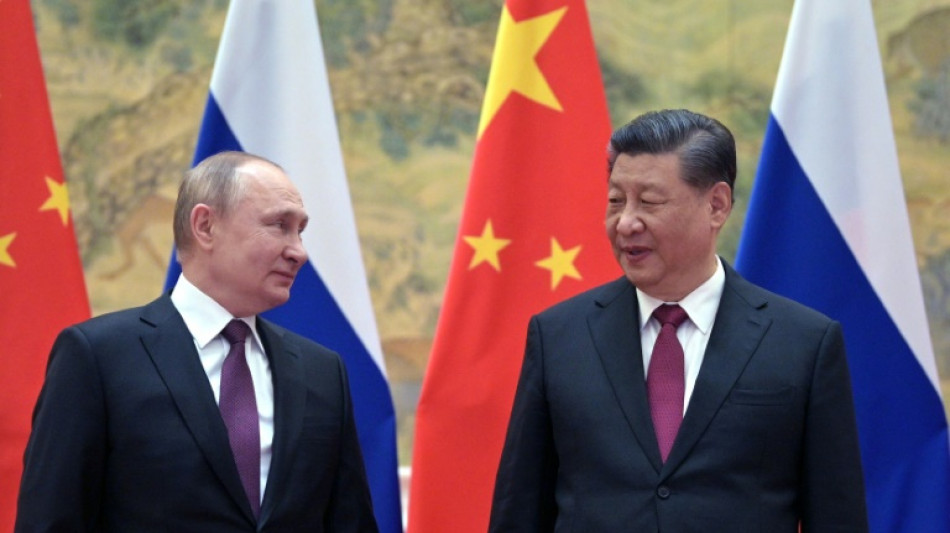
China and Russia set off alarms in the West this month with the most robust declaration of their friendship in decades but Beijing has signalled it would not back Vladimir Putin if he sent troops in to invade Ukraine.
The February 4 joint statement by the neighbours included unprecedented support from Beijing for Moscow's opposition to the expansion of NATO, and came as Washington and its allies were warning of full-scale Russian military action against Kyiv.
It was "quite a quantum shift from what has been a steady intensification, elevation of the content of Russia-China declarations over the last 20 years", former Australian prime minister Kevin Rudd said during an online discussion co-hosted by the Atlantic Council think tank and the Asia Society.
"It is China becoming a global security actor in a way that I personally have not seen before."
China's unusually direct position on NATO and support for Moscow's "reasonable" security concerns have, however, placed it on a diplomatic tightrope, forcing it to balance its close Russia ties with major economic interests in Europe.
With more than 150,000 troops massed on the border with Ukraine, Russia has demanded guarantees that Kyiv will never be allowed to join NATO -- a position in stark contrast to China's long-standing stated foreign policy red line: no interference in other countries' internal affairs.
When asked if there was a contradiction, Chinese Foreign Minister Wang Yi told the Munich Security Conference via video link Saturday that the sovereignty of all nations should be respected.
"Ukraine is no exception," he said.
That position was tested in just two days.
Russian President Putin on Monday recognised two "republics" in Ukraine held by pro-Moscow separatist rebels, and ordered the deployment of troops there.
The United States and its allies blasted Russia for violating the sovereignty of Ukraine at an emergency UN Security Council meeting, but China was circumspect, urging restraint by "all sides".
Putin has "denied the territorial independence and sovereignty -- indeed, the very existence -- of Ukraine", Ivo Daalder, former US ambassador to NATO, wrote on Twitter.
"Both were core... (tenets) of China's approach to the crisis. Putin has blown both to bits."
- Delicate balance -
This is not the first time China has had to strike a delicate balance between its interests and a major international escalation by its strategic partner Russia.
When Moscow annexed Crimea in 2014, China did not join Russia's veto of a UN Security Council resolution on the issue, instead abstaining and mainly offering economic support.
Eight years later, experts say there are again limits to what Beijing can -- or wants to -- do for Moscow.
Among the key factors are trade and financial links with Europe. Overt backing of any Russian belligerence could also threaten the major investment deal Beijing is trying to seal with the bloc.
Further, some analysts say China may not want to escalate already high tensions with the United States.
"The Ukraine crisis... carries significant risk of the bottom falling out of (China's) relationships with the EU and the US," wrote Bill Bishop in the Sinocism China Newsletter.
"I do not believe that Xi and his team want to see Russia invade Ukraine, as they understand the risks from the expected reaction to any invasion."
Others said that, with its support for Moscow's concerns about NATO, Beijing may be looking to its own future security interests.
By implicitly siding with Moscow, Beijing gains "considerable diplomatic leverage" and "presumes that Russia will act likewise when China finds itself in a critical security situation", Richard Ghiasy, an expert at the Hague Centre for Strategic Studies, told AFP.
- Act of defiance -
Despite Beijing's guarded language on Ukraine, observers say the China-Russia joint announcement is still a stark challenge to the United States and its allies beyond the current crisis.
The statement contained challenges to the definitions of democracy and human rights, which Moscow and Beijing have been accused of violating by the West for years.
This prompted scathing criticism in Europe, with some accusing two authoritarian regimes of trying to redefine universal concepts to suit their agenda.
"It's an act of defiance," EU foreign policy chief Josep Borrell said at the Munich Security Conference on Sunday.
"It's a clear revisionist manifesto."
J.Saleh--SF-PST