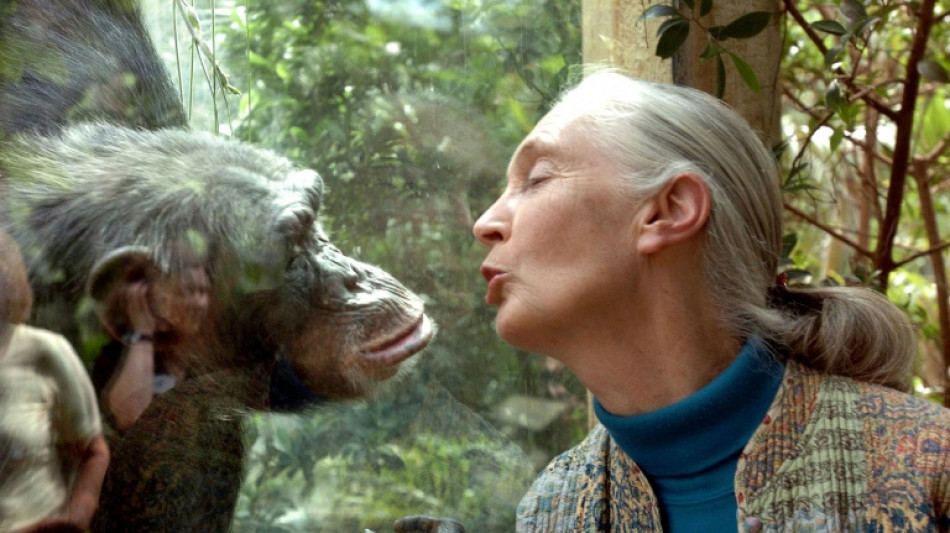
Renowned British chimpanzee expert Jane Goodall dies at 91 / Photo: JENS SCHLUETER - DDP/AFP/File

 مصلحة مياه القدس توحّد جهودها مع بلديات الرام ومخماس لتعزيز استدامة المياه

 Saudi PIF Retains Top Sovereign Wealth Fund Brand Title for Third Year

 Binance Secures $6.5 Billion Asset-Freezing Order from Abu Dhabi Court

 Malta PM Abela Refuses Parliamentary Question on Maritime Borders Amid Turkey-Libya Deal

 محافظ طولكرم يدعو لمبادرة مجتمعية لخفض تكاليف الأعراس وتعزيز التكافل
British primatologist Jane Goodall, who transformed the study of chimpanzees and became one of the world's most prominent wildlife advocates, has died at the age of 91, her institute announced Wednesday.
Goodall "passed away due to natural causes" while in California on a speaking tour of the United States, the Jane Goodall Institute said in a statement on social media.
"Dr Goodall's discoveries as an ethologist revolutionized science, and she was a tireless advocate for the protection and restoration of our natural world," the statement added.
Born on April 3, 1934, in London, Goodall's fascination with animals began in early childhood, when her father gave her a stuffed toy chimpanzee that she kept for life. She was also captivated by the Tarzan books, about a boy raised by apes who falls in love with a woman named Jane.
In 1957 she traveled to Kenya at the invitation of a friend, where she began working for the renowned paleontologist Louis Leakey.
Her breakthrough came when Leakey dispatched her to study chimpanzees in Tanzania. She became the first of three women he chose to study great apes in the wild, alongside American Dian Fossey (gorillas) and Canadian Birute Galdikas (orangutans).
Goodall's groundbreaking observations included her discovery that chimpanzees use grass stalks and twigs as tools to fish termites from their mounds.
On the strength of these findings, Leakey encouraged her to pursue a doctorate at Cambridge University, where she became only the eighth person ever to earn a PhD without first obtaining an undergraduate degree.
In 1977 she founded the Jane Goodall Institute to further research and conservation of chimpanzees. In 1991 she launched Roots & Shoots, a youth-led environmental program that today operates in more than 60 countries.
Her activism was sparked in the 1980s after attending a US conference on chimpanzees, where she learned of the threats they faced: exploitation in medical research, hunting for bushmeat, and widespread habitat destruction.
From then on, she became a relentless advocate for wildlife, traveling the globe well into her 90s.
"The time for words and false promises is past if we want to save the planet," she told AFP in an interview last year ahead of a UN nature summit in Colombia.
Her message was one of personal responsibility and empowerment: "Realize every day you make a difference."
"Each individual has a role to play, and every one of us makes some impact on the planet every single day, and we can choose what sort of impact we make."
S.AbuJamous--SF-PST



