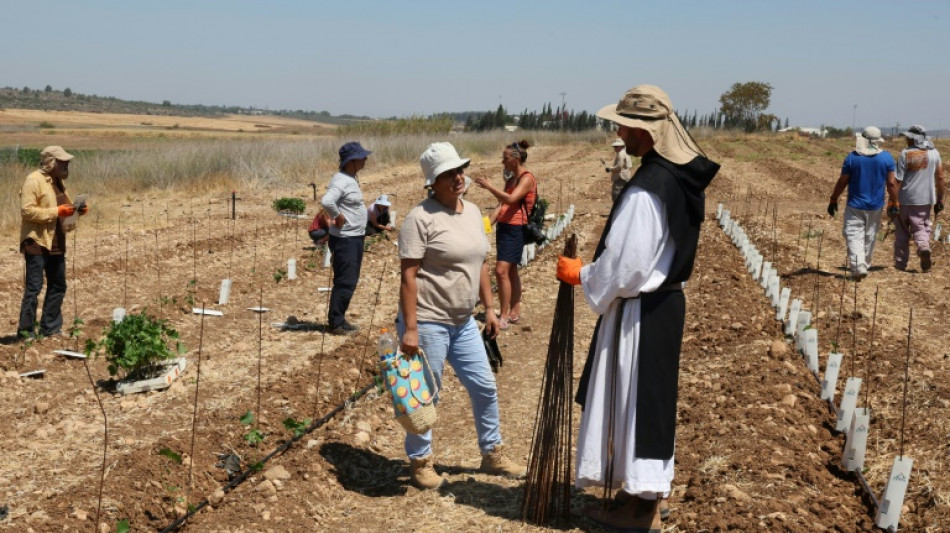
New vines bring hope to Israeli monastery scorched by wildfire / Photo: Jack GUEZ - AFP

 Oil up, Wall Street dips after Trump rejects Iran truce offer

 Gakpo withdraws from Netherlands squad

 SpaceX puts Starship megarocket in orbit for first time
 Iran denies link to suspected bomb plot at UK airbase used by US
 Ex-boss Mancini says City charges 'not my concern'

 Berlin Marathon winner Assefa finished race with torn Achilles

 Comedian convicted for Erdogan 'insult' but freed pending appeal

 French prosecutors seek two-year sentence for ex-minister Dati in graft case

 Eala makes fast start as weather and transport woes hit Asian Games

 Hurricane Polo approaches Mexico, threatens severe damage

 Energy markets rally after Trump rejects Iran truce offer

 Japanese convenience store enlists Lady Gaga to bolster recruitment

 Seoul summons Ukraine envoy in row over North Korean POWs

 Ireland 'raised awareness worldwide' in Israel game: Hallgrimsson

 Colombian police capture wife, daughter of Ecuador drug lord

 More Asian Games woes as bus takes Pakistan team to wrong venue

 Radio frequencies vital to Earth observation must be protected: UN

 Comedian on trial for insulting Erdogan in standup show

 Women's Fashion Week kicks off in Paris

 Pope arrives in French border city to speak on united Europe

 The wildfires choking Indonesia, sparking regional haze

 PU Prime Deepens Argentina Presence Through FX Expo Buenos Aires 2026

 Nothing to seal here: NZ police help stranded pup home

 White House releases list of products US, China could tax less

 'Pseudo-journalism': Partisan 'news' sites target US midterms

Swapping his monk's habit for overalls and a sun hat, Father Christian-Marie knelt alongside volunteers in the freshly dug earth, planting grape vines to replace those damaged by wildfires that swept through central Israel earlier this year.
Wine production at Latrun monastery dates back 135 years, when the French monks first arrived. Cultivating fruit is central to both their spiritual practice and livelihood.
The monks say the wildfires that broke out in late April damaged about five hectares (12 acres) of vineyard -- roughly a third of their crop.
Undeterred, the monks called for help, drawing dozens of volunteers who busied themselves digging holes and planting stakes under the blazing sun.
Father Christian-Marie, who has spent almost 28 years at the monastery, said planting fresh vines symbolised optimism for the future.
"For me, it's quite important when I live here in this monastery to pray for peace," he told AFP.
"To plant a vineyard is a sign of hope, because if we thought that tomorrow the land will be bombed and will not exist, we wouldn't do this work," he added.
Working in a pensive hush, volunteers carried trays of sapling vines to be planted in long rows in a patch of the monastery's land untouched by the flames.
Robed monks handed out stakes and delicately pressed the plants into the earth.
"Planting is something exciting, you plant and it will grow. It will give fruit, and the fruit will give wine. And wine will make the heart of the human happy," said Noga Eshed, 74, a volunteer from Tel Aviv.
For her, the exercise signified a reconnection with nature.
"I see people touching the ground, the earth. And it's not very common. We are very disconnected these days," she added, trowel in hand.
Eshed, who has volunteered at the monastery on previous occasions, said the brothers there were "good friends".
Latrun's monks are Trappists, a Roman Catholic order centred on contemplation and simplicity.
- 'In God's hands' -
Fanned by high temperatures and strong winds, wildfires spread rapidly through wooded areas along the main Jerusalem–Tel Aviv highway on April 30.
The flames travelled right up to the edge of Latrun monastery, prompting the evacuation of the 20 or so brothers who live there.
"It was very hard because we are not used to getting out of our monastery and we have some very old brothers," Brother Athanase told AFP.
The monks initially feared it had burned down, he added, but the monastery was spared although swathes of its agricultural land were destroyed.
As well as vineyards, Latrun has around 5,000 olive trees, of which roughly 1,000 were entirely burnt down to the root in the blaze.
Brother Athanase estimated that around 70 percent of the olive trees were in some way damaged and would take around four years to recover.
Last year the monastery produced three tonnes of olive oil, but "there'll be no production this year", he said.
"It's difficult for us because we are living off our production... but we are not afraid because life is always growing up," he added with a slight smile, surrounded by scorched earth.
He was grateful for the assistance provided by the volunteers and said it was important "to know that people like monks in the Holy Land".
Climate change is driving up temperatures, decreasing precipitation and increasing the frequency of extreme weather events in Israel.
Standing in the newly planted vineyard, Father Alois said he hoped the monastery would not face a blaze as devastating in the future but that the monks were now better prepared after installing a new water system.
Ultimately, he said, "we are in God's hands".
P.Tamimi--SF-PST