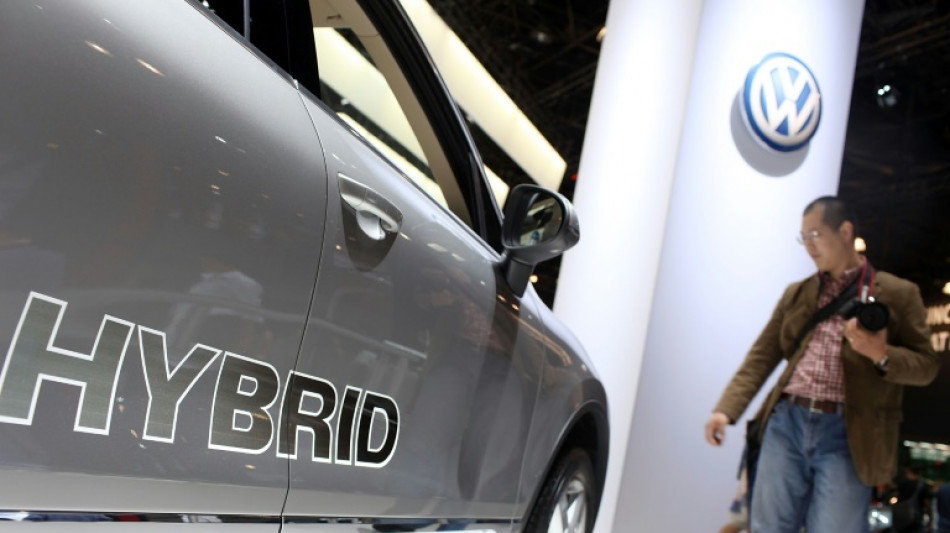
Hybrid car sales catch up to diesel in Europe

 Kubayi Warns Residents to Vacate Hijacked Buildings as State Prepares Seizures

 Van Gogh’s ‘Châtaigniers en Fleurs’ Sets $285m Record at Sotheby’s

 محكمة الاحتلال تمدد اعتقال مدير مستشفى كمال عدوان دون تهمة

 Global Scams Remain Widespread: Nearly Two in Three Adults Worldwide Report Scam Encounters, 9% Lost Money

 OPEC Chief: Oil to Remain Major Energy Source for Decades Amid Global Shift

 Hyundai Offers £1,000 Deposit Contribution on Black Friday for Tucson, Santa Fe, Kona, Ioniq 9 and Bayon
Hybrid car sales reached a milestone in Europe last year as they grabbed the same market share as diesel vehicles, while electric models gained more ground, industry data showed on Wednesday.
The figures come as the European Commission aims to ban the sale of new fossil fuel cars from 2035 and automakers have unveiled plans to transition to an electric future.
A green group warned, however, that conventional engines could stage a comeback if the European Union does not set more ambitious CO2 emissions standards.
Self-charging hybrid vehicles accounted for nearly 20 percent of new passenger cars registered across the 27-nation EU, matching diesel, with 1.9 million cars sold, according to the European Automobile Manufacturers' Association (ACEA).
This was up from an 11.9-percent market share for hybrids in 2020.
Hybrid cars have become the "perfect solution" for automakers to reduce their average CO2 emissions, said Felipe Munoz, analyst at auto industry specialists Jato Dynamics.
Self-charging hybrid cars are powered by a conventional engine and an electric motor that charges while driving.
Automakers also make plug-in hybrids that run on their electric battery until their power runs out and then run on fuel. Their market share rose to 8.9 percent last year.
Nearly 880,000 fully electric cars were sold last year, representing 9.1 percent of total car registrations.
Electric car sales have surged thanks to government incentives to buy them and growing output by automakers. They accounted for less than two percent of the market share in 2019 and 5.4 percent in 2020.
Petrol cars still held the biggest market share at 40 percent in 2021.
But electrified vehicles are chipping away at the lead, with their sales outstripping those of conventional engine cars in the last quarter of 2021.
- Market is 'consolidating' -
The rise of electric and hybrid vehicles came in a year that saw overall car sales fall to a three-decade low in Europe.
Automakers have been hit by the Covid pandemic and shortages of semiconductors, a key component in the computer systems integrated into conventional and electric vehicles.
Diesel car sales sank by a third in Europe last year, according to the ACEA.
Electric car sales doubled in several European countries last year, including Sweden, Italy and Ireland, and surged by 83 percent in Germany, the auto industry's biggest market.
In Britain, electric car sales rose by 76 percent while in Norway 19 out of the 20 most sold models in January were electric, taking an 83.7 percent market share.
"The EV (electric vehicle) market is consolidating, especially in the biggest markets, like in Norway," Munoz said.
Smaller markets such as Romania and Greece have also increasingly embraced electrified vehicles, with Tesla opening dealerships there and the arrival of cheaper models from traditional automakers.
- 'Slow lane' warning -
Transport & Environment, a green group, welcomed the rising share of electric cars in Europe.
"The unprecedented growth is undeniably the result of EU car CO2 targets," said T&E's senior director for vehicles, Julia Poliscanova.
Car emissions in Europe are capped at 95 grams of CO2 per kilometre.
"But the regulation takes the pressure off manufacturers this year, so we might see a revival of polluting fossil fuel car sales already," Poliscanova said.
"CO2 standards need to be more ambitious and more regular to stop EV sales being relegated to the slow lane."
C.AbuSway--SF-PST



