First major chunk breaks off world's biggest iceberg / Photo: Handout - NASA/AFP

 Dodgers eye three-peat, Red Sox face Yankees as MLB playoffs begin

 Certification of Boeing 737 MAX delayed by software bug

 Celine Dion wows Paris Fashion Week with surprise gig

 AMD buys firm founded by AI 'godmother' Fei-Fei Li

 Italy rebound in Turkey as France win late in Belgium

 Pope says concerns about AI 'should be taken seriously'

 Hurricanes to hoist title banner as NHL season begins

 Justice Alito steps aside from major US climate case

 Willis happy with England exile after retains Top 14 player award

 Spain housing protests keep heat on government as PM seeks new law

 Wissa spoils Zimbabwe homecoming as DR Congo win AFCON qualifier

 UK police release on bail five men held over airbase incident

 Ex-All Black Plummer 'sure' New Zealand will find Super Rugby solution

 Shein sees 1% revenue growth in first half of 2026

 Netherlands regrets Israel retaliation in settlements row

 Moscow seizes Russian assets of German food retailer Metro

 Bulgarian spirits inflamed by new rakia rules

 Documentary turns camera on architect Peter Zumthor

 UK police say releasing on bail five men held over airbase incident

 Trump admin finalizes reversal of US fuel economy standards

 US says no China arms sale plans after envoy cites Trump offer

 Dozens kidnapped in two weekend attacks in northern Nigeria

 Next stop the world: Pathirage wins Asian Games javelin gold

 Aster Launches Perpetual Grid Trading 2.0 with Up to 140,000 $ASTER Liquidity Mining Campaign

 Seoul says North Korean mines 'highly suspected' as cause of DMZ blast

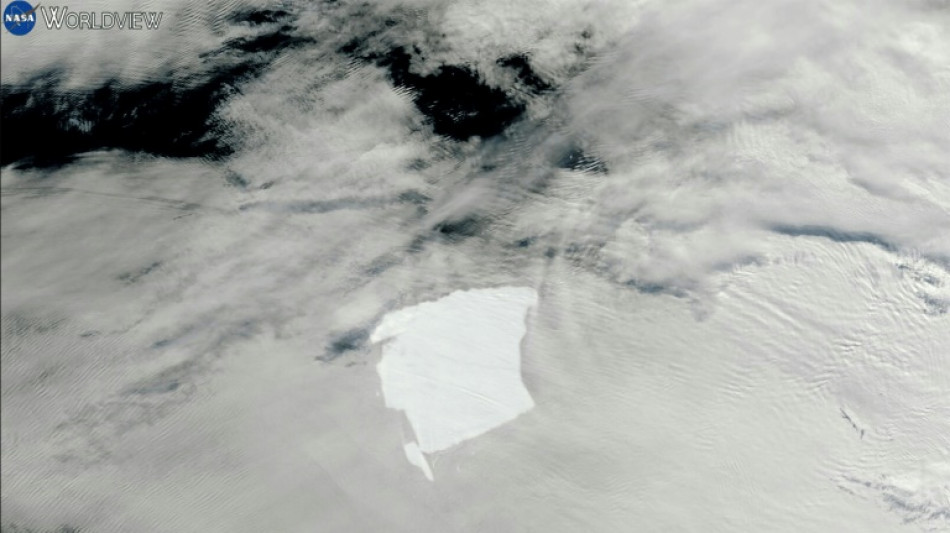
An enormous chunk has broken off the world's largest iceberg, in a possible first sign the behemoth from Antarctica could be crumbling, scientists told AFP on Friday.
The colossal iceberg -- which is more than twice the size of Greater London and weighs nearly one trillion tonnes -- had largely stayed intact since it started slowly moving north in 2020.
It has been drifting toward the remote island of South Georgia in the South Atlantic, raising the prospect it could run aground in shallower water and disrupt feeding for baby penguins and seals.
But a chunk about 19 kilometres (12 miles) long has cleaved off, said Andrew Meijers from the British Antarctic Survey, who encountered the iceberg in late 2023 and has tracked its fate via satellite ever since.
"This is definitely the first significant clear slice of the iceberg that's appeared," the physical oceanographer told AFP.
Soledad Tiranti, a glaciologist currently on an Argentinian exploration voyage in the Antarctic, also told AFP that a section had "broken" away.
The jagged piece has an area of roughly 80 square kilometres (31 square miles) -- huge in its own right, but just a fraction of the approximately 3360 square kilometres that remained.
Meijers said icebergs were full of deep fractures, and although this monumental specimen had shrunk over time and lost a much smaller piece, it had "held together pretty nicely".
"This is a sign that those rifts in it are starting to break up," he said.
In the past, other mega-icebergs had fallen apart "relatively quickly over the course of several weeks" once they started losing big pieces, he said.
It was hard to say if this was "a loose tooth just waiting to come out" or evidence of a much bigger change underway.
"I'm sorry to say but it's not really an exact science how these things fall apart... it's really hard to say if this is going to blow apart now, or it's going to hang together for longer," Meijers said.
Known as A23a, the world's biggest and oldest iceberg calved from the Antarctic shelf in 1986.
It remained stuck for over 30 years before finally breaking free in 2020, its lumbering journey north sometimes delayed by ocean forces that kept it spinning in place.
This monster block of freshwater was being whisked along by the world's most powerful ocean "jet stream" -- the Antarctic Circumpolar Current.
Meijers said its trajectory toward South Georgia, a crucial feeding ground for seals and penguins, would unlikely change because it had lost this chunk.
But should it collapse further it would pose "much less of a threat for wildlife" because foraging animals could manoeuvre unimpeded between the smaller chunks to find food, he added.
Icebergs had grounded there in the past and caused significant mortality to penguin chicks and seal pups.
Tiranti said the iceberg was expected to keep plodding its way north but its exact course depended greatly on how local currents influenced its movements.
burs-np/yad
Z.AlNajjar--SF-PST