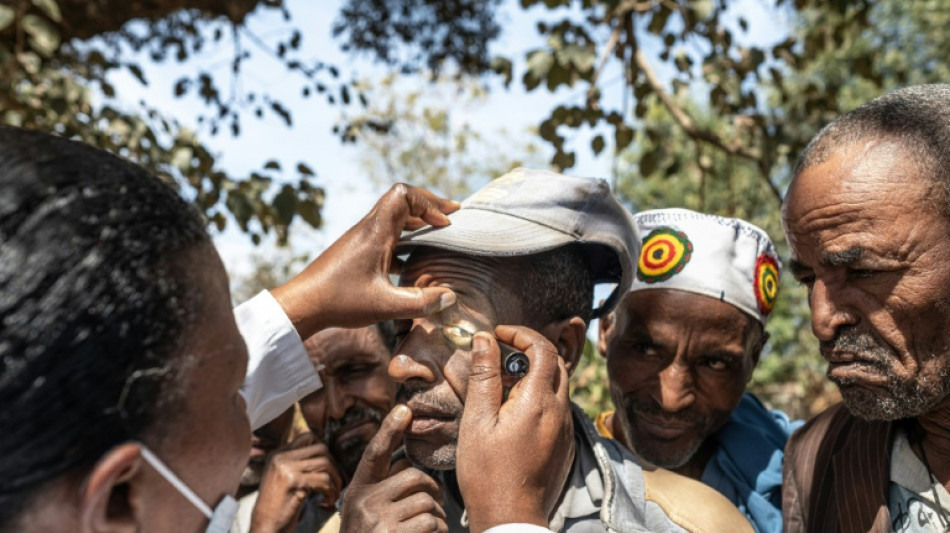
'I rip out my lashes to ease pain': Eye disease afflicts Ethiopia / Photo: Marco Simoncelli - AFP

 Dodgers eye three-peat, Red Sox face Yankees as MLB playoffs begin
 Certification of Boeing 737 MAX delayed by software bug
 Celine Dion wows Paris Fashion Week with surprise gig
 AMD buys firm founded by AI 'godmother' Fei-Fei Li

 Italy rebound in Turkey as France win late in Belgium

 Pope says concerns about AI 'should be taken seriously'

 Hurricanes to hoist title banner as NHL season begins

 Justice Alito steps aside from major US climate case

 Willis happy with England exile after retains Top 14 player award
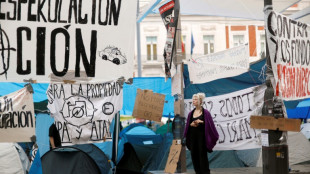 Spain housing protests keep heat on government as PM seeks new law

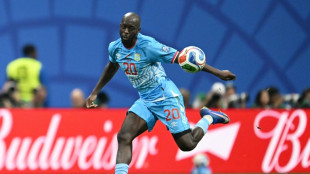 Wissa spoils Zimbabwe homecoming as DR Congo win AFCON qualifier
 UK police release on bail five men held over airbase incident

 Ex-All Black Plummer 'sure' New Zealand will find Super Rugby solution

 Shein sees 1% revenue growth in first half of 2026
 Netherlands regrets Israel retaliation in settlements row

 Moscow seizes Russian assets of German food retailer Metro

 Bulgarian spirits inflamed by new rakia rules

 Documentary turns camera on architect Peter Zumthor

 UK police say releasing on bail five men held over airbase incident

 Trump admin finalizes reversal of US fuel economy standards
 US says no China arms sale plans after envoy cites Trump offer

 Dozens kidnapped in two weekend attacks in northern Nigeria

 Next stop the world: Pathirage wins Asian Games javelin gold

 Aster Launches Perpetual Grid Trading 2.0 with Up to 140,000 $ASTER Liquidity Mining Campaign
 Seoul says North Korean mines 'highly suspected' as cause of DMZ blast

Scheicho Scheifa is haunted by the fear of going blind.
A disease called trachoma has turned his eyelids inwards, causing his eyelashes to scar his corneas so badly that one has already turned opaque.
The 35-year-old farmer and baker, who blinks frequently and suffers in sunshine, said the pain is so fierce he has now "stopped working entirely".
He has been mostly bound to his home in the small village of Asano, around 100 kilometres (60 miles) from Ethiopia's capital, Addis Ababa.
"Recently, I learned that the surface of my eye is wounded, and the left eye is severely damaged. The pain affects my ability to work and perform daily tasks," the father-of-two told AFP.
"Each time it flares up, I rip out my lashes to ease the pain," he added.
"The fear of going blind worries me whenever the pain strikes."
Trachoma is caused by infection with the bacterium Chlamydia trachomatis, which is spread through contact with the eyes or nose of infected people.
Flies that have touched infected people's eyes or noses can also transmit the disease.
- Two million blinded -
Women are blinded up to four times as often as men -- normally between the ages of 30 to 40 -- most likely because they are in more regular contact with children, the main reservoir of the disease.
According to the World Health Organization (WHO), trachoma is "hyperendemic in many of the poorest and most rural areas" of the world, and Africa is the most affected continent.
Around 103 million people worldwide live in the endemic areas for the disease, nearly half in Ethiopia.
Despite being in pain since childhood, Scheicho was initially reticent to undergo surgery -- which involves cutting into his eyelids and rotating the eyelashes away from his cornea -- since this had not improved his mother's condition.
He was finally convinced by Gizachew Abebe, an ophthalmologist and member of the Germany-based charity Christian Blind Mission.
The NGO has sought to inform "the community and patients to take care of their personal hygiene... a very important point to prevent trachoma", Gizachew said.
"You need to wash your face with clean water," he told a gathering of dozens of people in a small village near Asano.
That is not easy for this rural community, which is a three-hour walk to the nearest river and shares water with livestock.
- 'Hard to cut' -
The charity is working on improving access to clean water, and uses loudspeakers in markets in Butajira, the region's biggest town, to urge people to get tested for trachoma.
The least advanced cases can be treated with antibiotics or creams but more serious cases like Scheicho's require surgery.
He finally went under the knife in a small health centre without electricity in Asano, during AFP's visit.
After administering a local anaesthetic, Sister Tadelech made an incision on his upper eyelid.
"It is hard to cut," the ophthalmologist said.
But half an hour later, the operation was successfully completed.
"I feel better," a groggy Scheicho managed afterwards.
By the end of last year, 21 countries including Togo and Ghana, had eliminated trachoma as a public health problem, according to the WHO.
In Ethiopia, it could be possible to minimise the disease but "we will not eradicate" it until "people's standard of living" improves, Gizachew said.
K.AbuDahab--SF-PST