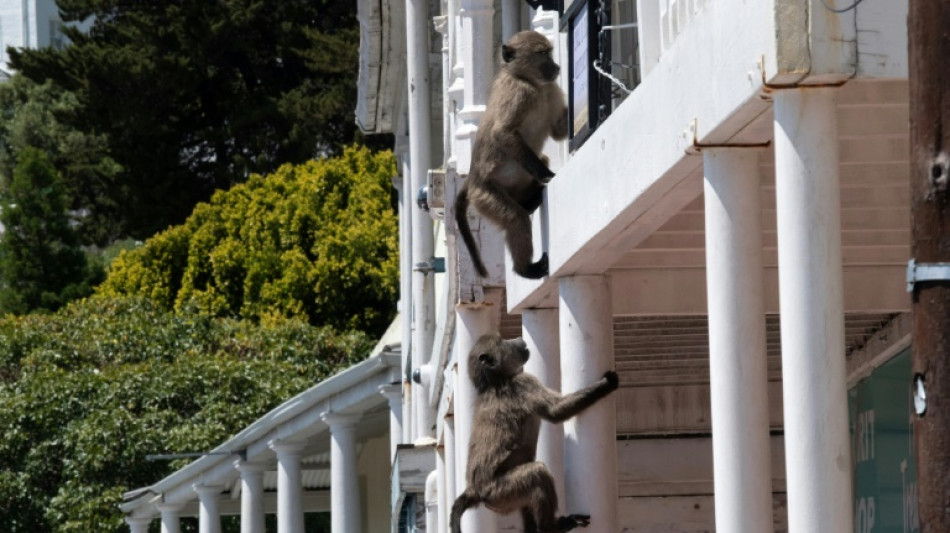
As baboons become bolder, Cape Town battles for solutions / Photo: RODGER BOSCH - AFP

 OpenAI cancels release of newest model due to safety concerns

 AI bosses head to White House as safety pressure builds

 Batista sacked as Costa Rica coach after six months

 Flooding, power cuts and evacuations as Hurricane Polo slams Mexico

 Dodgers eye three-peat, Red Sox face Yankees as MLB playoffs begin

 Certification of Boeing 737 MAX delayed by software bug

 Celine Dion wows Paris Fashion Week with surprise gig

 AMD buys firm founded by AI 'godmother' Fei-Fei Li

 Italy rebound in Turkey as France win late in Belgium

 Pope says concerns about AI 'should be taken seriously'

 Hurricanes to hoist title banner as NHL season begins

 Justice Alito steps aside from major US climate case

 Willis happy with England exile after retains Top 14 player award

 Spain housing protests keep heat on government as PM seeks new law

 Wissa spoils Zimbabwe homecoming as DR Congo win AFCON qualifier

 UK police release on bail five men held over airbase incident

 Ex-All Black Plummer 'sure' New Zealand will find Super Rugby solution

 Shein sees 1% revenue growth in first half of 2026
 Netherlands regrets Israel retaliation in settlements row

 Moscow seizes Russian assets of German food retailer Metro

 Bulgarian spirits inflamed by new rakia rules

 Documentary turns camera on architect Peter Zumthor

 UK police say releasing on bail five men held over airbase incident

 Trump admin finalizes reversal of US fuel economy standards

 US says no China arms sale plans after envoy cites Trump offer

On a sunny afternoon in Cape Town’s seaside village of Simon’s Town, three young chacma baboons cause a commotion, clambering on roofs, jumping between buildings and swinging on the gutters.
Enchanted tourists stop to photograph the troop crossing the road. Locals are less impressed: it’s a daily scene in the charming village nestled between the Atlantic Ocean and Table Mountain National Park.
About 500 chacma baboons -- among the largest monkey species and weighing up to 40 kilos (88 pounds) -- roam the peninsula south of Cape Town, says the South African National Biodiversity Institute.
And as human development pushes up the mountain into their natural habitat, the animals are increasingly entering plush properties to forage in gardens and take the pickings from the bins. Some manage to sneak into houses where they can wreak havoc.
Many locals are fond of the creatures, giving them pet names and following their daily adventures on social media.
But others are increasingly frustrated.
"They've become so bold now. They’re more domesticated than they should be," said Duncan Low, 60, who runs an ice cream shop.
The intruders have even started raiding kitchens and grabbing food from plates in restaurants. "They’re on a sugar and fast-food rush," Low said.
In 2021, the city put down a notorious alpha-male monkey who had terrorised residents with more than 40 raids for food in rubbish bins, from lawns and porches, sometimes entering homes while people were inside.
- Monkey management -
Tension between humans and baboons is "the highest it’s ever been", said ecologist Justin O’Riain, who directs the Institute for Communities and Wildlife in Africa at the University of Cape Town.
A baboon on the edge of a wild and an urban area is "the most difficult animal in the world to manage", O’Riain said.
"They are strong, they can climb… and they can learn from each other: there's no landscape that they can't conquer."
As human settlement of the Cape has expanded, the baboons have been "pushed higher and higher up the mountain" where foraging conditions are harder, O’Riain added.
The lush gardens that people have built, with fruit trees and swimming pools, are tempting attractions.
The City of Cape Town, in partnership with park authorities, has for years run a programme to manage the marauding monkeys that relies on teams of baboon monitors.
They employ a primarily non-lethal approach, O’Riain said.
However, some techniques, such as firing paintball guns to keep troops away or culling a particularly problematic animal, have come under fire.
Amid an increasingly emotional outcry, vociferous campaigner Baboon Matters announced court action against the city and parks authorities in May for failing to implement what it considers more acceptable control measures, such as baboon-proof fencing and bins.
Facing criticism and funding limits, the authorities said the baboon management programme would be wound down by the end of the year as they investigate other "more sustainable urban solutions".
It will however remain in place through December -- a particularly busy month for tourists -- but with fewer rangers, it said.
"We're going to lose our first line of defence," O’Riain said, with more baboons already entering urban areas often at risk to their lives.
- Deaths highest in 10 years -
Thirty-three baboons were known to have died between July 2023 and June 2024, the highest number in 10 years, city authorities say.
Nearly half the deaths were caused by human factors, including shooting with pellet guns, collisions with vehicles and dog attacks.
Coexistence with baboons should come with "a degree of human compliance", starting with managing food waste, conservation activist Lynda Silk, head of the Cape Peninsula Civil Conservation group, said.
"We don't need to be in competition with our natural resources: there can be ways that we can manage our lifestyles to minimise the negative impacts," she said.
For O’Riain, the only viable solution to the baboon battle is to erect fencing in certain areas that is made up of electric wiring and underground mesh to prevent the animals from digging underneath.
A prototype installed 11 years ago had shown great success, with almost no animals entering the area, he said. A 2023 report already suggested where the fencing should be placed.
"Baboons can come and forage right up to the edge of the fence and no one will disturb them," said O’Riain.
"It's a completely peaceful interaction, a win-win for people and for baboons."
K.AbuDahab--SF-PST