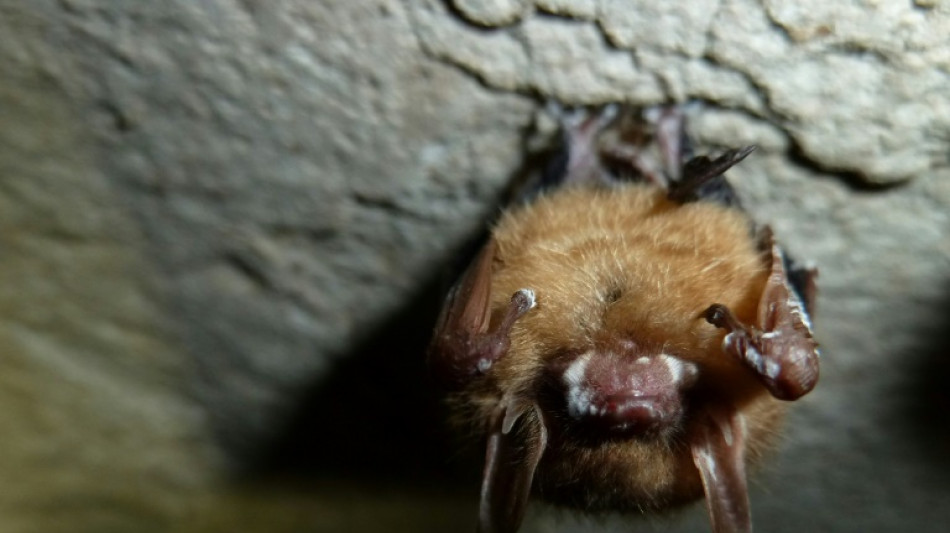
New tools give researchers hope for fungus-ravaged US bats / Photo: Handout - NATIONAL PARK SERVICE/AFP

 OpenAI cancels release of newest model due to safety concerns

 AI bosses head to White House as safety pressure builds

 Batista sacked as Costa Rica coach after six months

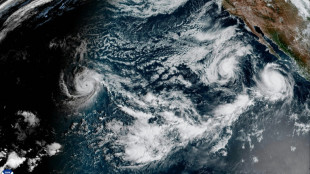
 Flooding, power cuts and evacuations as Hurricane Polo slams Mexico

 Dodgers eye three-peat, Red Sox face Yankees as MLB playoffs begin

 Certification of Boeing 737 MAX delayed by software bug

 Celine Dion wows Paris Fashion Week with surprise gig

 AMD buys firm founded by AI 'godmother' Fei-Fei Li

 Italy rebound in Turkey as France win late in Belgium

 Pope says concerns about AI 'should be taken seriously'

 Hurricanes to hoist title banner as NHL season begins

 Justice Alito steps aside from major US climate case

 Willis happy with England exile after retains Top 14 player award

 Spain housing protests keep heat on government as PM seeks new law

 Wissa spoils Zimbabwe homecoming as DR Congo win AFCON qualifier

 UK police release on bail five men held over airbase incident

 Ex-All Black Plummer 'sure' New Zealand will find Super Rugby solution

 Shein sees 1% revenue growth in first half of 2026

 Netherlands regrets Israel retaliation in settlements row

 Moscow seizes Russian assets of German food retailer Metro

 Bulgarian spirits inflamed by new rakia rules

 Documentary turns camera on architect Peter Zumthor

 UK police say releasing on bail five men held over airbase incident

 Trump admin finalizes reversal of US fuel economy standards

 US says no China arms sale plans after envoy cites Trump offer

Standing at a woodland entrance to the world's longest cave system in Kentucky, a park ranger warns those about to enter of an extremely deadly fungus -- not for humans, but for the bat populations it has devastated across North America.
In one of the most significant losses of wildlife in modern history, the fungus, which causes a disease called white-nose syndrome, has killed millions of the flying mammals since arriving in the eastern United States from Europe nearly 20 years ago.
Two decades on, no cure exists. But scientists are finally emerging with potential solutions.
And their research comes as the disease -- which sprouts white fuzz on the bats' tiny noses, ears and wings -- is spreading to the American West.
White-nose syndrome (WNS) was first confirmed at Mammoth Cave National Park in Kentucky in 2013, thriving in the pitch-black, cool conditions of its labyrinthine tunnels, which the group of visitors quickly descended into for their tour.
If WNS seems like a problem just for bats, scientists say, think again. The insect-eating animals play a vital ecological role and their loss is already reverberating.
All of the repercussions are not entirely understood. However in a recent study published in the journal Science, researchers linked the collapse of North American bat populations with higher use of pesticide and increased human infant mortality.
Particularly in the disease's early days, researches witnessed grisly scenes: dead bats clinging to the ceiling next to sick bats, and diseased bats crawling along the floor, especially in the northeast United States.
Further south at Mammoth Cave, located in an extremely cavernous region of verdant rolling hills and forests, bats have tended to head out into the wilderness to die, likely due to warmer winter weather, simply disappearing forever.
- Mass mortality -
The United States and Canada are home to more than 40 bat species, with WNS affecting those that hibernate -- although not all of them.
Counting bats is extremely difficult, but researchers widely agree the disease killed more than 90 percent of the three most impacted species -- the northern long-eared, tricolored and little brown bat which used to be extremely common.
At Mammoth Cave, mass mortality has also occurred among the Indiana bat, the park's cave resources management specialist, Rick Toomey, told AFP.
More than 400 miles (640 kilometers) of mapped passageways wind beneath the park, which Toomey compared to "a plate of spaghetti," attracting visitors who may not have known or been thinking about WNS.
"It doesn't cross my mind often at all, only when someone brings it up like they did today," Makenzie Johnson, a 24-year-old student visiting from Indiana, told AFP after the tour.
- Right tool, right time -
White-nose syndrome is caused by the fungus Pseudogymnoascus destructans (Pd), which infects bats during hibernation, waking them more easily and causing them to use up their energy reserves.
Scientists have been scrambling to find a solution -- so far with only partial results.
"If we can come up with a lot of different tools, and we understand how to use them, and use them in the right places at the right time, we could help get a number of bats through that initial phase of disease when we see high mortality," Michelle Verant, a wildlife veterinarian with the National Park Service, told AFP.
One of those tools is vaccines, which are fairly rare for fungal diseases, but are showing promise with comparatively more vaccinated bats returning to maternal roosts, she said.
According to Jonathan Reichard, assistant national coordinator for WNS at the US Fish and Wildlife Service, various disinfection tools for hibernation sites are being studied.
One is a chemical called polyethylene glycol 8000 that is sprayed in caves while bats are away in summer, reducing Pd's presence. Another is the application of UV light. But scientists warn other organisms can be harmed in the process.
Researchers are also fumigating caves and their bats with volatile organic compounds to slow the fungus's growth. And there is even a probiotic skin treatment, based on naturally occurring bacteria.
A double-stranded RNA application is also now under development, "which is something that can be highly specific to the fungus," Reichard added.
"We've gone from sort of having no idea what was happening to now having a suite of tools relevant for use in different areas and different situations," he said.
F.Qawasmeh--SF-PST