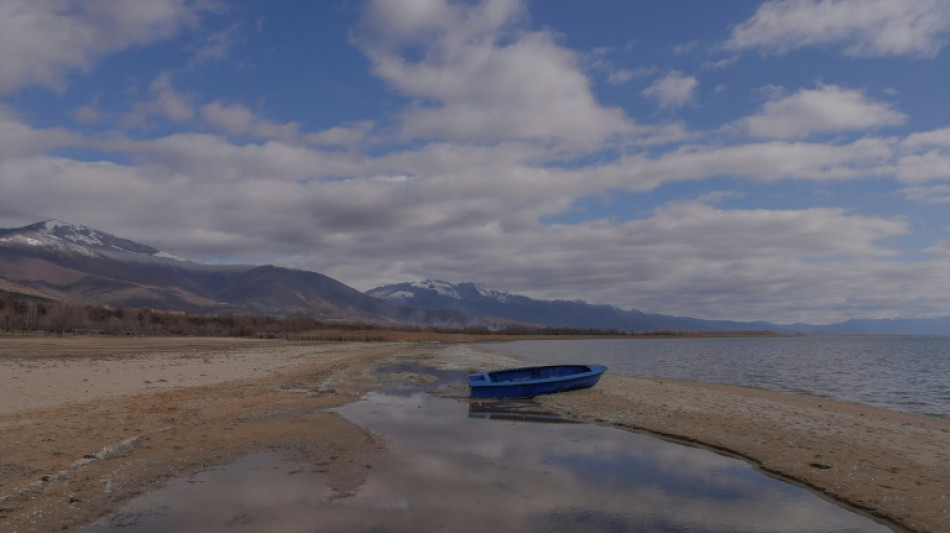
Shrinking lake on Albanian-Greek border struggles to survive / Photo: Armend NIMANI - AFP/File

 South Korea team latest to be bussed to wrong Asian Games venue

 Bears thrash Eagles 27-7 as third-string QB Keenum shines
 All Blacks name veteran Taylor captain as Mo'unga seizes 10 jersey
 Race against time as Asian Games cricket quarter-finals washed out
 India turns to corals and seagrass to shield against rising seas

 Manchester City's Premier League charges: What comes next?

 Brazil's cellphone crime: a security nightmare in every pocket

 Russia pummels Kyiv in latest deadly attack
 NFL Giants obtain QB McCarthy from Vikings

 Deal for evicted Spanish pensioner as PM seeks new housing law

 Clippers apologize, warn fans of 'challenges' after Leonard scandal

 Turkish comedian convicted for Erdogan 'insult' freed pending appeal

 Trump announces 'biggest' US steel plant in battleground Iowa

 Olise wonder strike gives Zidane's France win in Belgium

 US stocks fall, bond yields rise as Middle East war drags on

 Trump denies offering to sell arms to China's Xi

 Wemby ready for NBA Spurs to move rivals in climb to top

 Ukraine to postpone some spending amid delays in aid: PM

 Tuchel says Czech Republic game 'not yet a must-win'

 MaXhosa puts South Africa on the Paris fashion map

 Rose, Scott among 2027 World Golf Hall of Fame finalists

 Brunson says NBA champion Knicks can't get satisfaction

 France puts out largest wildfire since 1949

 Real Madrid's Perez summoned over Barcelona referee payments comments

 Oil takes off again, Wall Street dips after Trump rejects Iran truce offer
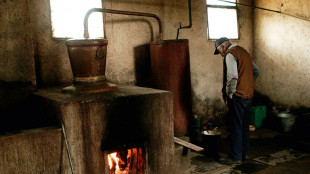
Plants and reeds have sprouted up as the waters of Little Prespa Lake on the Albanian-Greek border recede, their beauty overshadowing a painful truth: the lake is slowly dying.
The once crystal-clear lake has mostly been transformed into a marshy watering hole in this corner of southeastern Albania.
"A few years ago, this was a lake with pure water. Fishing was our life. But today we have nothing left. The lake is dead," said local resident Enver Llomi, 68.
Abandoned boats are now stuck in the mud or rot in the sun on dry land.
Cows have replaced the fish, and wander around without venturing too close to the retreating water.
The majority of Little Prespa Lake, also known as Small Lake Prespa, sits in Greek territory, with just its southern tip crossing into Albania. It is a smaller cousin of the larger Great Prespa Lake to the north.
According to experts, of the 450 hectares (1,100 acres) of Little Prespa Lake in Albania, at least 430 hectares have been transformed into swamps or dried up.
For the inhabitants, the beginning of the misfortune dates back to the 1970s, when communist authorities diverted the Devoll River to irrigate fields around the nearby Albanian city of Korca.
"A few years ago, we could catch up to 10 kilos (22 pounds) of fish per day, we could use the water to irrigate," Llomi told AFP with a bitter smile.
Climate change has exacerbated the problem, experts say. Rising temperatures and increasingly mild winters with little snowfall and a scarcity of precipitation have battered the lake.
"If this year the winter is dry it will be even worse. And if next summer it is also hot and dry – everything would be over," said local park ranger Astrit Kodra.
- 'Repercussions' -
Environmentalists say the fate of the lake should serve as a dire warning for the rest of the Balkans -- a region rich in water but where resource management is largely lacking.
"The death of a lake will have repercussions" on the neighbouring lakes of the larger Prespa and Ohrid, said Kodra.
The water levels at Great Prespa Lake -- one of the oldest in Europe, straddling the borders of Albania, Greece and North Macedonia -- are also in steep decline, reaching their lowest level in decades.
"The water in the lake on the Albanian side is today 10 meters (33 feet) lower than its level at the end of the 1970s," said Vasil Male, a manager of protected areas in Korca.
Male says the main cause is climate change.
"The reduction in precipitation is drying up water resources and has led to a decline in the level of Great Prespa Lake by 54 centimetres (21 inches) in the last four months alone," said environmental expert Llazi Stojan.
On the Greek side, the situation is also critical.
According to data from the National Lake Water Monitoring Network of Greece, "the level of the two lakes, the Small and Large Prespa, last August was at its lowest point since 2021".
In a 2022 report, NASA said satellite images showed that the larger Lake Prespa had lost seven percent of its surface area and half its volume between 1984 and 2020.
"And if Prespa shrinks further, the no less sublime Lake Ohrid, located just 10 kilometres (six miles) away, could also be affected," warns Stojan.
Experts in the region however say little can be done unless the countries that share the lakes cooperate to save them.
"We must intervene, we must act together as long as it is not too late," said Kodra.
"Humans and science can find solutions to save nature."
T.Khatib--SF-PST