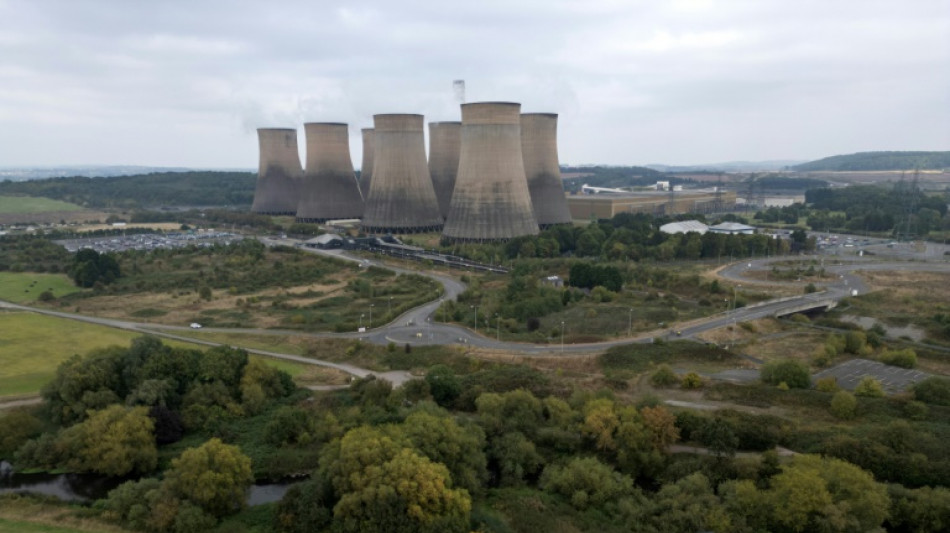
Britain's last coal-fired power station closes / Photo: Oli SCARFF - AFP/File

 South Korea team latest to be bussed to wrong Asian Games venue

 Bears thrash Eagles 27-7 as third-string QB Keenum shines

 All Blacks name veteran Taylor captain as Mo'unga seizes 10 jersey

 Race against time as Asian Games cricket quarter-finals washed out
 India turns to corals and seagrass to shield against rising seas

 Manchester City's Premier League charges: What comes next?

 Brazil's cellphone crime: a security nightmare in every pocket

 Russia pummels Kyiv in latest deadly attack
 NFL Giants obtain QB McCarthy from Vikings

 Deal for evicted Spanish pensioner as PM seeks new housing law

 Clippers apologize, warn fans of 'challenges' after Leonard scandal

 Turkish comedian convicted for Erdogan 'insult' freed pending appeal

 Trump announces 'biggest' US steel plant in battleground Iowa

 Olise wonder strike gives Zidane's France win in Belgium
 US stocks fall, bond yields rise as Middle East war drags on

 Trump denies offering to sell arms to China's Xi

 Wemby ready for NBA Spurs to move rivals in climb to top

 Ukraine to postpone some spending amid delays in aid: PM

 Tuchel says Czech Republic game 'not yet a must-win'

 MaXhosa puts South Africa on the Paris fashion map

 Rose, Scott among 2027 World Golf Hall of Fame finalists

 Brunson says NBA champion Knicks can't get satisfaction

 France puts out largest wildfire since 1949
 Real Madrid's Perez summoned over Barcelona referee payments comments

 Oil takes off again, Wall Street dips after Trump rejects Iran truce offer
The UK's last coal-fired power station will officially close its doors on Monday, making Britain the first G7 country to end its reliance on the fossil fuel to produce electricity.
The closure of Ratcliffe-on-Soar, a power plant that has dominated the surrounding central England landscape for nearly 60 years, marks a symbolic step in the UK's ambition to decarbonise electricity by 2030, and become carbon neutral by 2050.
"The era of coal might be ending, but a new age of good energy jobs for our country is just beginning," Energy Minister Michael Shanks said in a statement.
The owner of the Ratcliffe-on-Soar factory, Uniper said the site will be put into a two-year decommissioning period beginning in October.
The 350 Uniper employees and contractors that work at the site, will either be redeployed to other roles within the company or leave the business within three redundancy windows before the end of 2026, Uniper told AFP.
In its place will be a new development -- a "carbon-free technology and energy hub", the company said.
It marks the end of Britain's 140-year dependence on coal as it becomes the first in the G7 of rich nations to do away entirely with coal power electricity.
Italy plans to do so by next year, France in 2027, Canada in 2030 and Germany in 2038. Japan and the United States have no set dates.
"Britain has set an example the rest of the world must follow", said Doug Parr, policy director at Greenpeace UK.
"There are further battles to be had to phase out oil and gas, fulfilling the promise by all countries at COP28 to transition away from fossil fuels," he added.
- 'In the history books' -
The polluting fossil fuel played a vital part in British economic history, powering the Industrial Revolution of the 18th and 19th centuries that made the country a global superpower.
Even into the 1980s, it still represented 70 percent of the country's electricity mix before its share declined in the 1990s as the government began to implement stricter regulations to tackle pollution.
In the last decade the fall has been even sharper, slumping to 38 percent in 2013, 5.0 percent in 2018 then just 1.0 percent last year.
"Coal was the backbone of the UK’s power generation for over a century, but its place is now in the history books," said Friends of the Earth energy campaigner, Tony Bosworth.
"The priority now is to move away from gas as well, by developing as fast as possible the UK’s huge homegrown renewable energy potential and delivering the economic boost that will bring," he added.
In 2023, a third of electricity production was made up of natural gas while a quarter came from wind power and 13 percent from nuclear power, according to electricity operator National Grid ESO.
The new Labour government has plans to further decarbonise the energy mix.
It launched its flagship green energy plan after its election win in July, with the creation of a publicly owned body to invest in offshore wind, tidal power and nuclear power.
In recent years, Ratcliffe-on-Soar, which had the potential to power two million homes, was only used when big spikes in electricity use were expected, such as during a cold snap in 2022 or the 2023 heatwave.
Its last delivery of 1,650 tonnes of coal at the start of this summer barely supplied 500,000 homes for eight hours.
The history of Britain's reliance on coal dates back to 1882, when the world's first coal-fired power station was built in central London.
J.Saleh--SF-PST