Stockholm tests electric 'flying' ferry / Photo: Henrik MONTGOMERY - TT News Agency/AFP

 Grave of the Fireflies: Takahata Isao’s Lifelong Quest for Realism

 مطالبات برلمانية أمريكية لماسك بالاحتفاظ بسجلات استخدام أوكرانيا لشبكة ستارلينك

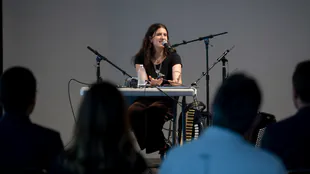 DJ Chaia Brings 'Yiddishland' Sound to Capital Region with Kleztronica Rave

 بطريرك القدس للاتين يهنئ المقدم رؤوف إميل بالإفراج عنه في منزله بالزبابدة

 أبو هولي والأسعد يبحثان مع الفصائل الفلسطينية في لبنان أزمة الكهرباء وحوكمة المخيمات

 Mkhwanazi and Former Ekurhuleni Officials to Face Court Over Blue Lights Scandal

 Metsola Urges EU Investment to Secure Global AI Leadership

One metre above the surface, a fully electric ferry is speeding across the waters of Stockholm as a Swedish company prepares to start taking its first regular passengers.
Equipped with three vertical wings, or hydrofoils, the craft is "able to fly out of the water when it's going fast enough," Andrea Meschini, head of R&D testing for the Candela P-12 ferry, told AFP.
"It's amazing, it feels like the future," Meschini said as he demonstrated the prototype off the coast of the Stockholm archipelago, adding that "it feels like a magic carpet."
Thanks to sensors that constantly adjust the foils, the ferry maintains its stability. By levitating above the water it consumes "up to 80 percent less" energy than a regular boat, according to Meschini.
Since it minimises friction, the ferry is able to go much faster than conventional ferries with a top speed of 55 kilometres per hour (34 miles per hour).
The company, Candela, is due to start taking passengers between the island of Ekero and central Stockholm in October -- a busy route that should take 35 minutes with the new ferry, half the time it takes by land.
Under the agreement with SL -- the Swedish capital's public transport operator -- Candela will only supply a single boat for the time being, with a capacity for 30 passengers.
Despite waves and the wakes produced by other boats passengers feel virtually nothing on board the shuttle.
Although the technology had already been developed -- Candela produces smaller leisure flying boats -- the larger ferry had to "fulfil a whole lot of standards to be seaworthy and safe for the passengers," Karin Hallen, programme manager at Candela, told AFP.
Candela is aiming to expand its technology on an international scale.
According to Meschini, the sector has "a lot of potential because most of the big cities around the world are built around water."
"Yet it is not used and developed in terms of public transport. We want to fill the gap," Meschini said.
Maritime transport is responsible for around three percent of the world's greenhouse gas emissions.
B.Mahmoud--SF-PST