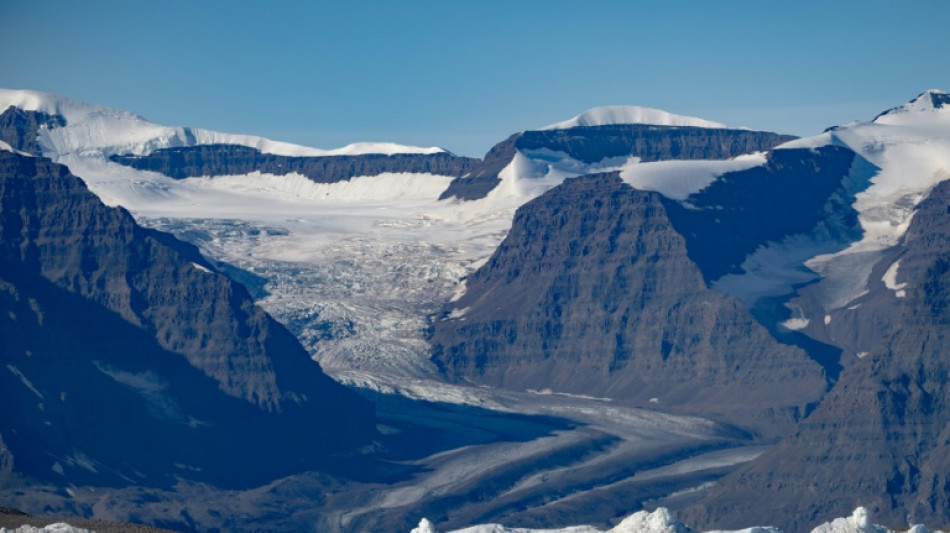
Oh my (long) days: Melting ice caps slow Earth's spin / Photo: Olivier MORIN - AFP/File

 MEXC Unveils "WE SEE YOU" Brand Visual Refresh, Putting People Behind Every Trade in Focus

 Thai capital cleans up after deadly floods

 NATO, EU allies rally to Estonia after 'sabotage' blamed on Russia

 Families demand justice for Cameroon's 'nightmare' wave of murdered women
 Tebas says Man City should face 'most severe' sanctions if guilty of rule breaches

 Pochettino calls Man City success 'a period of deception'

 Settler attack on West Bank village injures Israeli forces, drawing rare rebuke

 Mystery over UK airbase scare after reports no explosives found

 Spanish govt races to adopt housing law under protest pressure

 Estonia slams Russian 'sabotage' after arson attack on defence company

 Slovenia sees surge in '.si' sites after Trump hypes 'super intelligence'

 'Like a dream' for An as Games organisers 'sorry' for latest mix-up

 Tokyo suffers longest streak of rainy days on record

 Indonesia charges train driver over crash that killed 16 women
 صندوق النقد العربي يواصل دعم الاستقرار المالي والنقدي في المنطقة

 وزارة المالية تدعم توسع الشركات المصرية في السوق التنزانية

 محمد بن زايد يزور السعودية بعد فترة من الفتور في علاقات البلدين

 مخيم البداوي يحيي ذكرى مقتل فتح شريف بفعالية جماهيرية

 تدمير البيوت التراثية يهدد الذاكرة السياسية والعمرانية لجنوب لبنان

 اقتحامات واعتداءات إسرائيلية تسجل في عدة مناطق بالضفة الغربية

 سهم شي إن يتراجع 14% رغم إعلان أول أرباح منذ الطرح

 مجموعة الغندور ترصد 3 مليارات جنيه لتوسعات جديدة حتى 2030

 العربي الأفريقي الدولي يوسع برامج إعداد القيادات المصرفية

 إنفيديا تطلق منصة مفتوحة لضبط صلاحيات وكلاء الذكاء الاصطناعي

 دي بي ورلد تدشن خطاً بحرياً بين الهند والفجيرة وعُمان واليمن

It's well known that as far as the climate crisis goes, time is of the essence.
Now a study out Monday shows that the melting of the polar ice caps is causing our planet to spin more slowly, increasing the length of days at an "unprecedented" rate.
The paper, published in Proceedings of the National Academy of Sciences, shows that water flowing from Greenland and Antarctica is resulting in more mass around the equator, co-author Surendra Adhikari of NASA's Jet Propulsion Laboratory told AFP.
"It's like when a figure skater does a pirouette, first holding her arms close to her body and then stretching them out," added co-author Benedikt Soja of ETH Zurich.
"The initially fast rotation becomes slower because the masses move away from the axis of rotation, increasing physical inertia."
Earth is commonly thought of as a sphere, but it's more accurate to call it an "oblate spheroid" that bulges somewhat around the equator, a bit like a satsuma.
What's more, its shape is constantly changing, from the impacts of the daily tides that affect the oceans and crusts, to longer term effects from drift of tectonic plates, and abrupt, violent shifts caused by earthquakes and volcanoes.
The paper relied on observational techniques like Very Long Baseline Interferometry, where scientists can measure the difference in how long it takes for radio signals from space to reach different points on Earth, and use that to infer variations in the planet's orientation and length of day.
It also used the Global Positioning System, which measures Earth's rotation very precisely, to about one-hundredth of a millisecond, and even looked at ancient eclipse records going back millenia.
- Implications for space travel -
If the Earth turns more slowly, then the length of day increases by a few milliseconds from the standard measure of 86,400 seconds.
A currently more significant cause of slowdown is the gravitational pull of the Moon, which pulls on the oceans in a process called "tidal friction" that has caused a gradual deceleration of 2.40 milliseconds per century over millions of years.
But the new study comes to a surprising conclusion that, if humans continue to emit greenhouse gases at a high rate, the effect of a warming climate will be greater than that of the Moon's pull by the end of the 21st century, said Adhikari.
Between the year 1900 and today, climate has caused days to become around 0.8 milliseconds longer -- and under the worst-case scenario of high emissions, climate alone would be responsible for making days 2.2 milliseconds longer by the year 2100, compared to the same baseline.
That might not sound like a great deal, and certainly not something that humans are able to perceive.
But "there are definitely a lot of implications for space and Earth navigation," said Adhikari.
Knowing the exact orientation of Earth at any given moment is crucial when attempting to communicate with a spaceship, such as the Voyager probes that are now well beyond our solar system, where even a slight deviation of a centimeter can end up being kilometers off by the time it reaches its destination.
Y.AlMasri--SF-PST