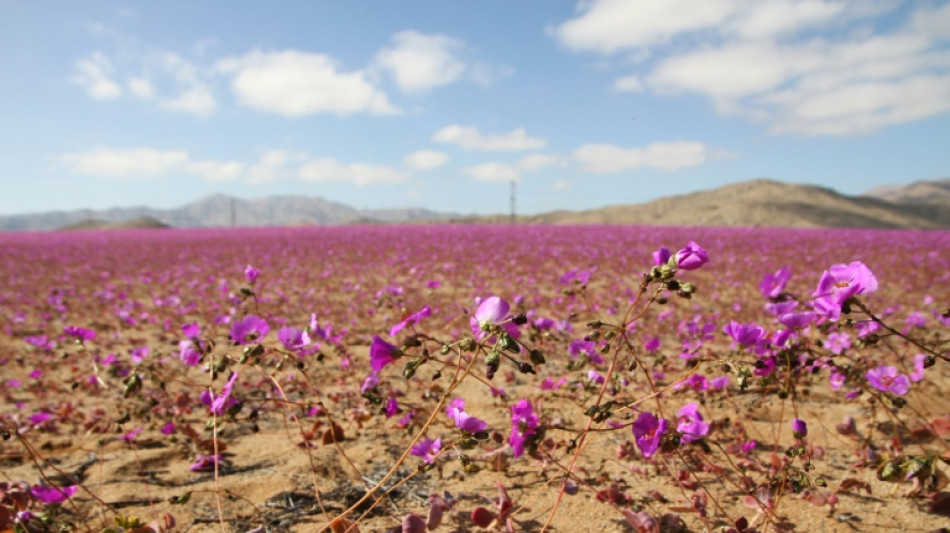
Unusual rainfall brings winter flowers to Chile's Atacama desert / Photo: Patricio LÓPEZ CASTILLO - AFP

 Grave of the Fireflies: Takahata Isao’s Lifelong Quest for Realism

 مطالبات برلمانية أمريكية لماسك بالاحتفاظ بسجلات استخدام أوكرانيا لشبكة ستارلينك

 DJ Chaia Brings 'Yiddishland' Sound to Capital Region with Kleztronica Rave

 بطريرك القدس للاتين يهنئ المقدم رؤوف إميل بالإفراج عنه في منزله بالزبابدة

 أبو هولي والأسعد يبحثان مع الفصائل الفلسطينية في لبنان أزمة الكهرباء وحوكمة المخيمات

 Mkhwanazi and Former Ekurhuleni Officials to Face Court Over Blue Lights Scandal

 Metsola Urges EU Investment to Secure Global AI Leadership

Large swaths of the Atacama desert, the driest on the planet, have been covered with purple and white flowers after unusual rainfall patterns in northern Chile.
Normally, such a desert bloom occurs every few years in the southern springtime -- if and when conditions are just right -- blanketing thousands of square kilometers.
But the flowers are making an appearance now in winter, something that hasn't happened since 2015, experts say.
Cesar Pizarro, head of biodiversity conservation at the National Forestry Corporation, told AFP that 11-12 millimeters (nearly half an inch) of rainfall in April "plus low cloud cover that has been very intense in the area and that wets these surfaces every night, helped activate these plants."
While the famed spring flowering desert spreads over 15,000 square kilometers (5,800 square miles), this winter efflorescence is covering only a few hundred square kilometers.
When the bloom is at its peak, more than 200 plant species blossom. Recent weather conditions appear to have mainly suited the "pata de guanaco," a purple flower that barely requires water and prefers sandy sites.
Scientists have not yet determined whether this phenomenon, also recorded in the winter of 2015, "is directly related to climate change or not, or to the El Nino or La Nina phenomena," said Pizarro.
V.AbuAwwad--SF-PST