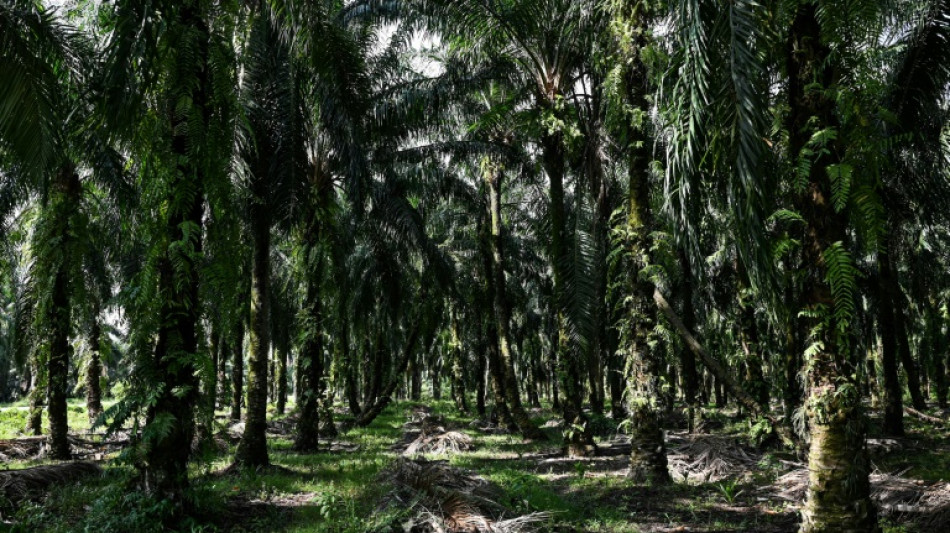
Vast concessions threaten Malaysia's forest: report / Photo: Mohd RASFAN - AFP/File

 Amaze Holdings (NYSE: AMZE) Executes Binding LOI to Acquire BullionFX | Alchemy, a Decentralized Gold-Backed Financial Ecosystem for Valued at US$155 Million
 Clashes between French teens, police as school blockades intensify

 Stocks move sideways despite oil moving lower
 African leaders to gather in Egypt for business summit
 UK decides against charging foreign visitors for museums

 Dallaglio to sell England World Cup winners' medal

 Brazil come from behind to beat Australia 4-2 in friendly

 Ruthless An retains Asian Games badminton crown as Kunlavut triumphs

 Alonso to stay with F1 team Aston Martin in 2027

 China badminton 'still strong' despite Asian Games slump

 'Exceptional' Turner painting shown in Rome before sale

 European stocks climb as oil dips

 Spain aims to ban evictions until 2030 amid housing protests

 Kunlavut first Thai man to win Asian Games badminton singles gold

 French far right says antisemitism claims part of 'total war' to derail presidency bid

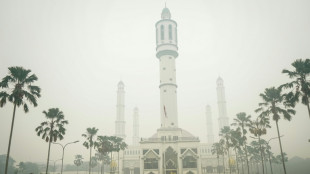 'Gift from God': Rain brings relief from Indonesia toxic haze

 Ex-world snooker champion jailed for 7 years for child sex crimes

 French teens clash with police as school blockades intensify

 FIFA accuses UEFA of 'misinformation campaign' in bid for World Cup papers

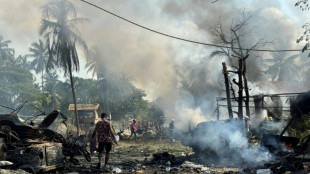 Myanmar airstrike toll hits 50 as families gather dead

 STARTRADER Raises Lloyd's of London Client Fund Insurance to USD 30 Million in Aggregate

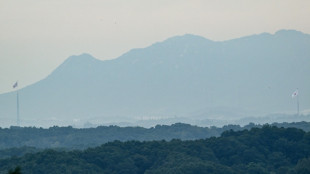 North Korean DMZ landmine blasts 'violation of armistice': Seoul

 مصر تستهدف زيادة حصة الصادرات السلعية إلى 30% من الناتج المحلي

 العربي الأفريقي الدولي يوسع برامج إعداد القيادات المصرفية

 مجموعة الغندور ترصد 3 مليارات جنيه لتوسعات جديدة حتى 2030

Vast concessions in Malaysia's forests threaten millions of hectares of rich natural habitats and risk the country's commitment to 50 percent forest cover, a report warned Tuesday.
NGO RimbaWatch said its analysis of concessions in the country's forest showed up to 3.2 million hectares could be slashed, potentially unleashing enormous carbon emissions and compromising key animal habitats.
"Malaysia has consistently been establishing concessions in forested areas, leaving vast areas at risk," said RimbaWatch director Adam Farhan.
"The Malaysian rainforest is millions of years old, and when it is lost, it is lost permanently," he told AFP.
Defining and delineating natural forest cover is complicated: some assessments categorise abandoned timber plantations or active palm oil plots as forest cover, while others only cover relatively untouched land.
So RimbaWatch used three different forest cover baselines for its research: one based on EU satellite data, one using official Malaysian data and one based on independent analysis by conservation start-up, The TreeMap.
RimbaWatch mapped concession grants onto these baselines to determine how much forest was at risk, working on the assumption that all trees in concession areas were threatened.
The analysis found 14-16 percent of Malaysia's remaining natural forest risks being cut down, or between 2.1 and 3.2 million hectares.
Malaysia has a longstanding commitment to maintain forest cover across 50 percent of its territory, but that promise is at risk and may even already have been broken, RimbaWatch said.
The dataset from The TreeMap's Nusantara Atlas estimates forest cover was already under 47 percent by 2022.
Timber and palm oil plantations are the key drivers of deforestation risk in Malaysia, but other threats including mining and even hydropower projects.
The report is the second time RimbaWatch has analysed the risk to Malaysia's forests. Its findings last year were rejected by Malaysian officials who said the group's definition of forest cover was misguided.
RimbaWatch counters that Malaysia defines forest cover too broadly.
"The Malaysian government allows for monoculture plantations to be counted as forest cover, which is an incredibly worrying development," said Adam.
"The 2.4 million hectares of loss expected for timber plantations will not be reported by the Malaysian government as deforestation," he added.
Malaysia's Minister of Natural Resources and Environmental Sustainability Nik Nazmi Nik Ahmad said Tuesday that authorities would "verify" RimbaWatch's report before responding, the New Straits Times reported.
"We know that there are challenges in some spots, but I think we are working very hard to protect that and we will go through the report seriously," he was quoted as saying.
Adam however warned that Malaysia is steaming ahead with concessions in forested areas, and even offering subsidies for timber plantations where native trees are removed to make way for quick-growing cash crops like acacia.
"The Malaysian rainforest has hundreds of species of trees per hectare, but monoculture has only one," said Farhan.
Y.AlMasri--SF-PST