Deadly Bangladesh cyclone one of longest seen / Photo: Munir Uz Zaman - AFP

 Tamil Film 'Arivu' Selected for 57th International Film Festival of India

 أسعار الديزل في الولايات المتحدة تنخفض دون 6 دولارات لأول مرة منذ شهرين

 Why Wind Farms Paint One Turbine Blade Black to Protect Birds

 Dianna Russini Seeks Super Bowl Radio Row Credential Amid Media Return

 Clare Luvanga Leads Washington Spirit to Third Straight NWSL Championship with 2-1 Win

 Malta Stuns Sweden with Late Penalty Comeback in Rugby Europe Trophy

 BingX: Major Announcement of Far-Reaching Significance

 أونروا تحذر من أزمة إنسانية في غزة بسبب القيود على الإغاثة

 Big Brother’s Omar El Mayer Addresses Backlash, Confirms Relationship with Rhianna Collins
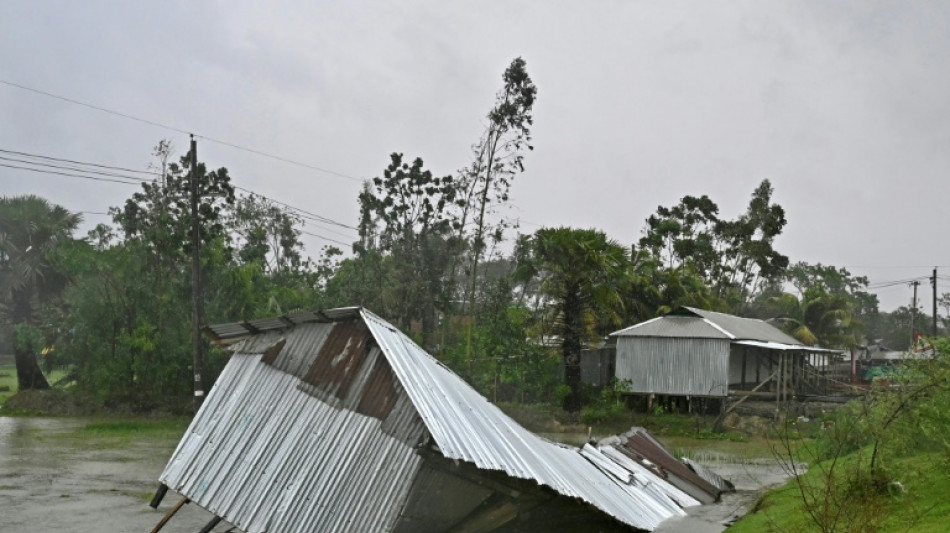
Bangladeshi weather experts said Tuesday that a deadly cyclone that carved a swathe of destruction was one of the quickest-forming and longest-lasting they'd experienced, blaming climate change for the shift.
Cyclone Remal, which made landfall in low-lying Bangladesh and neighbouring India on Sunday evening with fierce gales and crashing waves, left at least 21 people dead, destroyed thousands of homes, smashed seawalls and flooded cities across the two countries.
"In terms of its land duration, it is one of the longest in the country's history," Azizur Rahman, director of the state-run Bangladesh Meteorological Department told AFP, adding it had battered the country for more than 36 hours.
In contrast, Cyclone Aila, which hammered Bangladesh in 2009, lasted around 34 hours.
Cyclones have killed hundreds of thousands of people in Bangladesh in recent decades, and the number of superstorms hitting its densely populated coast has increased sharply, from one a year to as many as three, due to the impact of climate change.
Slow-moving -- and therefore longer-lasting -- storms bring greater destruction.
Rahman said the cyclone triggered massive rains, with some cities receiving at least 200 millimetres (7.9 inches).
- 'Impact of climate change' -
He said the cyclone formed more quickly than almost all the cyclones they have monitored in recent decades.
"Of course, quick cyclone formation and the long duration of cyclones are due to the impact of climate change," Rahman said.
"It took three days for it to turn into a severe cyclone from low pressure in the Bay of Bengal... I've never seen a cyclone formed from a low pressure in such a quick time," he said.
"Usually, a cyclone is formed in the south and southwest of the Bay of Bengal, then takes seven to eight days to turn into a severe cyclone."
But while scientists say climate change is fuelling more storms, better forecasting and more effective evacuation planning have dramatically reduced death tolls.
In Bangladesh, Cyclone Remal killed at least 15 people, including 12 reported by Kamrul Hasan, the country's disaster management secretary.
Some drowned. Others were crushed when their houses collapsed or trees uprooted by the gales landed on them.
On Tuesday, police inspector Bacchu Mia told AFP that three more people had died in Bangladesh's capital Dhaka after "they touched live electricity wires which fell on the roads when the storm hit".
In India, six people died, West Bengal state officials said.
V.AbuAwwad--SF-PST