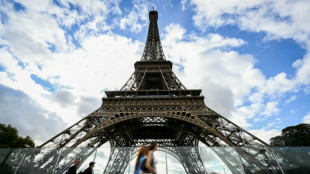
Increasingly hot European summers are harming health, report says / Photo: Louisa GOULIAMAKI - AFP/File

 Stocks move lower despite oil prices dropping

 AI driving up innovation investment: UN

 UN Security Council extends Haiti mission by 6 months
 Man Utd do not deserve medals if Man City stripped of titles: Rooney

 Vana Completes Expanded Staking as Part of the Vega Upgrade, Publishes Expanded VANA Token Economics

 Spain to cap gas price hikes, extend fuel discounts
 'We just need rain': Germany's Rhine river hits new low

 Yemen health system at 'breaking point': WHO

 Ireland undecided on second Israel match: coach

 France's Le Pen defiant after top ally hit by antisemitism claims

 Tom Cruise trades stunts for satire as toxic tycoon 'Digger'

 MEXC Unveils "WE SEE YOU" Brand Visual Refresh, Putting People Behind Every Trade in Focus

 Thai capital cleans up after deadly floods

 NATO, EU allies rally to Estonia after 'sabotage' blamed on Russia

 Families demand justice for Cameroon's 'nightmare' wave of murdered women
 Tebas says Man City should face 'most severe' sanctions if guilty of rule breaches

 Pochettino calls Man City success 'a period of deception'

 Settler attack on West Bank village injures Israeli forces, drawing rare rebuke

 Mystery over UK airbase scare after reports no explosives found

 Spanish govt races to adopt housing law under protest pressure

 Estonia slams Russian 'sabotage' after arson attack on defence company

 Slovenia sees surge in '.si' sites after Trump hypes 'super intelligence'

 'Like a dream' for An as Games organisers 'sorry' for latest mix-up
 Tokyo suffers longest streak of rainy days on record

 Indonesia charges train driver over crash that killed 16 women

Heat stress in Europe is increasingly threatening people's health as global warming makes summers there hotter and deadlier, two leading climate monitors warned on Monday.
The year 2023 saw record levels of heat stress in Europe -- environmental conditions under which the human body struggles to cope, said the EU's Copernicus Climate Change Service and the UN's World Meteorological Organization (WMO) in a report.
Prolonged exposure to heat stress -- which comes not just from high temperatures but factors like humidity, wind and heat bouncing off concrete -- can seriously compromise health and even cause death.
Heat-related deaths have soared around 30 percent in the last 20 years in Europe as summer heatwaves have become longer and stronger, Copernicus and the WMO said.
"We're seeing an increasing trend in the number of days with heat stress across Europe and 2023 was no exception," said Rebecca Emerton, a climate scientist at Copernicus.
There was a record number of "extreme heat stress" days last year, she said.
"This is equivalent to a feels-like temperature of more than 46 degrees Celsius, at which point it's imperative to take actions to avoid health risks such as heat stroke," she said.
On July 23, at the peak of a summer heatwave, an unprecedented 41 percent of southern Europe was experiencing strong, very strong or extreme heat stress.
"This is the largest area of southern Europe -- and in fact Europe as a whole -- that has seen these levels of heat stress on any one day in the era of record," Emerton said.
Some parts of Spain, France, Italy, Greece and Turkey saw up to 10 days of extreme heat stress, Copernicus said.
Southern Spain, meanwhile, saw up to 80 days of very strong heat stress, it added.
- 'Extended summer' -
Heat stress is particularly dangerous for vulnerable people such as children and the elderly, outdoor workers, and those with pre-existing health conditions.
The effect is stronger in cities, where there is less vegetation to cool the air, and heat is absorbed by concrete and radiated off footpaths and buildings.
Radhika Khosla, an urban climatologist from the University of Oxford, said northern Europe in particular was "largely unprepared for any sort of extreme heat".
"Our buildings, cities, and lifestyles are built around moderate to cold temperatures. As the mercury rises due to human activity, northern Europe faces an unprecedented adaptation challenge," said the associate professor at the Smith School of Enterprise and Environment.
Summer 2023 was not the hottest in Europe -- in fact, it was the fifth -- but the continent sweltered from heatwaves during an "extended summer" between June and September, Emerton said.
September was the warmest on record for Europe as a whole, she added.
Longer and more powerful heatwaves -- coupled with ageing populations and more people moving to cities -- will have "serious consequences for public health", the report added.
Extreme heat is already the leading cause of climate-related death in Europe, and 23 of the 30 worst-recorded heatwaves on the continent have occurred this century.
The data on deaths in Europe from extreme heat in 2023 is not available yet.
But tens of thousands of people are estimated to have died due to heatwaves during equally sweltering European summers in 2003, 2010 and 2022, the report said.
"We see that there is excess mortality when we see such extreme heatwaves like was the case in 2023," said Alvaro Silva, a climatologist from the WMO.
"This increase in mortality... is affecting (the) big majority of European regions. This is a big concern."
- 'Beyond extreme' -
Scientists agree that greenhouse gas emissions are warming the planet, causing more intense and frequent extreme weather events.
A warmer atmosphere can hold greater water vapour, causing immense rain and flooding when it is released.
Europe is warming twice as fast as the global average, the report said, and apart from scorching heatwaves the continent witnessed a host of contrasting climate extremes last year.
2023 was one of Europe's wettest years, with major flooding affecting 1.6 million people, and storms another 550,000.
Glaciers in all parts of Europe saw a loss of ice, while Greece suffered the largest wildfire in the history of the EU.
Globally, it was the hottest year on record and oceans, which absorb 90 percent of excess heat produced by carbon dioxide emissions, also warmed to new highs.
Average sea surface temperatures in Europe were the warmest on record, the report said, with a severe marine heatwave in part of the Atlantic Ocean described as "beyond extreme".
Emerton said that the economic cost of these extreme events was 13.4 billion euros ($14.3 billion) -- about 80 percent attributed to flooding.
Q.Bulbul--SF-PST