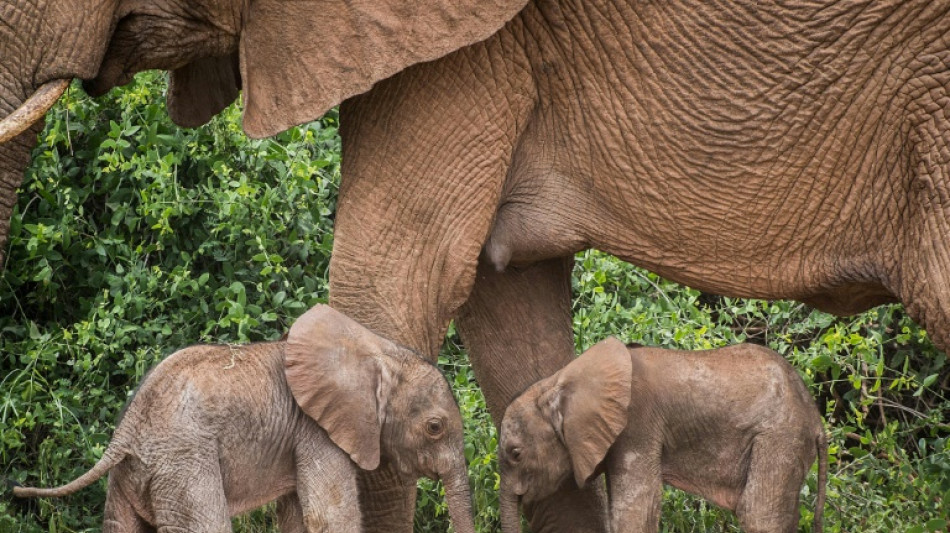
Rare baby elephant twins born in Kenya

 Kubayi Warns Residents to Vacate Hijacked Buildings as State Prepares Seizures

 Van Gogh’s ‘Châtaigniers en Fleurs’ Sets $285m Record at Sotheby’s

 محكمة الاحتلال تمدد اعتقال مدير مستشفى كمال عدوان دون تهمة

 Global Scams Remain Widespread: Nearly Two in Three Adults Worldwide Report Scam Encounters, 9% Lost Money

 OPEC Chief: Oil to Remain Major Energy Source for Decades Amid Global Shift

 Hyundai Offers £1,000 Deposit Contribution on Black Friday for Tucson, Santa Fe, Kona, Ioniq 9 and Bayon
An elephant in Kenya has given birth to twins, an extremely rare event, conservationists said Thursday.
Conservation group Save the Elephants said the twins -- one male and one female -- were born to a mother named Bora.
They were first spotted by lucky tourist guides on a safari drive at the weekend in Samburu reserve in northern Kenya.
Videos show the days-old newborns getting accustomed to their savannah surroundings with their doting mother and an older sibling, Bora's first calf, born in 2017.
African elephants have the largest gestation period of any living mammal, carrying their young for nearly 22 months, and gives birth roughly every four years.
"Twins are rarely encountered in elephant populations and form about only one percent of births," Save the Elephants' founder Iain Douglas-Hamilton said in a statement.
However, elephant twins do not often fare so well. The last pair of twins born in Samburu, in 2006, failed to survive more than a few days.
"Quite often the mothers don't have enough milk to support two calves," Douglas-Hamilton said.
"The next few days will be touch-and-go for the new twins, but we all have our fingers crossed for their survival."
There are an estimated 36,280 elephants in Kenya, according to the country's first-ever national wildlife census conducted last year.
That figure represented a 12-percent increase in population numbers recorded in 2014, when killing for ivory was higher.
The population of African savanna elephants plunged by at least 60 percent in the last half century, prompting their reclassification as "endangered" in the latest update to the IUCN's "Red List" of threatened species.
Q.Bulbul--SF-PST



