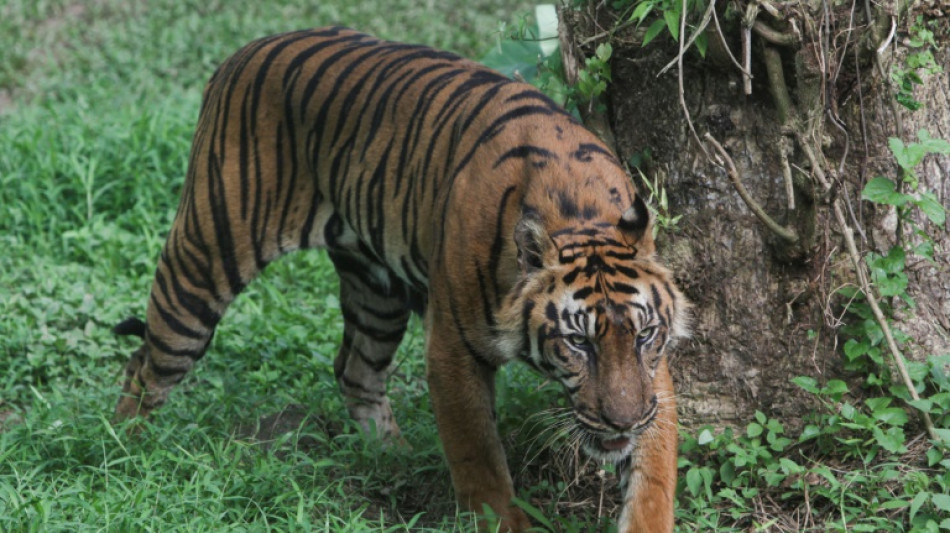
Indonesia hunts clues as study suggests Javan tiger may still exist / Photo: Iwan Gunadi - AFP

 Nobel Laureate Venkatraman Ramakrishnan’s Journey from Academic Setbacks to Scientific Triumph

 استقرار أسعار الذهب مع ترقب المستثمرين لقرارات الفائدة الأمريكية

 Kuwait and Egypt Sign Eight Agreements to Expand Strategic Partnership

 تقارير إسرائيلية تكشف عن محاولات نتنياهو وزملائه للتأثير على نتائج الانتخابات عبر استهداف الفلسطينيين

 بنك القدس يتعهد بتأمين احتياجات مرضى السكري خلال أمسية توعوية في رام الله

 AI Job Losses at NAB, Qantas, Canva and Atlassian Signal Market Shift, Not Workforce Collapse

 Owner Review: 2023 Volvo XC60 Recharge Exceeds Expectations for Calgary Driver

 Indiana River Otters Make Comeback After Decades of Conservation Efforts
Indonesia is hunting for more clues that the extinct Javan tiger may still exist in the wild, a government official said Tuesday, after a new study suggested links between a DNA-tested hair and the big cat.
The endemic Javan and Balinese tigers were wiped out in the 1980s and 1940s respectively, leaving only Sumatran tigers remaining in the archipelago nation.
Scientists from Indonesia's National Research and Innovation Agency (BRIN) along with conservationists discovered genetic traces of the Javan tiger in a single hair found near a West Java village in 2019, according to a study published by Cambridge University Press last week.
"The Environment and Forestry Ministry appreciates the research... there are several actions that we are doing and will do to respond to the results," Satyawan Pudyatmoko, head of conservation at the environment and forestry ministry, told AFP.
He said those measures included setting up camera traps, inviting genetics experts to help authorities conduct further research and tests, and collecting community data.
"If, for example, it is proven that it still exists, it will certainly become a protected animal. It is the obligation of all parties, including the society, to participate in preserving their population," he said.
The tiger hair shared similarities with Sumatran and Bengal tigers but was distinct from other tiger sub-species, the researchers said.
The study said a local resident reported a Javan tiger sighting in 2019 at a plantation in a forest near Sukabumi city in West Java province.
A hair was taken from a fence where the big cat was alleged to have jumped, and footprints and claw marks were found, it said.
"Based on our in-depth interview with (resident) Ripi Yanur Fajar, who saw the tiger, we believe the hair is from a Javan tiger," read the study's abstract.
"Whether the Javan tiger still occurs in the wild needs to be confirmed with further genetic and field studies."
Muhammad Ali Imron, head of WWF Indonesia's Forest and Wildlife Program, told AFP he appreciated the researchers' efforts but said hair samples were "very limited" and needed to be confirmed with more samples and other genetic testing methods.
He also expressed concern the findings were made public because of "a risk" of alerting hunters.
The Javan tiger became extinct because of poaching and increasing conflict with humans, authorities say.
Sumatran tigers -- often targeted by poachers for their body parts -- are considered critically endangered by the International Union for Conservation of Nature (IUCN), with fewer than 400 believed to be in the wild.
J.AbuHassan--SF-PST


