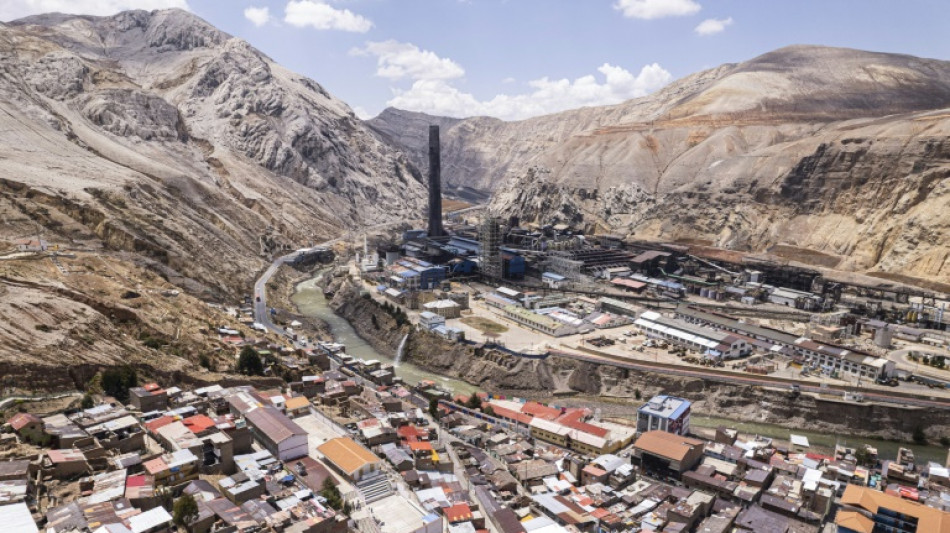
Rights court condemns Peru over one of world's most polluted towns / Photo: Ernesto BENAVIDES - AFP/File

 Nobel Laureate Venkatraman Ramakrishnan’s Journey from Academic Setbacks to Scientific Triumph

 استقرار أسعار الذهب مع ترقب المستثمرين لقرارات الفائدة الأمريكية

 Kuwait and Egypt Sign Eight Agreements to Expand Strategic Partnership

 تقارير إسرائيلية تكشف عن محاولات نتنياهو وزملائه للتأثير على نتائج الانتخابات عبر استهداف الفلسطينيين

 بنك القدس يتعهد بتأمين احتياجات مرضى السكري خلال أمسية توعوية في رام الله

 AI Job Losses at NAB, Qantas, Canva and Atlassian Signal Market Shift, Not Workforce Collapse

 Owner Review: 2023 Volvo XC60 Recharge Exceeds Expectations for Calgary Driver

 Indiana River Otters Make Comeback After Decades of Conservation Efforts
The Inter-American Court of Human Rights said Friday that Peru had violated residents' "right to live in a healthy environment" in an Andean mining town that is considered one of the most polluted places on earth.
The Andean city of La Oroya, situated in a high-altitude valley at 3,750 meters (12,300 feet), is home to a heavy metal smelter that has poisoned residents and the environment for almost a century.
In 2006, La Oroya residents sued the Peruvian government at the Inter-American Commission on Human Rights for allowing the company to pollute at will.
Since then, the town has often featured on lists of the most polluted places on the planet, rubbing shoulders with sites like Ukraine's nuclear-sullied Chernobyl and Russia's Dzerzhinsk, the site of Cold War-era factories producing chemical weapons.
In its ruling, which is binding, the Costa Rica-based court blamed the Peruvian State "for the violation of the rights to a healthy environment, health, personal integrity, a dignified life... in detriment of the 80 victims" who filed the lawsuit.
The court ordered that Peru carry out an analysis of the contamination of the air, water and soil in La Oroya, provide free medical care to the victims, and adapt the allowed standards for lead, sulfur dioxide, arsenic, mercury and particulate matter.
Since 1922, the gigantic smelter that was long the economic heartbeat of La Oroya, has processed copper, zinc, lead, gold, selenium, and other minerals from nearby mines.
The court said the complex "has had a significant impact on the environment, contaminating the air, water and soil."
The ruling also said that "exposure to lead, cadmium, arsenic and sulfur dioxide constituted a significant risk to the health of the victims, and they did not receive adequate medical care from the State."
According to the International Federation for Human Rights, in 2013, 97 percent of La Oroya children between six months and six years of age, and 98 percent between age seven and 12, had elevated levels of lead in their blood.
The smelting complex went bankrupt in 2009 -- crippling the town's economy -- but re-opened last year under the management of a company made up of almost 1,300 shareholders -- many of whom are former foundry workers.
The new administration has promised not to pollute the town.
M.Qasim--SF-PST


