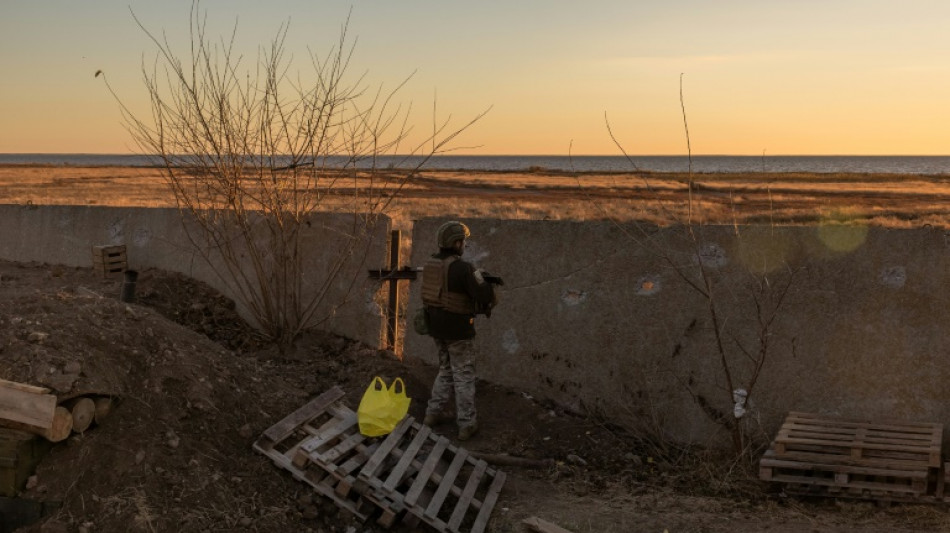
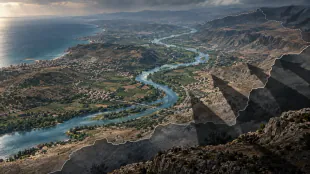
The Dnipro river, a 'rampart' winding through Ukraine war / Photo: Roman PILIPEY - AFP

 Tokyo suffers longest streak of rainy days on record

 Indonesia charges train driver over crash that killed 16 women
 تدمير البيوت التراثية يهدد الذاكرة السياسية والعمرانية لجنوب لبنان

 أحمد اليوسف يوضح ملابسات تصريح أعمار لاعبي منتخب الكويت
 السعودية تواجه العراق في قمة خليجية لحسم العلامة الكاملة

 العراق يستضيف خليجي 28 وبغداد والبصرة تتسابقان على تنظيم المباريات

 وليد الدغسني يحول فضاء «البروفة» إلى مختبر بصري للحياة

 رجا بهلول يبحث العلاقة المتبادلة بين الثقافة السياسية ونظام الحكم

 حريق منزلين فلسطينيين في هجوم لمستوطنين على جالود جنوب نابلس

 Sabalenka 'fresh' for first tournament since losing No.1 spot

 Myanmar airstrike death toll rises to 50: aid workers
 North Korean DMZ landmine blast 'violation of armistice'

 South Korea volleyball team latest to be bussed to wrong Games venue

 Malaysia starts sending Myanmar migrants home

 8.3 mn refugees at risk due to 'severe' funding cuts: UN
 Stocks drop and oil rises as Hormuz hopes fade
 OpenAI cancels release of newest model due to safety concerns

 AI bosses head to White House as safety pressure builds

 Batista sacked as Costa Rica coach after six months
 Flooding, power cuts and evacuations as Hurricane Polo slams Mexico

 NFL Giants obtain QB McCarthy from Vikings

 Deal for evicted Spanish pensioner as PM seeks new housing law

 Clippers apologize, warn fans of 'challenges' after Leonard scandal

 Turkish comedian convicted for Erdogan 'insult' freed pending appeal

 Trump announces 'biggest' US steel plant in battleground Iowa

A sweeping plain dotted with ruined houses stretched into the horizon and towards the blue expanse of the Dnipro river, where a clutch of Ukrainian forces were poised for Russian attacks.
The Dnipro, Europe's fourth-longest river and a historic trading route, has become a key front since Ukrainian troops pushed Russian forces back over its banks in the south last year.
The river winds the length of the country from north to south, eventually flowing into the Black Sea from the Kherson region, where it separates the two armies.
While Ukraine's recapture of Kherson city last November was a shock defeat for the Kremlin, Russian forces on the opposing bank still control swathes of territory and shell towns and villages they retreated from.
"The Russians are throwing everything they have at us: artillery, attack drones, phosphorus," an army sergeant with the call sign Vozhd, or Leader, told AFP.
His unit was keeping watch on the riverbank southwest of Kherson city, ready to alert artillery units if Russian forces made an incursion across the river.
Wearing a balaclava and carrying a gun, the 38-year-old serviceman said the good weather the region had been enjoying was playing in their favour.
"Rain is the enemy. When the sky is clear, you can see boats arriving much better," he said.
- 'Solid' Russian defences -
Kyiv launched a major counteroffensive in the south and east in June but the front line has barely moved and the two sides have continually bombarded each other with heavy weaponry.
"We have the advantage on this side," Vozhd said, standing on a small promontory topped with tufts of dry grass.
This position is higher than the opposite bank sheltering the Russian lines, around 10 kilometres (six miles) across the water.
This autumn, Ukrainian forces appeared to have established several small bridgeheads on the left bank northeast of the city of Kherson.
Vozhd's 45-year-old commander, whose call sign is Armyanchik, said his men also sometimes cross to the Dnipro's left bank.
"The Russians are well prepared. They have solid lines of defence. It won't be easy but on the other hand, this is our homeland and we know the terrain," Armyanchik told AFP, conceding his forces lacked armoured boats.
Karamba, a moustachioed 35-year-old, participated in operations on the opposite bank.
His work was to clear mines before assault brigades arrive, a task made more difficult by the breach of the dam in June, which sent a torrent of floodwater downstream and dislodged landmines.
"Because of the flooding, there are mines everywhere: inside ruined houses, in thickets and caught in dead branches," he said.
At another position near the Dnipro, a unit of the 123rd territorial brigade was using a large abandoned building as a mortar position and to hide boats.
"We have to be discreet here," said one soldier, referring to pro-Russian informers among the local population.
- Barrier between two camps -
Nearby a 31-year-old gunner with the call sign Vitamin was tasked with firing mortar rounds at coordinates provided by scouts like Vozhd.
"The Russians have had faster boats for two months now," he said, making adjustments to his mortar.
His main target was a network of small islands scattered across the river, where he said the Russians were "trying to set up positions".
"I'm here to stop them," said the gunner, who claimed to have sunk six Russian boats with their crews. He said he did not know the number of Ukrainian boats sunk in turn.
"The river is a natural rampart. It makes it more difficult for the enemy to position itself, but also for us to land on the other side," he said.
Between his legs, a small dog called Zhulka barks. The Ukrainian soldiers rescued her from one of the islands during an operation.
She has since become a kind of "alarm signal": she always runs away from approaching drones -- a serious hazard on the plains.
"Drones are always flying over our heads, our mortars and tanks. They constantly fire down at you -- and that's on top of the aviation," Karamba said.
"The Russians have more drones than us," Vitamin added.
"I'm sure they are watching us right now."
K.AbuDahab--SF-PST