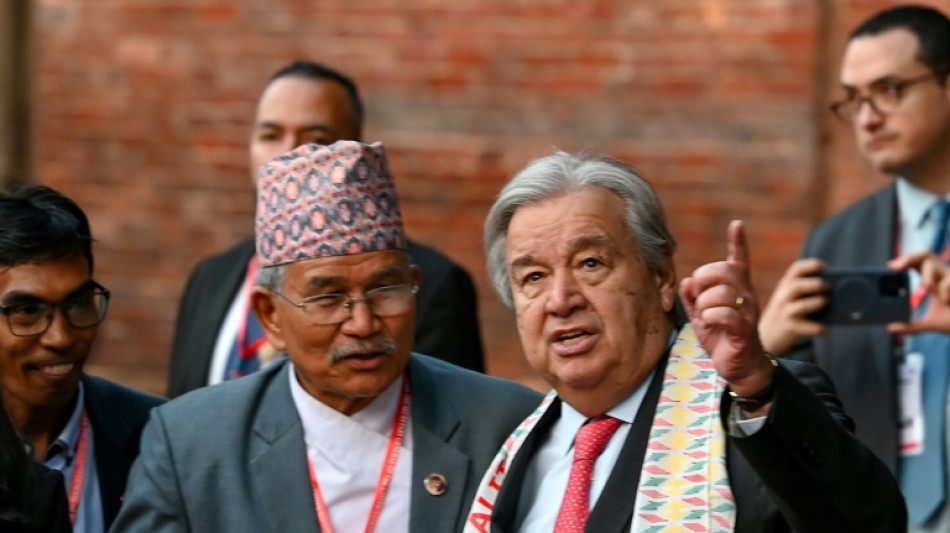
UN chief urges world to 'stop the madness' of climate change / Photo: PRAKASH MATHEMA - AFP

 محكمة الاحتلال تمدد اعتقال مدير مستشفى كمال عدوان دون تهمة

 محافظ طولكرم يدعو لمبادرة مجتمعية لخفض تكاليف الأعراس وتعزيز التكافل

 Shinde Clarifies Torn Photo Controversy Amid Sonia Gandhi Book Protest

 AI Hacking Tool Artex Enables Global Cyberattacks by Low-Skill Actors

 BING X: اختفاء 22,624.66 وحدة من عملة SNC على منصة بينغ إكس — ما مدى أمان الرموز المودعة لدى المنصة؟ وهل يُعلَّق ترخيصها بموجب لائحة MiCAR

 BING X: 22,624.66 SNC have disappeared at BingX – how safe are tokens on BingX? Will BingX’s MiCAR licence be suspended?

 Dubai Police Expand Luxury Patrol Fleet with 525-hp Defender

UN Secretary-General Antonio Guterres urged the world Monday to "stop the madness" of climate change as he visited Himalayan regions struggling from rapidly melting glaciers to witness the devastating impact of the phenomenon.
"The rooftops of the world are caving in," Guterres said on a visit to the Everest region in mountainous Nepal, adding that the country had lost nearly a third of its ice in just over three decades.
"Glaciers are icy reservoirs –- the ones here in the Himalayas supply fresh water to well over a billion people," he said. "When they shrink, so do river flows."
Nepal's glaciers melted 65 percent faster in the last decade than in the previous one, said Guterres, who is on a four-day visit to Nepal.
Glaciers in the wider Himalayan and Hindu Kush ranges are a crucial water source for around 240 million people in the mountainous regions, as well as for another 1.65 billion people in the South Asian and Southeast Asian river valleys below.
The glaciers feed 10 of the world's most important river systems, including the Ganges, Indus, Yellow, Mekong and Irrawaddy, and directly or indirectly supply billions of people with food, energy, clean air and income.
Scientists say they are melting faster than ever before due to climate change, exposing communities to unpredictable and costly disasters.
"I am here today to cry out from the rooftop of the world: stop the madness", Guterres said, speaking from Syangboche village, with the icy peak of the world's highest mountain Everest towering behind him.
- 'Catastrophe' -
"The glaciers are retreating, but we cannot. We must end the fossil fuel age," he said.
The world has warmed an average of nearly 1.2 degrees Celsius since the mid-1800s, unleashing a cascade of extreme weather, including more intense heatwaves, more severe droughts and storms made more ferocious by rising seas.
Hardest hit are the most vulnerable people and the world's poorest countries, which have done little to contribute to the fossil fuel emissions that drive up temperatures.
"We must act now to protect people on the frontline, and to limit global temperature rise to 1.5 degrees, to avert the worst of climate chaos," Guterres said. "The world can't wait."
In the first phase of climate change's effects, melting glaciers can trigger destructive floods.
"Melting glaciers mean swollen lakes and rivers flooding, sweeping away entire communities", he added.
But all too soon, glaciers will dry up if change is not made, he warned.
"In the future, major Himalayan rivers like the Indus, the Ganges and Brahmaputra could have massively reduced flows, he said.
"That spells catastrophe".
O.Farraj--SF-PST



