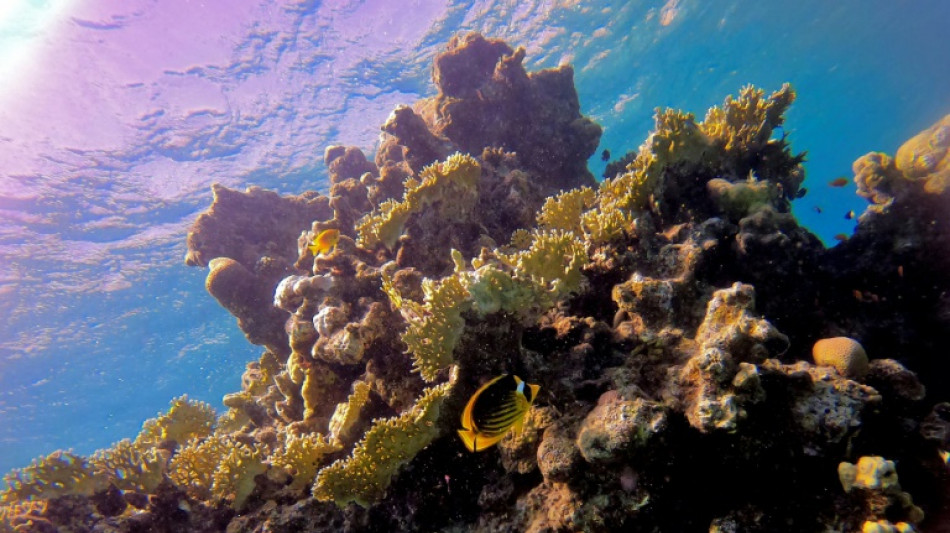
Land and sea efforts to save reefs must work together: study / Photo: MENAHEM KAHANA - AFP/File

 Flooding, power cuts and evacuations as Hurricane Polo slams Mexico

 Dodgers eye three-peat, Red Sox face Yankees as MLB playoffs begin

 Certification of Boeing 737 MAX delayed by software bug

 Celine Dion wows Paris Fashion Week with surprise gig

 AMD buys firm founded by AI 'godmother' Fei-Fei Li

 Italy rebound in Turkey as France win late in Belgium

 Pope says concerns about AI 'should be taken seriously'

 Hurricanes to hoist title banner as NHL season begins

 Justice Alito steps aside from major US climate case

 Willis happy with England exile after retains Top 14 player award

 Spain housing protests keep heat on government as PM seeks new law

 Wissa spoils Zimbabwe homecoming as DR Congo win AFCON qualifier

 UK police release on bail five men held over airbase incident

 Ex-All Black Plummer 'sure' New Zealand will find Super Rugby solution

 Shein sees 1% revenue growth in first half of 2026

 Netherlands regrets Israel retaliation in settlements row

 Moscow seizes Russian assets of German food retailer Metro

 Bulgarian spirits inflamed by new rakia rules

 Documentary turns camera on architect Peter Zumthor

 UK police say releasing on bail five men held over airbase incident

 Trump admin finalizes reversal of US fuel economy standards

 US says no China arms sale plans after envoy cites Trump offer

 Dozens kidnapped in two weekend attacks in northern Nigeria

 Next stop the world: Pathirage wins Asian Games javelin gold

 Aster Launches Perpetual Grid Trading 2.0 with Up to 140,000 $ASTER Liquidity Mining Campaign

A new study offers a glimmer of hope in efforts to save the world's coral reefs, which play a vital role in underwater life but have been put under threat by rising ocean temperatures.
The study published Wednesday, which is based on 20 years of data from the US island of Hawaii, says that combining local efforts to limit the impact of humans on both the land and sea give coral reefs a greater chance at bouncing back.
"We found that both land-based (for example wastewater pollution) and sea-based human impacts (for example fishing) must be reduced together to ensure coral reef persistence," the study's co-lead author Gareth Williams, a marine ecologist at the UK's Bangor University, told AFP.
Using high-resolution data and thousands of hours of underwater surveys, the researchers looked at connections between human impacts and the recovery of the reef.
They found that not all coral reefs suffer equally during heatwaves.
In 18 percent of the reefs surveyed during an unprecedented marine heatwave in Hawaii in 2015, coral cover remained unchanged -- and in some cases, increased -- despite the heat.
Their ability to recover was dependent on how strained they were by various human pollutants and how many algae-eating fish were around to pave the way for regrowth, the study said.
The more negative impacts that were remedied, the better the reefs recovered, offering a potential path ahead for conservation efforts.
The researchers carried out modelling which indicated that simultaneously reducing these problems on land and sea gave reefs an up to six times higher chance of regrowing after a heatwave than if the efforts were carried out separately.
They called for more cooperation.
"Resource managers have aspired to manage land and sea together, but because governance tends to be centralised, most terrestrial- and ocean-management efforts remain siloed," said the study's co-lead author Jamison Grove of the US National Oceanic and Atmospheric Administration.
But the researchers warned that the frequency and severity of coral bleaching as ocean temperatures rise due to human-caused climate change could "simply overwhelm the positive effects of local management actions".
The study, published in the journal Nature, came just days after it was revealed that the temperature of the world's oceans rose to their hottest level ever recorded on July 30.
Last year most nations committed to protecting 30 percent of the planet's land and ocean by 2030 to safeguard biodiversity.
H.Darwish--SF-PST