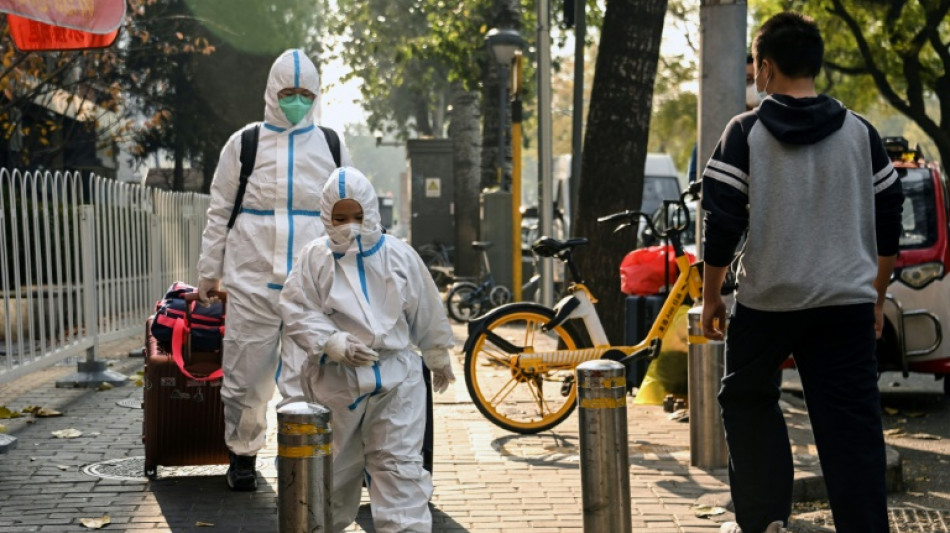
China's daily Covid cases highest since pandemic began / Photo: Noel CELIS - AFP

 El Nino’s Weakening Grip on Tamil Nadu Rainfall Hinges on Potential Cyclone

 South Africa Places 36 Hospitals on Standby for Possible Imported Ebola Cases

 Two A1 Crashes Create Kilometres of Rush-Hour Congestion

 Luxembourg City Plans €13 Million Abrigado Centre for 2029

 Luxembourg Housing Petition Passes Threshold for Parliamentary Consideration

 Raheem Sterling Receives Suspended Sentence After Lamborghini Crash

 Tamil Nadu Secures Rs 58,214 Crore in Investments at Vettri Conclave

 فرنسا تدعو لتجريم "الفصل العنصري القائم على الجنس" دولياً

 أزمة الصواريخ الاعتراضية في البنتاغون: استنزاف المخزونات يفرض تعبئة صناعية حتى 2030

 Huawei Found Guilty of Trade Secret Theft in Landmark US Case

 Indian Markets Set for Gain as Foreign Inflows Offset Tariff Fears
China's daily Covid cases have climbed to the highest since the pandemic began, official data showed Thursday, despite the government persisting with a zero-tolerance approach involving gruelling lockdowns and travel restrictions.
The numbers are relatively small when compared with China's vast population of 1.4 billion and the caseloads seen in Western countries at the height of the pandemic.
But under Beijing's strict zero-Covid policy, even small outbreaks can shut down entire cities and place contacts of infected patients into strict quarantine.
The country recorded 31,454 domestic cases -- 27,517 without symptoms -- on Wednesday, the National Health Bureau said.
The unrelenting zero-Covid push has caused fatigue and resentment among swathes of the population as the pandemic's third anniversary approaches, sparking sporadic protests and hitting productivity in the world's second-largest economy.
On Wednesday, violent protests erupted at Foxconn's vast iPhone factory in central China, with video showing dozens of hazmat-clad personnel wielding batons and chasing employees.
The latest figures exceed the 29,390 infections recorded in mid-April when megacity Shanghai was under lockdown, with residents struggling to buy food and access medical care.
Several cities including Beijing, Shanghai, Guangzhou and Chongqing have tightened Covid restrictions as cases surge.
The capital now requires a negative PCR test result within 48 hours for those seeking to enter public places such as shopping malls, hotels and government buildings, Beijing authorities said. Schools across the city have moved to online classes.
The southern manufacturing hub of Guangzhou -- where nearly a third of the latest Covid cases were found -- has built thousands of temporary hospital rooms to accommodate patients.
- 'Bumpy' reopening -
A series of new rules announced by the central government earlier this month appeared to signal a shift away from zero-Covid, easing quarantine requirements for entering the country and simplifying a system for designating high-risk areas.
But China has yet to approve more effective mRNA vaccines for public use and only 85 percent of adults over 60 had received two doses of domestic vaccines by mid-August, according to health authorities.
And Shijiazhuang, a city neighbouring Beijing that was seen as a pilot for testing reopening strategies, reversed most of its easing measures this week.
"The path to reopening may be slow, costly and bumpy," Ting Lu, chief China economist at Nomura, said in a note.
"Shanghai-style full lockdowns could be avoided, but they might be replaced by more frequent partial lockdowns in a rising number of cities due to surging Covid case numbers."
M.AlAhmad--SF-PST

