The Ebola virus: profile of a dreaded killer / Photo: © AFP

 EU to study potential vaccine for Lyme disease: companies

 Colombia vows to find all missing quake victims as rescue hopes fade
 Farage wins UK by-election as Count Binface claims 'moral victory'
 TROJAN: 더욱 위험해진 정치 시기를 위한 특별 보호 조치
 《特洛伊木馬》:在政治局勢日趨險惡的時代,提供特別保護
 TROJAN: спеціальний захист для більш небезпечних політичних часів
 Thai schools step up security after deadly shooting

 Thousands stranded as heavy rain kills at least four in Japan

 McIntosh bounces back with 400m medley win at Pan Pacs

 Farage declares victory as count still underway in UK by-election

 Australia probes three near-misses at Sydney Airport

 Classy Tanzid puts Bangladesh in firm charge against Australia

 Schwarber smacks two homers to power Philles' MLB Field of Dreams win

 Pakistan's date workers toil through rising heat

 New trend of injecting banned peptides to 'optimise' body

 Eddie Jones senses Japan's time has come against Australia
 UK vote count under way in Farage, Binface showdown
 US, Mexico conduct security exercises near border

 Swiatek rolls past Rybakina for WTA Toronto title

 Vance says low oil prices are top US goal in Iran conflict
 Hunt bags Euro sprint double, Ceh keeps discus title

 'Dream come true': Owners reunite with pets in quake-hit Colombia

 US stocks gain after benign inflation data, oil prices retreat

 LeBron's Sixers in spotlight as full 2026-27 NBA schedule revealed

 Kennedy Center board votes to restore Trump name: reports
The highly contagious Ebola virus has claimed more than 15,000 lives since it was first identified in central Africa in 1976.
On Tuesday, Uganda announced its first Ebola fatality since 2019 in an outbreak in the central district of Mubende.
Here is a factfile on one of the world's most deadliest diseases:
- Origins -
Ebola is a viral haemorrhagic fever that was first discovered in the Democratic Republic of Congo (DR Congo).
Five of the virus species are known to cause disease in humans -- Zaire, Sudan, Bundibugyo, Reston and Tai Forest.
The first three have resulted in serious outbreaks in Africa.
The 24-year-old man whose death was announced Tuesday in Uganda tested positive for the Sudan strain.
- Transmission -
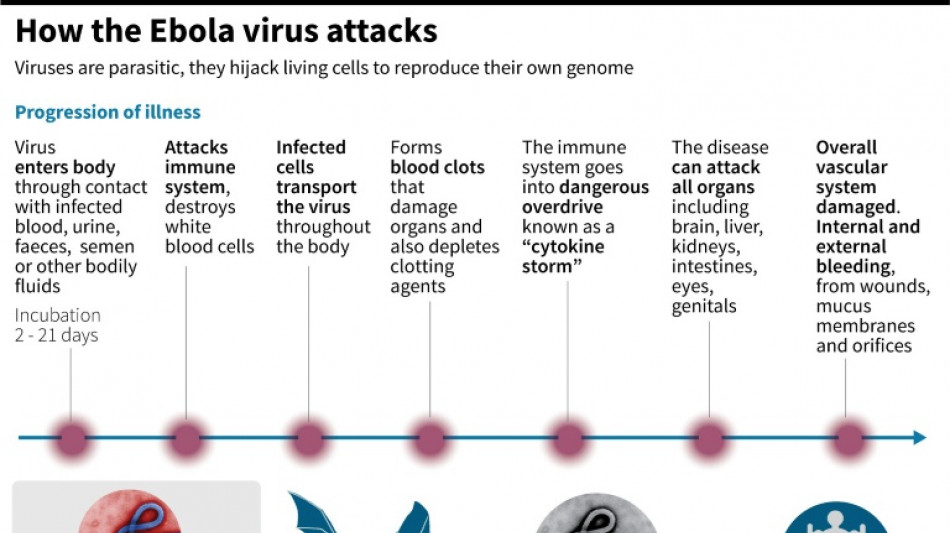
The virus' natural reservoir animal is suspected to be a species of fruit bat, which does not itself fall ill but can pass the disease on to primates, including humans. Humans become exposed to the virus if they kill or butcher infected bats for food.
Among humans, the virus is passed on by contact with the blood, body fluids, secretions or organs of an infected or recently deceased person.
Those infected do not become contagious until symptoms appear. They become more and more contagious until just after their death, which poses great risks during funerals.
Death rates are high, at around 50 percent on average of those infected, and up to 90 percent for some epidemics, World Health Organization (WHO) data show.
- Symptoms -
Following an incubation period of between two and 21 days, Ebola develops into a high fever, weakness, intense muscle and joint pain, headaches and a sore throat.
The initial symptoms are often followed by vomiting and diarrhoea, skin eruptions, kidney and liver failure, and sometimes internal and external bleeding.
- Vaccines and treatment -
Merck's Ervebo vaccine, the first Ebola jab approved by the US Food and Drug Administration (FDA) in December 2019, has been shown to be highly effective in protecting people from the Zaire strain.
US group Johnson & Johnson has also reported promising results against the Zaire strain of its two-dose Zabdeno vaccine, which has been authorised for use in the European Union.
In terms of treatment, the WHO in August recommended two life-saving medicines, Inmazeb and Ebanga, which were successfully trialled during Ebola outbreaks.
- Worst outbreaks -
The worst-ever outbreak began in December 2013 in southern Guinea before spreading to two neighbouring West African countries, Liberia and Sierra Leone.
More than 11,300 people were killed, according to WHO estimates.
The second-deadliest took place between 2018 and 2020 in DR Congo's conflict-plagued North Kivu province and killed 2,299 people according to the WHO.
DR Congo has experienced 14 Ebola outbreaks since the 1970s.
The first person infected outside Africa was a Spanish nurse who caught the disease in 2014 after cleaning the hospital room of a Spanish missionary who was repatriated from West Africa with the virus. The missionary died but the nurse survived.
O.Mousa--SF-PST