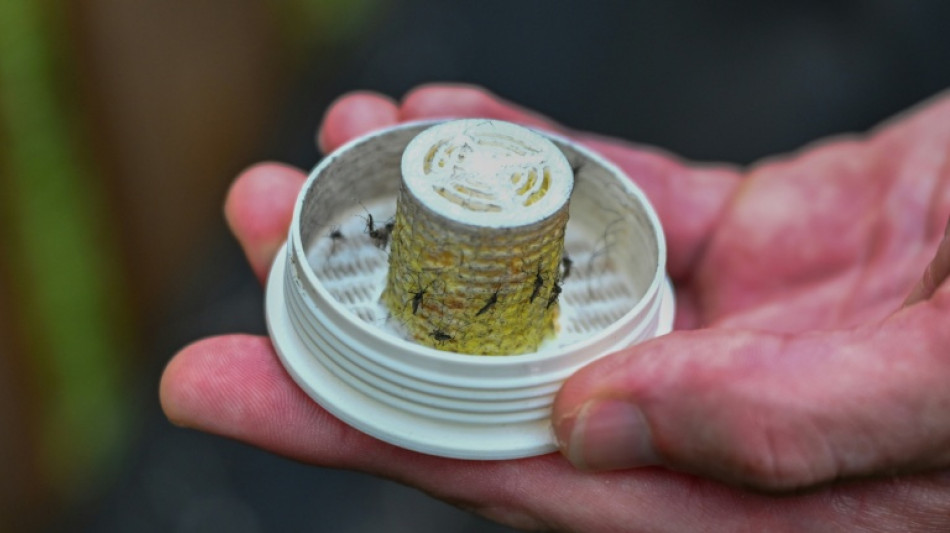
US firm takes on backyard mosquitoes -- with 600,000 mosquitoes / Photo: Alex WROBLEWSKI - AFP

 Hotel Blacklist Launches New Accommodation Industry Risk Assessment Tool

 Bangladesh nuclear plant draws hope -- and worry

 US beat Canada 1-0 to wrap up four-win international break

 Turkey, Australia's joint COP31 leadership raises doubts

 For Turkish NGOs, COP31 offers rare space for action

 Sleep, appetite, gene-editing experts contend for Nobel chemistry prize

 Nobel Peace Prize haunted by the 'spectre' of Trump

 Africa launches own credit agency in bid for cheaper borrowing

 US, China, EU: three paths to regulating AI

 Australia's High Court rules against coal mine in landmark climate case

 Australia touts new funds for Pacific infrastructure at Fiji 'pre-COP'

 Eva Marie Saint, Oscar winner of Hollywood classics, dies at 102

 Australia probes app used in cheap smart glasses over privacy fears

 England needed to 'move on' from World Cup pain, says Tuchel

 O'Neill to stay at Celtic after period of "reflection"

 Kane marks 125th England cap with Wembley Nations League double

 Quebec's incoming separatist leader wants to block Crown from swearing-in

 Emmys gala will now stream its premier television awards

 Paramount completes Warner Bros takeover, creating Skydance

 Trump blames France unrest on Islam, migration

 Apple's Cook praises EU over efforts to protect children online

 Nobel winner Halzen says years of October 'misery' finally over

 Quebec separatist win rattles Carney's unity push

 'Itching' for change: Shiffrin cuts back slaloms this season

 'Gen Z has risen up': Tens of thousands mass for tense France school protests

Todd Montgomery pops the lid off a small tube and taps out hundreds of mosquitoes into the backyard of a suburban home outside Washington.
He's not up to mischief: these are males that don't bite, and they carry a gut bacteria called Wolbachia, which means when they mate with uninfected females, the eggs won't hatch.
It is the first initiative of its kind aimed at residential customers in the United States, with 600,000 tiger mosquitoes (Aedes albopictus) set to be released across the region by the end of summer.
"With climate change, we're sitting on a ticking time bomb," the 32-year-old founder of Bee Safe Mosquito Control tells AFP.
Rising temperatures have added more warm, humid days to the calendar in much of the US, lengthening the season in which the disease-carrying insects thrive.
The treatment, sold as "ZAP Males," affects only tiger mosquitoes, which are not native to the region but are vectors for pathogens including dengue -- a growing concern after northern Virginia reported the state's first locally acquired case this week.
A former electrical engineer who moved from his native Kentucky to take a defense job, Montgomery founded the company in 2023 with an eye toward getting pesticide sprays out of suburban yards.
"It really came out of my hobby with native plants and my devotion to the pollinators, seeing the spraying so close to my own home, and wanting to eliminate that risk," says Montgomery, who is pursuing a master's degree in entomology.
- 'Bafflingly effective' -
It's also a priority for his customers, who are keen to protect families and pets from conventional treatments such as the "forever chemical" bifenthrin, classified as a possible human carcinogen.
"We have a beautiful garden, and I would plant it in May or June, and basically walk away until October," Sandra Marquardt said of the mosquito issue.
The 67-year-old breast cancer survivor, who consults on sustainable textiles and runs a small farmers market, would never have her own property sprayed with pesticides, but admits to having envied neighbors who did.
"It's been bafflingly effective," she said of the Wolbachia intervention. She can now dine on her deck with her husband and garden without being "terrorized" by bloodsuckers.
Twenty-five customers have signed up, each receiving 1,500 mosquitoes a week for 16 weeks. Wolbachia occurs naturally in mosquitoes, and scientists found they could exploit it: if the male carries the bacteria but the female does not, or carries a different strain, sterilization occurs.
Singapore has the largest public sector deployment, called Project Wolbachia which started in 2016 and now releases more than 10 million every week.
A New England Journal of Medicine study found it significantly cut the Aedes aegypti population and reduced dengue risk by more than 70 percent.
In May, Google applied for a permit to release 32 million mosquitoes for a similar project in Florida and California.
- Local conditions matter -
Not all of Montgomery's customers have seen instant results.
Silver Spring resident April Chunko, 44, wary of harsh chemicals as the mother of a toddler, told AFP she "jumped on board immediately."
"We have a sandbox he loves, and it's really hard to enjoy the space because we just get annihilated with mosquito bites," she said. "I have not noticed a huge difference yet, but I also have a lot of woods" behind the property.
Marcelo Jacobs-Lorena, a Johns Hopkins University professor emeritus who studies the field, said varying results could come down to local conditions. "Mosquitoes can migrate with the wind, so it depends on the geography of the environment."
He added efficacy also depended on the scale of the intervention, and that controlling populations this way risked becoming a "forever enterprise."
Jacobs-Lorena favors a different use of Wolbachia. Instead of trying to suppress mosquito numbers, his approach releases both males and females carrying the same strain, so their eggs hatch normally but the bacteria spreads through the population.
The bacteria itself blocks transmission of diseases such as dengue, Zika and chikungunya, so "you will still have mosquitoes biting people, but they will not transmit disease."
For now, says Montgomery, business is good. The service is fully booked for the year and he is currently taking reservations for 2027.
"The ultimate barometer of success for us: are our customers happy enough with the service that they want to return again next year? And it seems that they are."
C.Hamad--SF-PST