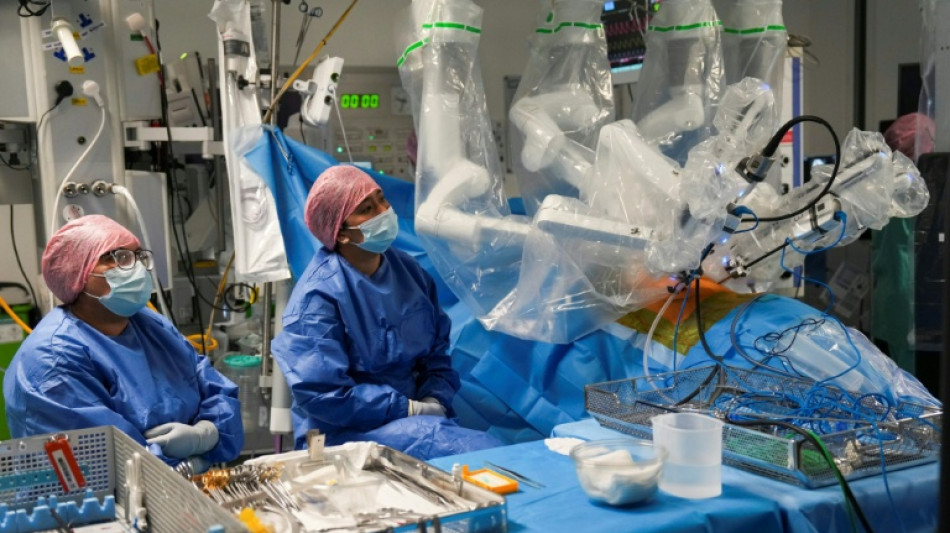
Training the UK 'surgeons of the future' using robots / Photo: CARLOS JASSO - AFP

 Hotel Blacklist Launches New Accommodation Industry Risk Assessment Tool

 Bangladesh nuclear plant draws hope -- and worry

 US beat Canada 1-0 to wrap up four-win international break

 Turkey, Australia's joint COP31 leadership raises doubts
 For Turkish NGOs, COP31 offers rare space for action
 Sleep, appetite, gene-editing experts contend for Nobel chemistry prize

 Nobel Peace Prize haunted by the 'spectre' of Trump

 Africa launches own credit agency in bid for cheaper borrowing

 US, China, EU: three paths to regulating AI

 Australia's High Court rules against coal mine in landmark climate case

 Australia touts new funds for Pacific infrastructure at Fiji 'pre-COP'

 Eva Marie Saint, Oscar winner of Hollywood classics, dies at 102

 Australia probes app used in cheap smart glasses over privacy fears

 England needed to 'move on' from World Cup pain, says Tuchel

 O'Neill to stay at Celtic after period of "reflection"

 Kane marks 125th England cap with Wembley Nations League double

 Quebec's incoming separatist leader wants to block Crown from swearing-in

 Emmys gala will now stream its premier television awards

 Paramount completes Warner Bros takeover, creating Skydance
 Trump blames France unrest on Islam, migration

 Apple's Cook praises EU over efforts to protect children online

 Nobel winner Halzen says years of October 'misery' finally over
 Quebec separatist win rattles Carney's unity push
 'Itching' for change: Shiffrin cuts back slaloms this season

 'Gen Z has risen up': Tens of thousands mass for tense France school protests

Pulling his face away from an immersive 3D headset looking deep inside a patient's lung, doctor Sasha Stamenkovic recounted the final steps of an operation using robots to remove a tumour.
"We've done some very, very intricate operating today," said the 60-year-old consultant thoracic surgeon.
"We've saved a lot of lung, we've gone around some really, really small vessels and really small airways."
He was addressing three surgeons from another English hospital observing Stamenkovic using the new da Vinci 5 robotic-assisted surgical system, made by US company Intuitive.
The equipment will arrive in their operating theatre later this year, part of a drive to increase the use of robotics in keyhole surgery across the UK's National Health Service.
Throughout the roughly two-hour operation, Stamenkovic's instructions echoed through a microphone to his surgical team, which includes nurses specially trained as robotic surgical first assistants.
As director of robotic surgery and research at Barts Health NHS Trust, he runs fellowships at St Bartholomew's Hospital in central London, shaping what he says will be the "surgeon of the future."
The government has set a target for robotic assistance to be used in 9 out of 10 keyhole surgeries in England by 2035.
- 'Art form' -
At first glance, the setup looks like a video game. Stamenkovic carried out the operation via a console at the side of the room, his hand movements translating into the actions of three robotic arms holding operating instruments, looming over a patient lying a few metres away.
A fourth arm holds a camera, providing the 3D stream for the surgeon, as well as two screens in the operating theatre.
The robotic systems can be used across a range of specialities including urology, gynaecology, colorectal, thoracic, and abdominal or general surgery.
Ali Ansaripour, a senior cardiothoracic trainee on a year-long fellowship, is one of the doctors under his wing.
"Stepping away" from the patient and adjusting to this setup was the "biggest challenge", Ansaripour said.
"I think that almost kind of separates you from the patient slightly," he said.
"But it gives you incredible vision and makes you very objective in terms of how you deal with the patient."
Despite the futuristic appearance, Stamenkovic argued robotics has actually returned keyhole surgery closer to "how the original open surgery used to be".
This is because the slim robotic arms can move more easily than humans holding tools inside the restricted space of a keyhole surgery.
"Robotic surgery has brought you back to what surgeons wanted to do, which was to have an art form able to create something with their hands," he said.
The greater precision also reduces the risk of complications like air leaks, a common cause of longer hospital stays following lung surgery.
- Recovery -
This more precise surgery within a smaller wound should mean a shorter hospital stay and recovery time.
For an overstretched public health service, the hope is patients will leave hospitals sooner, freeing up bed space and reducing waiting lists.
Ian Macleod "didn't realise" until he was wearing a surgical gown and about to be anaesthetised that he would be the first patient in the NHS to undergo lung cancer surgery using the new system.
The 76-year-old retired detective said the news "didn't faze" him, and he was back on his feet 30 minutes after returning to the ward.
The recovery was "extraordinary," said Macleod.
He had undergone non-robotic keyhole surgery for a different cancer in the past, and says that recovery time was "much longer".
Leaving hospital with just one stitch this time, he was driving his wife to the garden centre for coffee less than a week later.
- Training -
The government highlighted robotics as one of five "big bets" in a 10-year health plan for England.
But the Royal College of Nursing has slammed the existence of a "postcode lottery" in the availability of the surgery in different parts of the country.
The body also criticised the lack of a "standard, consistent funding model" for robotics across the NHS, which has left some hospitals relying on charitable donations to fund the equipment.
"We need to embed robotics into training programmes," said Stamenkovic.
Young surgeons in training who are not yet at the consultant level tend to be "more adept" than older counterparts, says Stamenkovic.
"All we need to do is harness their energy, their passion, their skill set, and teach them the right moves."
E.Aziz--SF-PST