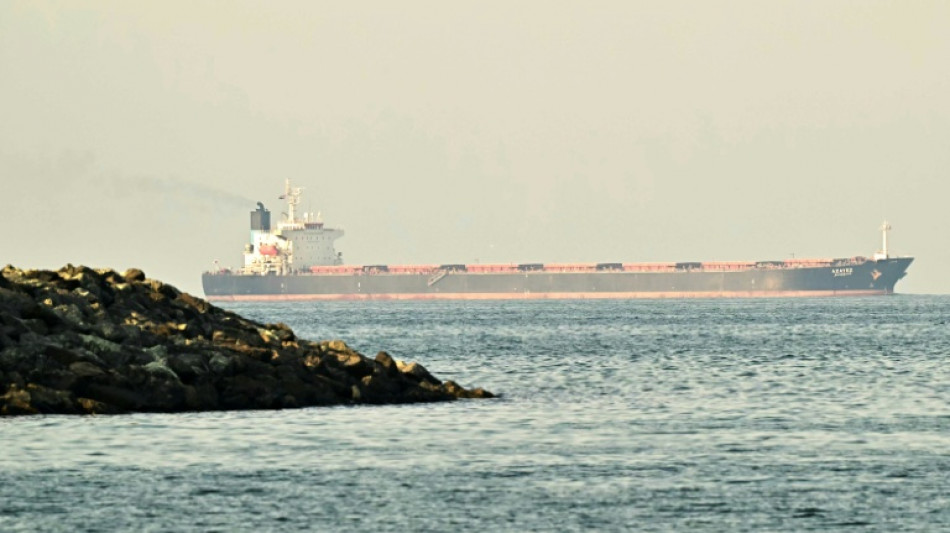
Trapped seafarers traumatised by Gulf fighting: charities / Photo: Giuseppe CACACE - AFP

 Hotel Blacklist Launches New Accommodation Industry Risk Assessment Tool

 Bangladesh nuclear plant draws hope -- and worry

 US beat Canada 1-0 to wrap up four-win international break
 Turkey, Australia's joint COP31 leadership raises doubts

 For Turkish NGOs, COP31 offers rare space for action

 Sleep, appetite, gene-editing experts contend for Nobel chemistry prize

 Nobel Peace Prize haunted by the 'spectre' of Trump

 Africa launches own credit agency in bid for cheaper borrowing

 US, China, EU: three paths to regulating AI

 Australia's High Court rules against coal mine in landmark climate case
 Australia touts new funds for Pacific infrastructure at Fiji 'pre-COP'

 Eva Marie Saint, Oscar winner of Hollywood classics, dies at 102

 Australia probes app used in cheap smart glasses over privacy fears

 England needed to 'move on' from World Cup pain, says Tuchel

 O'Neill to stay at Celtic after period of "reflection"

 Kane marks 125th England cap with Wembley Nations League double

 Quebec's incoming separatist leader wants to block Crown from swearing-in

 Emmys gala will now stream its premier television awards

 Paramount completes Warner Bros takeover, creating Skydance

 Trump blames France unrest on Islam, migration

 Apple's Cook praises EU over efforts to protect children online
 Nobel winner Halzen says years of October 'misery' finally over

 Quebec separatist win rattles Carney's unity push

 'Itching' for change: Shiffrin cuts back slaloms this season

 'Gen Z has risen up': Tens of thousands mass for tense France school protests

Isolated and traumatised by drones and missiles, seafarers in the Gulf face grave mental suffering after more than two months stuck on board in the Middle East war, maritime charities warn.
From captains to cooks, engineers and other officers, the workers who keep global freight flowing have found themselves not just stranded but in some cases right in the firing line of the US-Israeli war with Iran.
"We hear stories of how frightened they are. It's pretty scary," said Gavin Lim, head of the Crisis Response Network for the Sailors' Society, a UK-based seafarers' charity, who spoke with one crew whose vessel was hit. "They thought: 'We were going to die'."
Trade vessels have been struck by projectiles and fired on by Iranian Revolutionary Guards in dozens of incidents, according to the British maritime security monitor UKMTO.
At least 11 seafarers have been killed, according to the International Maritime Organization.
"They see drones flying, they see missiles flying, and then we see instances where the ships get hit," said Lim. "You can imagine that anxiety and fear building up. 'Are we just bait? Are we going to be a victim so that someone can make a point?'"
The Seafarers' Charity cites hypervigilance, burnout, fatigue, loneliness, depression and anxiety as some of the mental strains facing the 20,000 seafarers stranded by Iran's blockade of the Strait of Hormuz since February 28.
At least two commercial vessels have been seized by Iranian forces under their blockade of the vital trade route. A video showed masked guards with guns boarding a ship.
"We heard that one of the seafarers, an officer, suffered a panic attack while the vessel was being boarded," said John Canias, maritime operations coordinator for the International Transport Workers' Federation (ITF).
"Fortunately, the news is they have been taken care of... they have been allowed to speak to their family through the internet."
- Bereaved families -
The strain extends to the seafarers' families at home, worried about their stranded loved ones -- or in the worst cases, bereaved.
On March 1, the second day of the conflict, a projectile hit a tanker in the Gulf, killing a 25-year-old Indian seafarer as he started his shift in the engine room, said Melanie Warman, communications director for the Sailors' Society, who spoke to his family.
"The mother has been in and out of hospital, not eating. It's obviously a really desperate situation," she told AFP.
"For the families, this is really, really difficult. We hear from families who can't reach their loved ones on board ships and they're really frantic with worry."
Like the Sailors' Society, another sailors' helpline charity, the International Seafarers' Welfare and Assistance Network (ISWAN), fields calls from trapped workers and offers them practical and psychological support.
"Most of the calls are around repatriation -- what are their rights, how to go about it -- and also obviously the sort of the stress and the worry about being in a conflict zone and not being trained or prepared for it," said ISWAN's chief executive, Simon Grainge.
- Training to cope -
Some charities are working with shipping companies to strengthen support for seafarers under unprecedented strain.
"The most up-to-date guidance we have on mental health and attacks is really based around Somali piracy, which is more under control" since attacks in the Indian Ocean surged in the early 2000s, said Deborah Layde, chief executive of the Seafarers' Charity.
"One of the things that quite a few organisations are now calling for is really up-to-date guidance on how to deal with wartime issues," she added. "This isn't something that a lot of shipping companies are ready for."
To that end, the charity has turned to mental health professionals to help provide guidelines and a webinar to guide seafarers to cope with the stress of the situation.
"There's this constant higher level of stress and hypervigilance without that ability to reset as they might normally do. There's exhaustion," said Rachel Glynn-Williams, a psychologist working with seafarers who is involved in developing the webinar.
"At the point I pick up crew conversations, they will have been on hyper-alert for a sustained amount of time, so their nervous system will be heightened and it's going to take a little time, depending on the individual, for that nervous system to reset," she told AFP.
"For some people, it might be fairly soon afterwards, within a matter of days, if not hours. For others, it might take a little longer."
L.Hussein--SF-PST