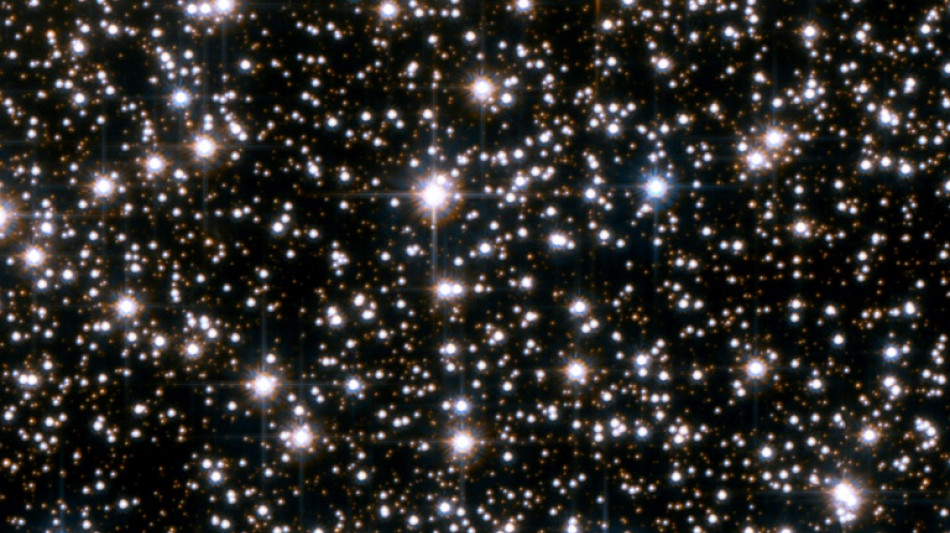
Lost in space: Sperm struggles to navigate during weightless sex / Photo: © ESA/AFP/File

 Hotel Blacklist Launches New Accommodation Industry Risk Assessment Tool
 Bangladesh nuclear plant draws hope -- and worry

 US beat Canada 1-0 to wrap up four-win international break
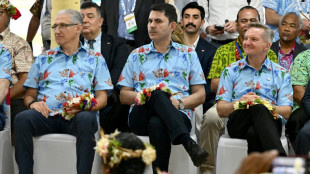 Turkey, Australia's joint COP31 leadership raises doubts
 For Turkish NGOs, COP31 offers rare space for action
 Sleep, appetite, gene-editing experts contend for Nobel chemistry prize

 Nobel Peace Prize haunted by the 'spectre' of Trump

 Africa launches own credit agency in bid for cheaper borrowing

 US, China, EU: three paths to regulating AI

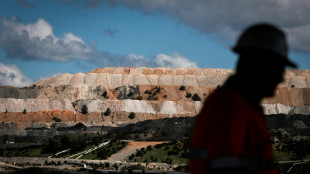 Australia's High Court rules against coal mine in landmark climate case
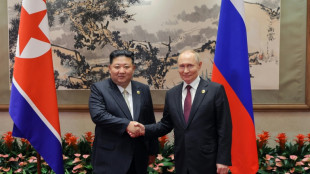
 Australia touts new funds for Pacific infrastructure at Fiji 'pre-COP'

 Eva Marie Saint, Oscar winner of Hollywood classics, dies at 102

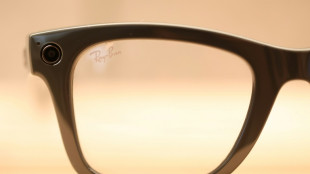 Australia probes app used in cheap smart glasses over privacy fears
 England needed to 'move on' from World Cup pain, says Tuchel

 O'Neill to stay at Celtic after period of "reflection"

 Kane marks 125th England cap with Wembley Nations League double

 Quebec's incoming separatist leader wants to block Crown from swearing-in
 Emmys gala will now stream its premier television awards

 Paramount completes Warner Bros takeover, creating Skydance

 Trump blames France unrest on Islam, migration

 Apple's Cook praises EU over efforts to protect children online

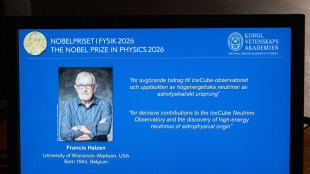 Nobel winner Halzen says years of October 'misery' finally over
 Quebec separatist win rattles Carney's unity push

 'Itching' for change: Shiffrin cuts back slaloms this season
 'Gen Z has risen up': Tens of thousands mass for tense France school protests
Scientists have used a tiny plastic "obstacle course" to test how much sperm would struggle to navigate during sex in the weightlessness of space.
Some particularly resilient sperm still made it through the course, suggesting that conceiving children in space will still be possible, according to research published on Thursday.
However a bigger problem could be that the development of embryos after fertilisation was harmed by a lack of gravity, the Australian team of researchers found.
With humanity setting its eyes on colonising space -- next week NASA hopes to launch its first crewed mission around the Moon in half a century -- scientists have been studying how difficult it will be to procreate on spaceships or other worlds.
One of the biggest challenges is that sperm will no longer be pulled downwards by Earth's gravity.
"Sperm need to actively find their way to an egg, and this study is the first to put that ability to the test under space-like conditions," Nicole McPherson, a researcher at Adelaide University in Australia, told AFP.
The scientists used a plastic chamber that resembles the female reproductive tract to act as a "miniature obstacle course", the senior author of the new study said.
"Think of it as a tiny race track... sperm are introduced at one end and have to swim their way through to the other."
- Filtering out weak runners -
Both human and mice sperm were sent down the course, which was inside a device that uses constant rotation to simulate the microgravity of space.
The sperm was about 50 percent worse at navigating through the course compared to how they perform under Earth's gravity.
This worked out to be roughly a 30-percent drop in successful fertilisation, according to the study in the journal Communications Biology.
However the sperm that did make it through seemed to produce better-quality embryos, which could turn out to be "beneficial", McPherson said.
It appeared that the stress of microgravity acted as a "filter" that effectively cleared the field, "leaving only the most capable sperm in the running," she explained.
A bigger problem came in the first 24 hours after sperm had fertilised the eggs.
"The results reversed sharply, with fewer embryos formed, and those that did were of poorer quality," McPherson said.
This suggests that microgravity "may not be the deal-breaker we feared, but protecting the embryo from weightlessness in those critical first hours will likely be essential for reproduction in space," she added.
Some including billionaire SpaceX founder Elon Musk have ambitious plans to make humans an interplanetary species by establishing settlements on the Moon then Mars.
There has also been speculation that the first baby conceived outside the bounds of Earth could be the result of a couple having sex on a flight launched by the booming space tourism industry.
McPherson emphasised that much more research is needed to understand how reproduction works in space, adding that fertilisation is "only one small piece of a very long and complex puzzle".
"We are still a long way from seeing the first space baby."
M.Qasim--SF-PST