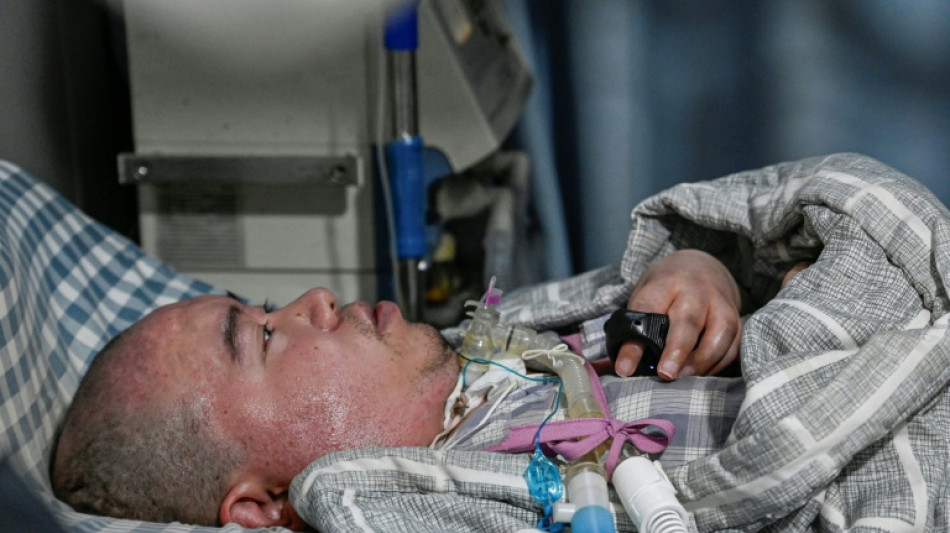
Chinese quadriplegic runs farm with just one finger / Photo: Jade GAO - AFP

 Myanmar leader lands in Malaysia for migrant return talks
 Indian central bank hikes rates for first time since 2023
 US military on Okinawa face curfew, alcohol ban after murder case

 Fierce lobbying in EU over 'forever chemicals'
 Dodgers beat Braves and Padres avoid sweep in MLB playoffs

 Mourning, war and elections as Israel marks October 7

 Messi says Argentina retirement is 'saddest day of my career'
 Oil rises and stocks fall as Hormuz worries flare

 Pacific presses world for help 'surviving' climate change at pre-COP summit
 Verstappen revival to be put to the test in steamy Singapore
 US woman who survived botched execution is conscious, speaking: lawyers
 Climate champion Australia digging more coal

 Emotion, tears as Messi retires from Argentina national team

 Dodgers push Braves to the brink of MLB playoff exit
 Crisis-stricken Haiti postpones elections
 N. Korea's Kim pledges 'invariable support' in Putin birthday letter
 OGRD Alliance Advances PLPC Multi-Asset Platform Following APHELAR Milestone, Expanding Licensing and Strategic Capital Frameworks

 Emotion, tears as Messi prepares for Argentina farewell
 Kane eyes Ronaldo record after matching England cap mark

 Spain fight back to beat Croatia, Kane adds to record for England

 Merino double helps Spain beat Croatia, reach Nations League quarters

 US stocks hit fresh records as oil stabilizes on rising supplies
 As Messi bows out, Argentines say 'thank you'

 Ronaldo opens door for Portugal return, apologises for walkout

 'Nobody seems to care': Russian city shrugs off plague reports

Quadriplegic and bedridden in a prefabricated home, 36-year-old Li Xia can only move one finger and one toe -- yet he runs a high-tech farm in southwestern China using sensors, cameras and a computer.
Li, who suffers from a genetic degenerative condition that progressively weakens muscles, relies on a ventilator permanently connected to his windpipe to breathe, but grows celery with the help of his 62-year-old mother.
From his bed, he operates four greenhouses that lie 10 metres (33 feet) away via a programme he created and a computer screen hanging above him on an adjustable arm.
"Through this microcomputer and the programme I developed, and a mobile app, I can monitor various data points from the farm, such as temperature, humidity, nutrient solution concentration, and pH levels," Li told AFP.
"With the cameras, I can see if the water pump is working or if the fans are running."
With the one finger he is able to move, he controls the on-screen cursor using a trackball.
"To click, I use a flex sensor attached to my toe," said Li from his home in Shiping village, near the southwestern city of Chongqing.
Duchenne muscular dystrophy (DMD), which he suffers from, is an incurable genetic disease that affects almost exclusively males, at a rate of one in 5,000 births.
Over the years, it causes muscles to weaken, increasing the risk of falls, before paralysis sets in, affecting cardiac activity and breathing.
Until the early 2000s, boys with the condition rarely lived beyond their teens. But with comprehensive care, survival into the 30s and even 40s is possible.
Li, who was once able to get around in a wheelchair, experienced a sudden medical crisis in 2020 when he was 30 years old. He fell into a coma, became incontinent and quadriplegic.
"I was devastated," he said.
"But after a few months, I pulled myself together and looked for things that made sense."
- A way forward -
He discovered hydroponics, an innovative cultivation technique where vegetables are grown not in soil, but in a solution of water enriched with essential nutrients.
Partially automated, it requires little manual labour, allows for crops to be precisely controlled and ensures good yields.
"I grew up in the countryside, so I've always been in contact with seeds, soil and vegetables," he said.
"I also love digital technologies and programming. I realised I could combine the two."
Li taught himself computer programming and learned how to design a circuit board.
His case is in many ways similar to others with severe neuromotor disorders, such as British physicist and cosmologist Stephen Hawking, who was confined to a wheelchair and could only communicate through a voice synthesiser.
Or Jean-Dominique Bauby, who was paralysed after a stroke and authored his 1997 book "The Diving Bell and the Butterfly" by blinking his left eye, the only movement he could still control.
For the farm tasks involving manual labour, Li is reliant on his mother Wu Dimei.
"She is my arms and legs, and I am her brain," he said.
- 'Quite happy' -
Li explains what needs to be done and supervises her work in the greenhouses via a video link to his smartphone.
Wu operates tools, measures out fertiliser, installs equipment and connects cables.
In addition to farm work, she provides for her son day and night, including cooking and cleaning the ventilation tube in his windpipe.
"I don't have time to rest," Wu told AFP.
Even with the help of her daughter, who regularly helps bathe her brother, Wu only sleeps three to five hours a night.
"But it's worth it," said Wu, who is divorced. "It may not seem like it, but our family is quite happy."
They mainly rely on the income of Li's sister, who works, and their mother's pension.
Li said he saw the high-tech farm as a "niche" with "great prospects", and hoped to provide his family with a livelihood.
"If I succeed, it would allow me to fulfil a dream, but also to earn money and improve our living conditions," he said.
They moved to a prefabricated portable home in 2022, and his celery is now sold to a local supermarket chain.
"We're not making a profit yet," said Li, who embarked on his venture in 2022
"But my dream is to expand this farm, turn it into a successful business, produce more and earn more.
"My motivation is to see our vegetables grow, be harvested, sold and end up on people's plates."
S.Barghouti--SF-PST