'Bleak' future for seals decimated by bird flu, scientists warn / Photo: Handout - BRITISH ANTARCTIC SURVEY/AFP

 Indonesian court hears 'negligence' complaint against state over fires, haze

 Rubio in Greece to urge against Western civilisation 'decline'
 Micron workers at Taiwan plant vote in favour of strike

 In 'The Social Reckoning,' Jeremy Allen White takes on Facebook's 'frightening' ambition

 Chip industry activists call for South Korea to recognise cancer cases

 Famine-scarred southern Madagascar braces for El Nino

 How the EU regulates lobbyists

 I.Coast refuge offers lifelong care for youngsters scorned as 'sorcerers'

 Indian central bank hikes rates for first time in more than 3 years

 Hotel Blacklist Launches New Accommodation Industry Risk Assessment Tool

 Bangladesh nuclear plant draws hope -- and worry

 US beat Canada 1-0 to wrap up four-win international break

 Turkey, Australia's joint COP31 leadership raises doubts

 For Turkish NGOs, COP31 offers rare space for action

 Sleep, appetite, gene-editing experts contend for Nobel chemistry prize

 Nobel Peace Prize haunted by the 'spectre' of Trump

 Africa launches own credit agency in bid for cheaper borrowing

 US, China, EU: three paths to regulating AI

 Australia's High Court rules against coal mine in landmark climate case

 Australia touts new funds for Pacific infrastructure at Fiji 'pre-COP'

 Eva Marie Saint, Oscar winner of Hollywood classics, dies at 102

 Australia probes app used in cheap smart glasses over privacy fears

 England needed to 'move on' from World Cup pain, says Tuchel

 O'Neill to stay at Celtic after period of "reflection"

 Kane marks 125th England cap with Wembley Nations League double

The world's largest species of seal has been devastated by bird flu, which has wiped out half of all breeding females at a key wildlife haven near Antarctica, scientists warned Thursday.
The remote island of South Georgia is the home of a majority of all southern elephant seals. Males of these blubbery giants can grow up to two metres (six feet seven inches) long, weigh nearly four tonnes (8,800 pounds) -- and have a distinctive elephant-trunk-like proboscis on their face that earned the mammals their name.
Bird flu arrived on South Georgia in 2023 during an outbreak that has seen the virus spread across the world like never before, killing millions of birds and infecting many mammals, including several humans.
Earlier this year, scientists warned that bird flu had sparked the worst die-off on record for southern elephant seals when it spread among a population on Argentina's coast in 2023.
In a study published in the journal Communications Biology on Thursday, a UK team of researchers gave the first estimate for how hard South Georgia's seals have been hit.
"It paints a pretty stark and harrowing picture," Connor Bamford, a marine ecologist at the British Antarctic Survey and lead author of the study, told AFP.
According to the last count in 1995, South Georgia is home to 54 percent of all southern elephant seals.
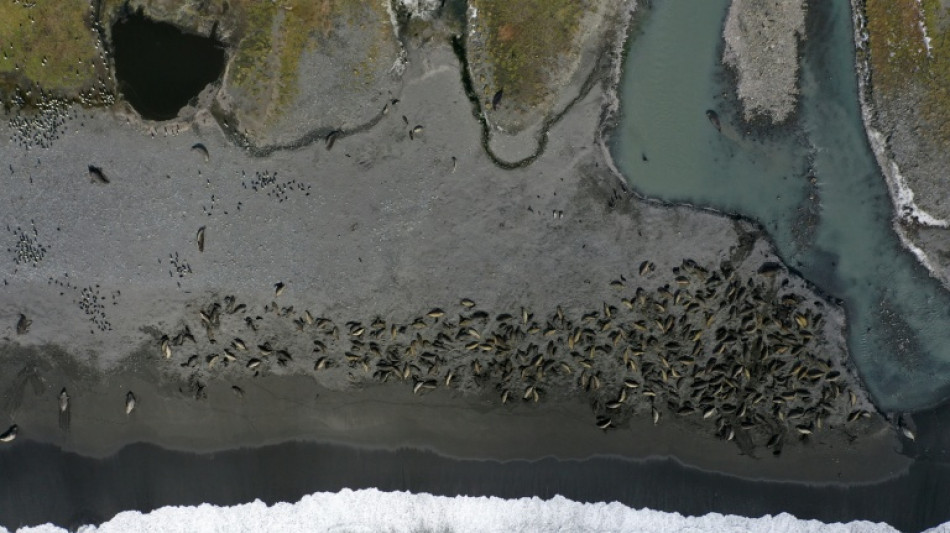
On the same day of the year in 2022 and 2024, the scientists used hand-launched drones to take images of the island's three biggest breeding beaches.
After bird flu arrived, the number of breeding females plummeted by 47 percent, a loss of around 53,000 seals, according to the study.
- Sick mothers abandoning pups -
Many pups also died on the beach after being abandoned by their bird-flu-infected mothers.
Scientists at the breeding ground on the Valdes Peninsula along Argentina's coast have determined that 97 percent of elephant seal pups died either from being abandoned or contracting bird flu in 2023.
On the peninsula, an even higher rate of breeding females -- 67 percent -- were estimated to have been wiped out.
"If the South Georgia population responds similarly to the modelled outlook at Peninsula Valdes, the future is bleak," the authors of the new study said.
However, Bamford did not think the elephant seals would be pushed "close to extinction".
The South Georgia population is much larger -- numbering in the hundreds of thousands -- so is likely to be more resilient, he said.
"That being said, the impacts to this population will be felt for many years to come," he added.
For the Valdes seals, scientists have estimated that the aftermath of this bird flu outbreak will likely reverberate until the end of the century.
The researchers believe that the seals are transmitting the virus to each other via water droplets, Bamford said.
While elephants spend most of their time in the water, they breed in densely packed colonies on wide, sandy beaches.
"There are thousands of them together, all coughing and splattering," Bamford said, adding that the seals are also particularly "snotty".
The scientist called for "regular check-ups" on South Georgia's elephant seals.
B.AbuZeid--SF-PST