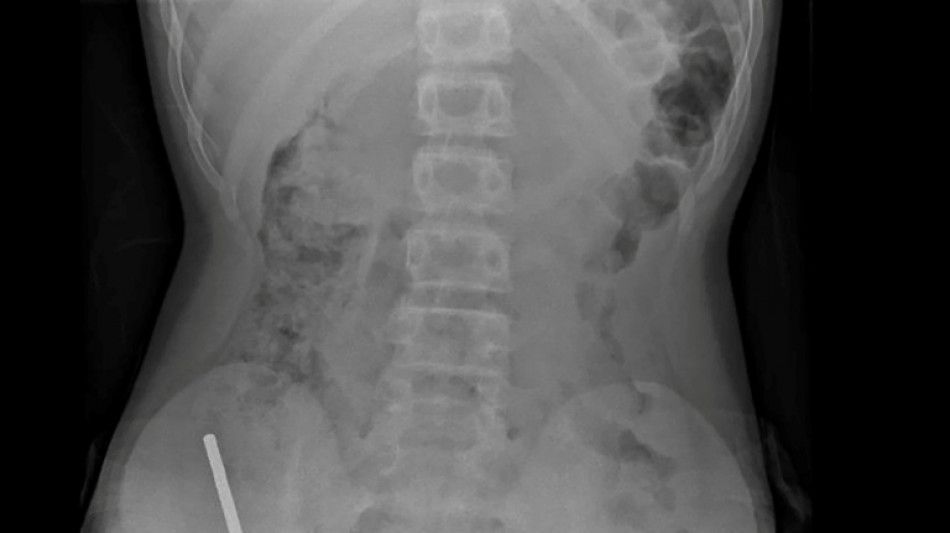
Surgeons remove up to 100 magnets from N. Zealand teen's gut / Photo: Handout - NEW ZEALAND MEDICAL JOURNAL (NZMDJ)/AFP

 Indonesian court hears 'negligence' complaint against state over fires, haze

 Rubio in Greece to urge against Western civilisation 'decline'

 Micron workers at Taiwan plant vote in favour of strike

 In 'The Social Reckoning,' Jeremy Allen White takes on Facebook's 'frightening' ambition

 Chip industry activists call for South Korea to recognise cancer cases
 Famine-scarred southern Madagascar braces for El Nino

 How the EU regulates lobbyists

 I.Coast refuge offers lifelong care for youngsters scorned as 'sorcerers'

 Indian central bank hikes rates for first time in more than 3 years

 Hotel Blacklist Launches New Accommodation Industry Risk Assessment Tool

 Bangladesh nuclear plant draws hope -- and worry

 US beat Canada 1-0 to wrap up four-win international break

 Turkey, Australia's joint COP31 leadership raises doubts

 For Turkish NGOs, COP31 offers rare space for action

 Sleep, appetite, gene-editing experts contend for Nobel chemistry prize

 Nobel Peace Prize haunted by the 'spectre' of Trump

 Africa launches own credit agency in bid for cheaper borrowing

 US, China, EU: three paths to regulating AI

 Australia's High Court rules against coal mine in landmark climate case

 Australia touts new funds for Pacific infrastructure at Fiji 'pre-COP'

 Eva Marie Saint, Oscar winner of Hollywood classics, dies at 102

 Australia probes app used in cheap smart glasses over privacy fears

 England needed to 'move on' from World Cup pain, says Tuchel

 O'Neill to stay at Celtic after period of "reflection"

 Kane marks 125th England cap with Wembley Nations League double

A 13-year-old boy in New Zealand swallowed up to 100 high-power magnets he bought on Temu, forcing surgeons to remove tissue from his intestines, doctors said on Friday.
After suffering four days of abdominal pain, the unnamed teen was taken to Tauranga Hospital on the North Island.
"He disclosed ingesting approximately 80–100 5x2mm high-power (neodymium) magnets about 1 week prior," said a report by hospital doctors in the New Zealand Medical Journal.
The magnets, which have been banned in New Zealand since January 2013, were bought on the online shopping platform Temu, they said.
An X-ray showed the magnets had clumped together in four straight lines inside the child's intestines.
"These appeared to be in separate parts of bowel adhered together due to magnetic forces," they said.
No date was given for the operation.
Temu said it had launched an investigation to ensure it complies with safety requirements in New Zealand.
Doctors said the pressure of the magnets had caused necrosis -- tissue death -- in four areas of the boy's small bowel and caecum, which is part of the large intestine.
Surgeons operated to remove the dead tissue and retrieve the magnets, and the child was able to return home after an eight-day spell in hospital.
"This case highlights not only the dangers of magnet ingestion but also the dangers of the online marketplace for our paediatric population," said the authors of the paper, Binura Lekamalage, Lucinda Duncan-Were and Nicola Davis.
Surgery for ingestion of magnets can lead to complications later in life such as bowel obstruction, abdominal hernia and chronic pain, they said.
Temu said it was sorry to learn of the boy's surgery.
"We have launched an internal review and reached out to the authors of the New Zealand Medical Journal article to obtain more details about the case," a spokesman said in a statement.
"At this stage, we have not been able to confirm whether the magnets involved were purchased through Temu or identify the specific product listing.
"Nonetheless, our teams are reviewing relevant listings to ensure full compliance with local safety requirements."
The Chinese-founded e-commerce giant has come under criticism in markets including the European Union for allegedly not doing enough to rid illegal products from its platform.
P.AbuBaker--SF-PST